Prison and Punishment in American History
The US incarcerates more people than any country on earth. This section traces two centuries of deliberate choices — about who gets locked up, how they're punished, and what it costs.
Prison and Punishment in American History
The United States incarcerates more people than any other country on earth — approximately 2 million as of 2023, a rate of roughly 600 per 100,000 people, more than five times the incarceration rate of most Western European countries. This did not happen by accident, and it did not happen all at once. It is the product of two centuries of deliberate choices about what punishment is for, who deserves it, and how much it should cost to inflict. The articles in this section trace those choices from their origins to their present consequences.
The through-line is not cruelty, exactly — though there is plenty of that. The through-line is the persistent use of incarceration and punishment as tools for managing specific populations, combined with a recurring pattern of framing each new development as a reform over what came before.
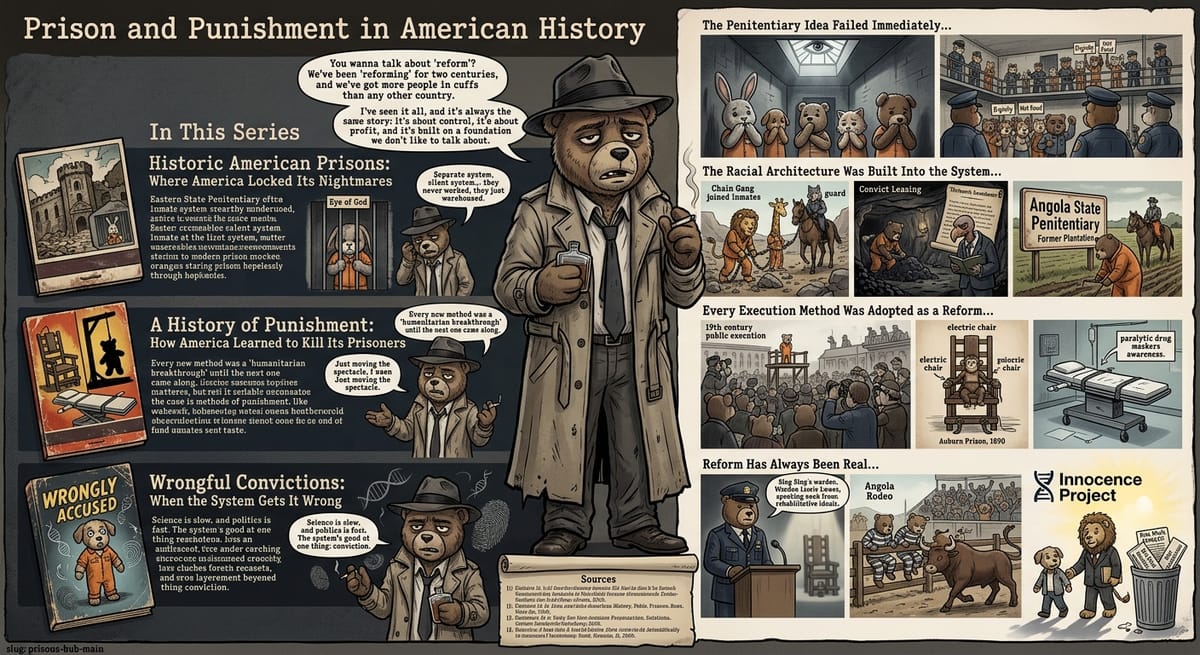
In This Series
- Historic American Prisons: Where America Locked Its Nightmares
- A History of Punishment: How America Learned to Kill Its Prisoners
- Wrongful Convictions: When the System Gets It Wrong
The Penitentiary Idea Failed Immediately and Survived Anyway
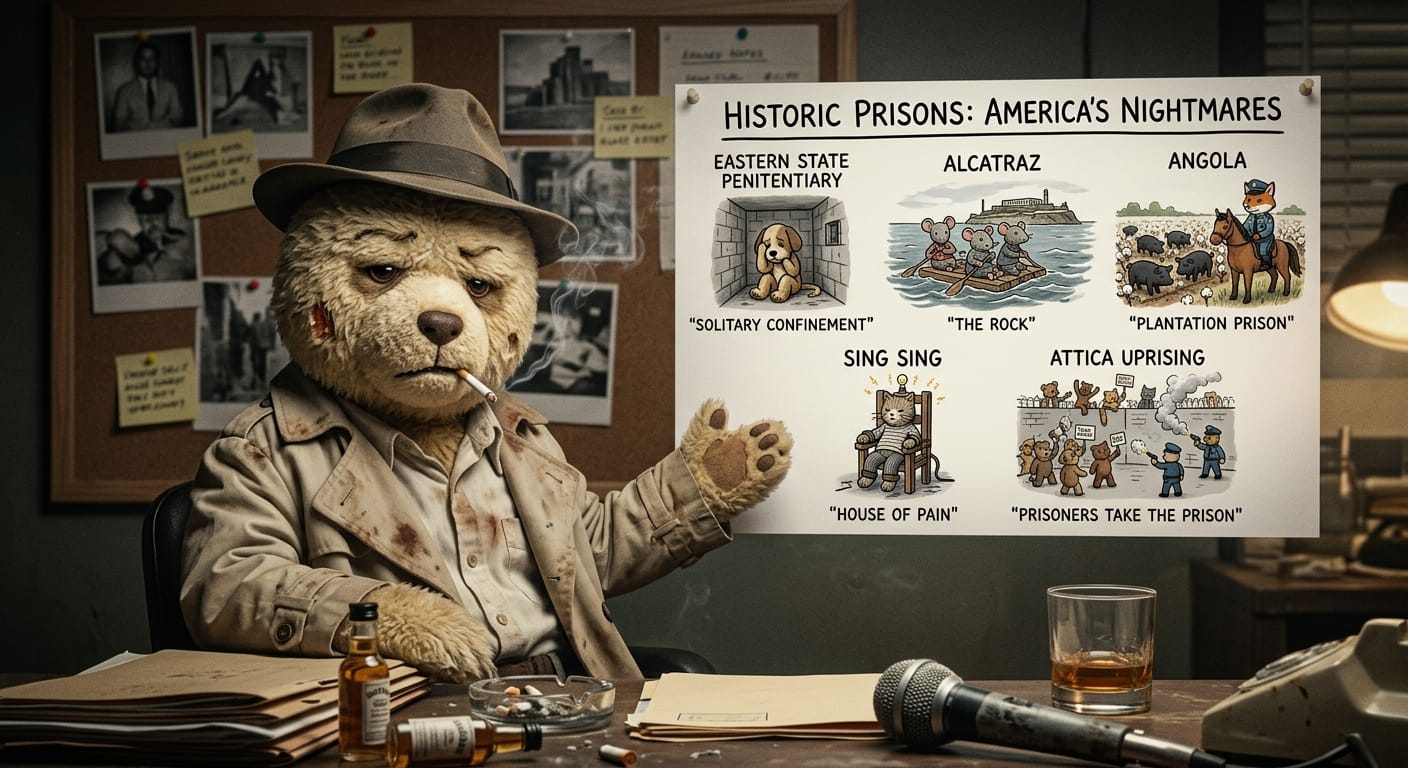
When Eastern State Penitentiary opened in Philadelphia in 1829, its Quaker-influenced designers believed they had found the answer: total isolation would force reflection and produce transformation. The building was meticulous — individual cells, private exercise yards, a skylight called the “Eye of God.” Charles Dickens visited in 1842 and found men in evident psychological deterioration. The reformers saw penitence. The separate system was abandoned in practice by the 1860s as overcrowding made it impossible, but the institution kept running because Pennsylvania had no other place to put people.
The word “penitentiary” itself — the idea that prisons were places of spiritual correction — came from Eastern State. By the time of Attica in 1971, the word had long since become ironic. The 1,281 prisoners who held 42 staff members hostage that September were not asking for spiritual guidance. They were asking for hot food, adequate medical care, and protection from arbitrary punishment. Governor Nelson Rockefeller’s response was to send in state police who killed 43 people, all of them by gunfire, and then let the state blame the prisoners for the deaths.^1^
The Racial Architecture Was Built Into the System From the Start
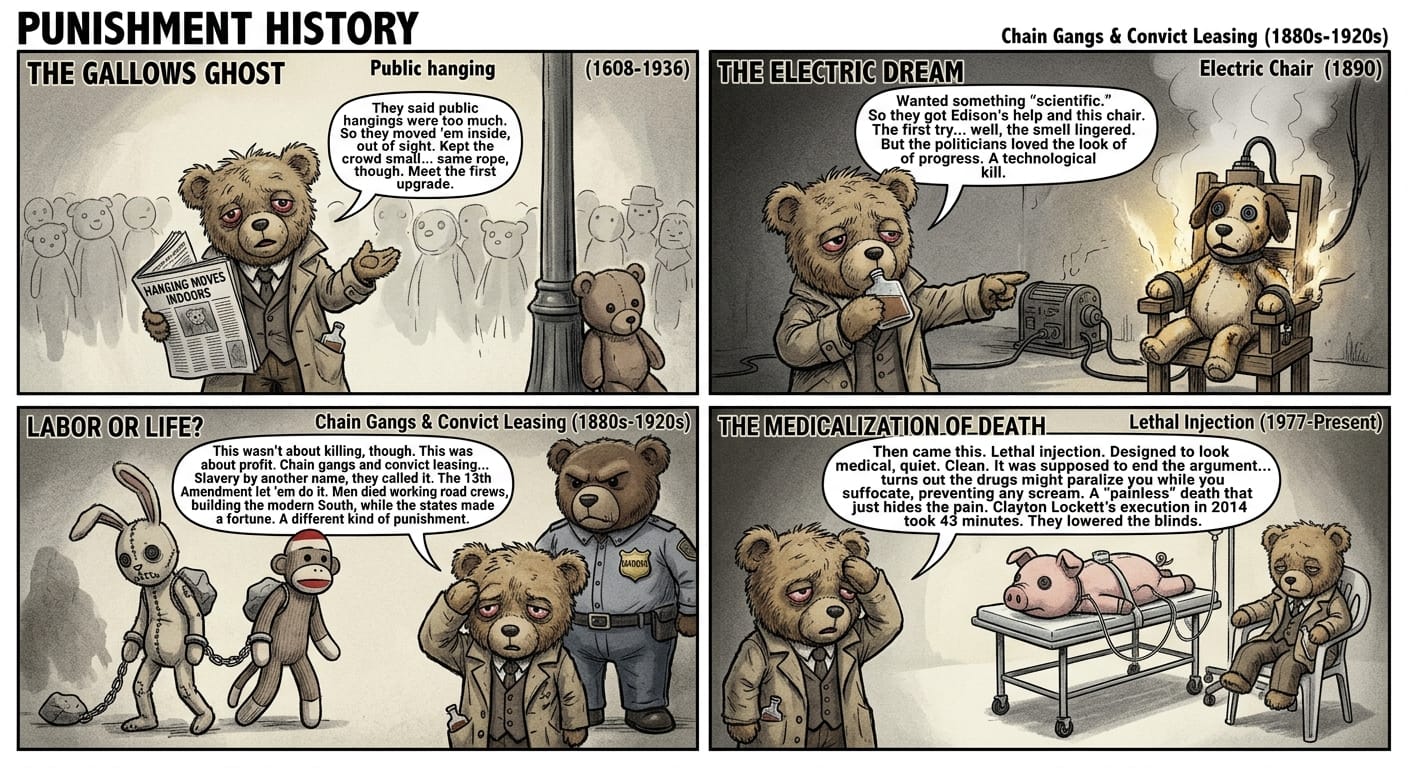
The chain gang and convict leasing are often discussed as aberrations — harsh practices from a harsh era. They were not aberrations. They were the direct continuation of the plantation labor system through a different legal mechanism. The Thirteenth Amendment abolished slavery except as punishment for crime. Southern states immediately passed Black Codes that criminalized the ordinary activities of Black life — vagrancy, unemployment, “impudent” behavior toward white people — and used the resulting convictions to supply leased labor to coal mines, turpentine camps, and railroad contractors. The annual death rate at some Alabama mining operations in the 1880s exceeded 30 percent.^2^
Angola State Penitentiary sits on 18,000 acres of a former plantation in Louisiana, named after the West African country of origin of the enslaved people who worked it. The state purchased the land in 1901. The men incarcerated there still grow crops under the supervision of mounted guards. Roughly 73 percent of Angola’s current population is Black, in a state where Black residents are 33 percent of the general population. Approximately 75 percent are serving life sentences without parole. The plantation became a prison, and the prison preserved the plantation — the administrative language changed but the structure did not.
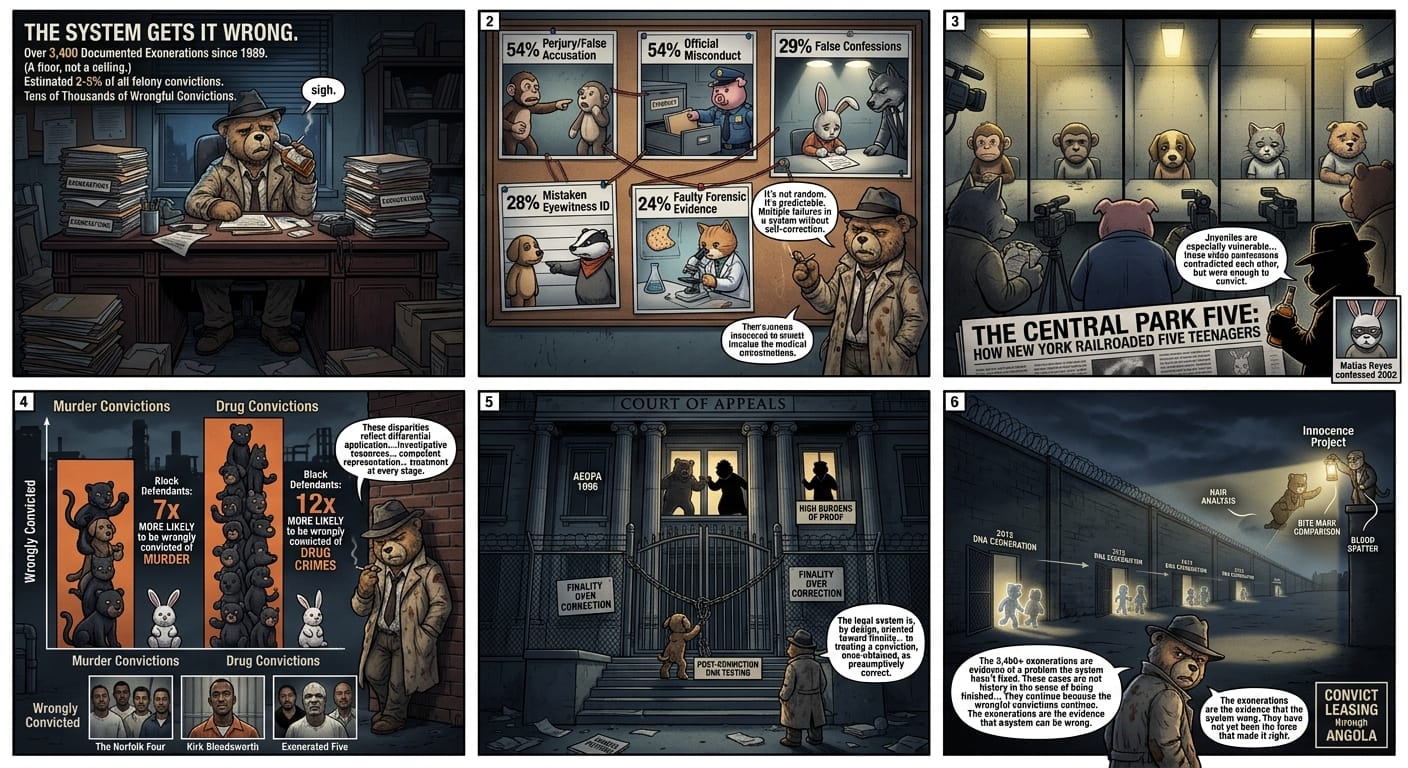
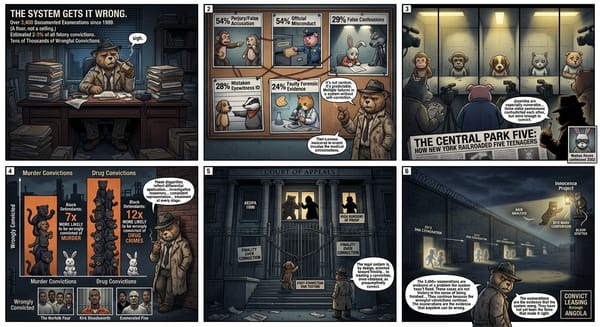
The racial disparities in who gets convicted of what extend through every layer of the system. Black people are seven times more likely to be wrongly convicted of murder than white people, according to the National Registry of Exonerations. When the Central Park Five — Yusef Salaam, Kevin Richardson, Antron McCray, Raymond Santana, and Korey Wise — were interrogated for up to 30 hours without adequate access to counsel in 1989, they were 14 to 16 years old, and the New York City justice system processed them from arrest to conviction in approximately a year. Matias Reyes confessed to the actual crime in 2002.^3^
Every Execution Method Was Adopted as a Reform and Produced Its Own Failures
Public execution in America ran from the colonial period through 1936, when Rainey Bethea was hanged before an estimated 10,000 to 20,000 spectators in Owensboro, Kentucky. The national press coverage of Bethea’s hanging focused almost entirely on the crowd’s behavior, not on the execution or the man being executed. Three months later, Kentucky moved executions inside prison walls. What changed was the audience, not the practice.
The electric chair was adopted in New York in 1888 as a humane improvement on hanging. The first execution, of William Kemmler at Auburn Prison on August 6, 1890, required two charges, produced visible burning, and was described by witnesses as worse than hanging. The state called it a success. Lethal injection was designed in 1977 by an Oklahoma medical examiner who later admitted he had “no idea” whether the protocol would work. A 2005 study in The Lancet found that 43 percent of prisoners in four states had anesthetic blood levels consistent with possible awareness during execution. The paralytic drug in the protocol ensures that an inadequately sedated prisoner cannot show distress to witnesses. Clayton Lockett’s execution in Oklahoma on April 29, 2014 took 43 minutes. The state called it manageable.^4^
Reform Has Always Been Real and Always Fallen Short in the Same Ways
Every era has produced its reformers, and every era’s reforms have fallen short in similar ways. Lewis Lawes, warden of Sing Sing from 1920 to 1941, was a vocal opponent of capital punishment who wrote bestselling books about prison reform while overseeing a prison that executed hundreds of people. Burl Cain, who ran Angola from 1995 to 2016, invited documentarians and journalists inside, launched seminary programs, and made the prison’s rodeo — which involves men serving life sentences competing with a bull while spectators pay admission — into a tourist attraction that the state promoted.
The Innocence Project has contributed to more than 375 DNA exonerations since 1992, including 21 people on death row. It has also documented that the forensic methods used to convict many of those people — hair analysis, bite mark comparison, blood spatter interpretation — were never scientifically validated. The National Academy of Sciences said as much in a 2009 report and recommended an independent forensic science commission. Congress never created one.
What This Section Covers
The articles here examine three interconnected dimensions of American prison and punishment history. The historic prisons series looks at five institutions that shaped the prison system as it exists today: Eastern State, Alcatraz, Angola, Sing Sing, and Attica. The punishment history series traces the evolution of methods — public execution, chain gangs, convict leasing, the electric chair, lethal injection — that reveal the continuity beneath the changes. The wrongful convictions series documents what happens when the system convicts the wrong people and examines the organizations fighting to reverse it.
Together, they map a system that has expanded dramatically, reformed selectively, and never resolved its central questions: what punishment is for, who it is aimed at, and what it costs — to the people it holds, and to everyone else.
─────────
Sources:
- Thompson, Heather Ann. Blood in the Water: The Attica Prison Uprising of 1971 and Its Legacy. Pantheon Books, 2016.
- Blackmon, Douglas A. Slavery by Another Name: The Re-Enslavement of Black Americans from the Civil War to World War II. Doubleday, 2008.
- Burns, Sarah. The Central Park Five: A Chronicle of a City Wilding. Knopf, 2011.
- Death Penalty Information Center. Execution Methods in the United States. 2023.
In This Section