Convict Leasing: The System That Made Prisons Profitable
After 1865 Southern states leased Black prisoners to coal mines and lumber camps that worked them to death. Annual mortality at some Alabama operations exceeded 30 percent.
Convict Leasing: The System That Made Prisons Profitable
Between the end of the Civil War and the early twentieth century, Southern states developed a system for managing their prison populations that was, by any honest accounting, a continuation of slavery under a different legal framework. States would arrest men — overwhelmingly Black men, convicted under laws specifically designed to criminalize Black freedom — and then lease those men to private businesses. The businesses worked them in coal mines, turpentine camps, railroad construction, and cotton fields, paid the state a fee per prisoner per year, and bore no further responsibility for what happened to the men they’d leased. The businesses had every economic incentive to extract as much labor as possible and no economic incentive to keep the workers alive. The death rates were catastrophic.
The Thirteenth Amendment Created the Opening and Southern States Used It Immediately
The Thirteenth Amendment abolished slavery in 1865 “except as punishment for crime.” Southern states understood immediately what that exception permitted. Within a few years of the Civil War’s end, every former Confederate state had passed Black Codes — laws that criminalized vagrancy, unemployment, failure to honor labor contracts, and dozens of minor offenses that had not been crimes before. These laws were enforced selectively and aggressively against Black Southerners. A man who hadn’t found work within a specified period could be arrested for vagrancy. A man who left one employer for another could be charged with contract violation. Once convicted, he could be leased to a private business.^1^
The first convict lease contract in Alabama was signed in 1866, a year after the war ended. Georgia signed its first lease with the Western and Atlantic Railroad in 1868. By the 1880s, every Southern state had a convict lease system operating. The economic logic was straightforward: states received revenue instead of incurring costs, and private businesses received a captive labor force that could not quit, could not organize, and could be punished violently for any resistance.
What Were the Conditions in the Mines and Camps?
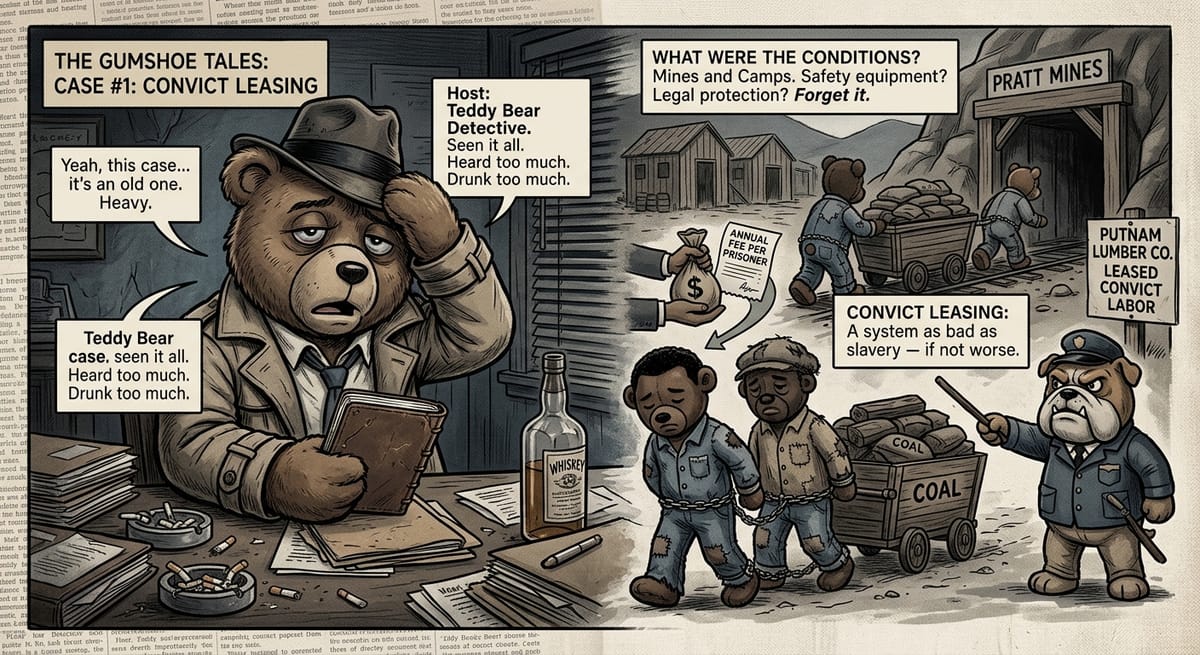
A man leased to the Pratt Mines near Birmingham, Alabama in the 1880s or 1890s worked underground in coal seams sometimes less than four feet high, in air thick with coal dust, with no safety equipment and no legal protection. He ate what the mining company fed him. He slept in a cage or a barracks. He was chained at night and guarded during the day by armed company employees who faced no legal accountability for how they treated him. When he was too injured or too sick to work, he was typically worked until he died, because there was no incentive for the company to invest in his recovery — the state would lease them another man.^2^
Mortality records from convict lease operations are incomplete because the companies had no obligation to keep them. What records survive are disturbing. At some Alabama mines in the 1880s, annual mortality rates exceeded 30 percent — meaning roughly a third of the leased workforce died each year. John T. Milner, an Alabama industrialist who was among the largest users of convict lease labor, recorded in his private papers that the cost of a leased convict was so low that it was cheaper to work a man to death and receive a replacement than to invest in his health or safety.
Mary Church Terrell, the Black civil rights activist and co-founder of the NAACP, wrote in 1907 that convict leasing was “a system as bad as slavery — if not worse.” Her comparison was deliberate and documented: she noted that slaveholders had at least had an economic incentive to keep their enslaved workers alive because they represented capital investment. Convict lessees had no such incentive.^3^
One White Victim Ended What Decades of Black Deaths Could Not
The campaign to end convict leasing took decades and came from multiple directions. Black civil rights organizations documented the conditions and the racial targeting. Progressive-era journalists published exposés. White business interests occasionally complained that convict lease operations undercut free labor. The Alabama Child Labor Committee and similar organizations, focused primarily on white children forced into industrial labor, sometimes allied with anti-leasing advocates.
The most effective opposition came from inside the system’s own economics. In 1911, a free labor mine exploded in Briceville, Tennessee, and miners blamed a strike-breaking convict lease operation at a competing mine. Free miners had been organizing for years against the competitive disadvantage of convict labor. The Coal Creek War of 1891 saw miners repeatedly seize and free leased convicts from company stockades; the state militia was called out repeatedly. Eventually the economic and political pressure produced legislative action.
Florida abolished convict leasing in 1919 after an investigation revealed that a farm in Columbia County had beaten at least 11 leased prisoners to death, including Martin Tabert, a 22-year-old white North Dakotan who had been arrested for riding a freight train without a ticket and sold to the Putnam Lumber Company for $20. Tabert’s death produced national press coverage and, crucially, focused white public attention on a system that had been killing Black men for decades without producing the same outrage.^4^
Alabama abolished convict leasing in 1928. Georgia abolished it in 1908 but replaced it with county chain gangs. By the 1930s, most Southern states had formally ended the practice.
Convict Leasing Was Replaced by Prison Farms That Operated the Same Way
Convict leasing was replaced by state-run prison farms — Angola in Louisiana, Parchman in Mississippi, Ramsey in Texas — where the state operated the plantation directly rather than leasing the labor to a private operator. The change in management structure did not change the fundamental character of the system: Black men convicted under racially discriminatory laws performing forced agricultural labor without pay. The prison farm was convict leasing with the state as the company, which eliminated the revenue stream but preserved the coerced labor.
The profitability model that convict leasing pioneered also didn’t disappear — it evolved. The private prison industry that emerged in the 1980s, when the Corrections Corporation of America was founded in 1983, reintroduced the model of private profit from incarceration. The specific mechanism changed — private prisons charge the government per inmate rather than paying the government per worker — but the logic of extracting value from mass incarceration was the same logic that built the convict lease system in 1866. The constitutional exception that made it possible in 1866 is still in the text of the Thirteenth Amendment today.
The same Black Codes that fed the convict lease machine are covered in the racial terror section as the direct mechanism connecting emancipation to re-enslavement. The Attica uprising is one of the clearest moments where the people held by this evolved system resisted it openly.
─────────
Sources:
- Blackmon, Douglas A. Slavery by Another Name: The Re-Enslavement of Black Americans from the Civil War to World War II. Doubleday, 2008.
- Curtin, Mary Ellen. Black Prisoners and Their World: Alabama, 1865–1900. University Press of Virginia, 2000.
- Terrell, Mary Church. “Peonage in the United States.” The Nineteenth Century, August 1907.
- Mancini, Matthew J. One Dies, Get Another: Convict Leasing in the American South, 1866–1928. University of South Carolina Press, 1996.
Part of A History of Punishment — ← Back to series hub