Public Executions: When Death Was Entertainment
For most of American history executions were public events. The last one drew 20000 people to Owensboro Kentucky in 1936. The crowd's behavior ended the practice — not the act itself.
Public Executions: When Death Was Entertainment
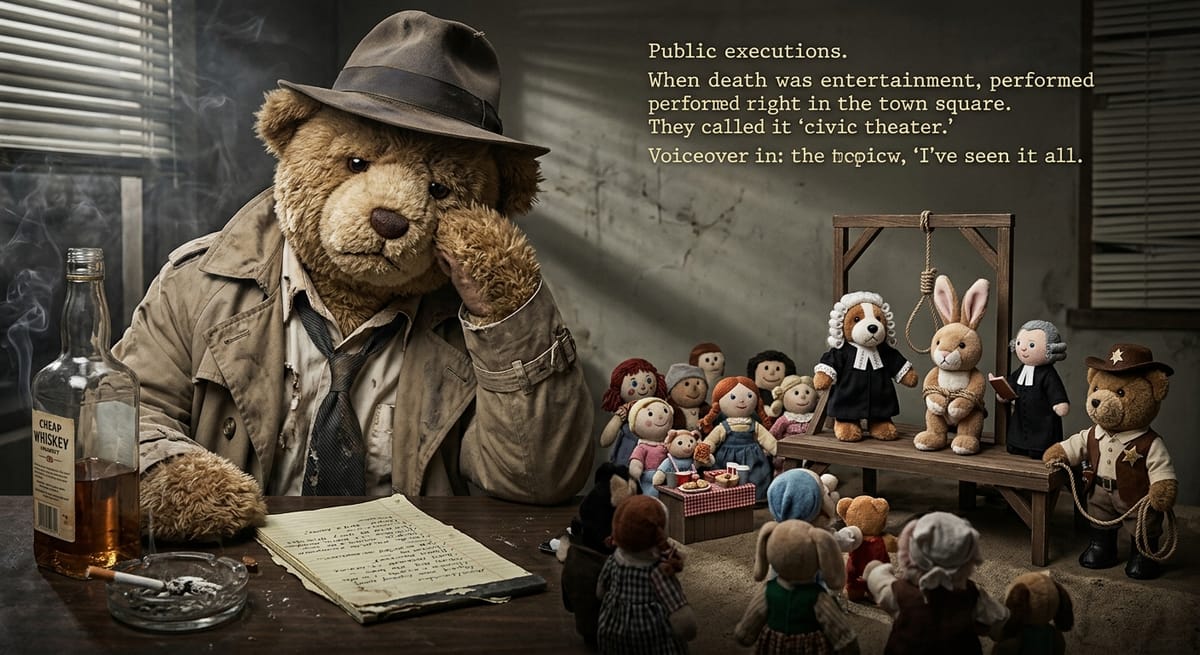
For most of American history, executions were public events. The scaffold was built in the town square, announcements ran in the local newspaper, vendors sold food, and children came with their parents. The crowd sometimes numbered in the thousands. This was not incidental to the practice — it was the point. Public execution was a spectacle of state power, a demonstration that the law could and would take life, performed for an audience that was supposed to leave changed by what it had witnessed.
Colonial Courts Turned Executions Into Civic Theater
The first recorded execution in the English colonies of North America was that of George Kendall in Virginia in 1608, executed by firing squad for spying for Spain. By the eighteenth century, public hanging was the standard method across the colonies, carried out by local sheriffs in public spaces and attended by whatever portion of the community chose to come. Executions were scheduled in advance, announced publicly, and often preceded by a sermon — the condemned man’s final spiritual state was considered a matter of community concern.
Ministers published execution sermons that sold widely. Cotton Mather, the Boston Puritan minister, attended at least two dozen executions during his career and wrote execution sermons that were among the most popular publications in colonial Massachusetts. His 1693 sermon at the execution of James Morgan, convicted of murder in Boston, was reprinted multiple times and distributed throughout New England. The sermon’s purpose was dual: to demonstrate the condemned man’s repentance (or lack of it) and to reinforce the community’s moral framework. Execution was, in this model, a form of civic theater.^1^
The scaffold’s location in public space was deliberate. New Haven, Connecticut built its gallows on the New Haven Green in the center of town. Boston’s executions took place on Boston Common. Philadelphia’s were held in the center of the city. Proximity to civic life was the point — execution was not hidden away but integrated into the fabric of public order as a visible demonstration of what that order would do to those who violated it.
Did Public Execution Actually Deter Crime?
The theory behind public execution was that the sight of death would deter crime. This was the explicit argument made by legal reformers, sheriffs, and clergy throughout the eighteenth and early nineteenth centuries. It was also, increasingly, challenged by reformers who argued the opposite: that public executions were brutalizing rather than civilizing, that they attracted disorderly crowds, inspired sympathy for condemned criminals, and demonstrated the worst rather than the best of civic life.
Benjamin Rush, the Philadelphia physician and signer of the Declaration of Independence, published an essay in 1787 arguing against capital punishment on both moral and practical grounds. He found few allies at the time, but he was articulating a position that would gradually gain ground over the following century. By the 1820s and 1830s, reformers across the northeastern states were producing arguments against public execution that drew on enlightenment philosophy, emerging scientific theories of human behavior, and simple observation of what execution crowds actually looked like — drunken, rowdy, occasionally violent.^2^
New York became the first state to restrict public execution when it moved hangings inside prison walls in 1835, following a public outcry over the behavior of the crowd at an 1833 execution in New York City. Pennsylvania followed in 1834. By the end of the nineteenth century, most Northern states had moved executions behind prison walls. Southern states and many Western states kept public executions longer.
Rainey Bethea’s Hanging Ended Public Execution in America
The last public execution in the United States took place in Owensboro, Kentucky on August 14, 1936. Rainey Bethea, a 22-year-old Black man convicted of the rape and murder of a 70-year-old white woman named Lischia Edwards, was hanged before a crowd estimated at between 10,000 and 20,000 people — people who had traveled by car, bus, and train to witness the event. Newsreel cameras were present. National news correspondents filed stories. The crowd behavior was described by those reporters as carnival-like; vendors sold food and souvenirs.^3^
The execution of Rainey Bethea became, almost immediately, the argument for ending public executions in America. The news coverage emphasized the size and mood of the crowd rather than any question about Bethea’s guilt or the justice of his sentence. Editorials across the country used the spectacle to argue that public execution had become an embarrassment — not because of what it did to the condemned man but because of what it revealed about the spectators. Three months after Bethea’s execution, Kentucky passed a law moving executions inside prison walls.
The question of Bethea’s guilt itself received less scrutiny than the crowd’s behavior. Some historians have raised questions about the adequacy of his legal representation and the reliability of the evidence against him, but in 1936 those questions were largely beside the point. Bethea’s execution was news because of the crowd, not because of Bethea.
The Spectacle Moved Behind Walls but Never Disappeared
Public execution in the strict sense ended after 1936, but the appetite for witness didn’t disappear — it transformed. Execution witnesses were narrowed to a controlled list: family members of the victim, select officials, journalists. The execution chamber moved behind walls, but the press was often permitted inside, and accounts of executions circulated widely. Cameras were not permitted in most execution chambers, but written descriptions of the condemned man’s last words and final physical state were reported in detail.
In Missouri, a local television station broadcast an execution over closed-circuit television in 1994, provoking legal challenges and immediate reversal. In Oklahoma, botched executions became news events, with journalists permitted to witness procedures that went wrong in ways that the public watched unfold through their reporting. The 2014 execution of Clayton Lockett in Oklahoma, in which the lethal injection failed to work as designed and Lockett was observed to be conscious and writhing for 43 minutes before dying of a heart attack, generated the kind of coverage that public executions in their traditional form would have produced — a public confrontation with what state killing actually looked like.^4^
The spectacle never went away. It was just made less visible, which made it easier to maintain.
The transition from public scaffold to private chamber tracks the same shift that moved chain gangs off public roads — visibility became politically costly, so the act was hidden rather than ended. The electric chair was adopted as the chamber method precisely because it looked scientific and private compared to the rope.
─────────
Sources:
- Mather, Cotton. The Wonders of the Invisible World. Samuel Green, 1693.
- Rush, Benjamin. “An Enquiry into the Effects of Public Punishments upon Criminals and upon Society.” Philadelphia, 1787.
- Loevy, Robert D. “The Last Public Hanging in America.” Louisville Courier-Journal, August 2011.
- Pilkington, Ed. “Oklahoma Execution of Clayton Lockett Took 43 Minutes.” The Guardian, April 30, 2014.
Part of A History of Punishment — ← Back to series hub