Prison & Punishment
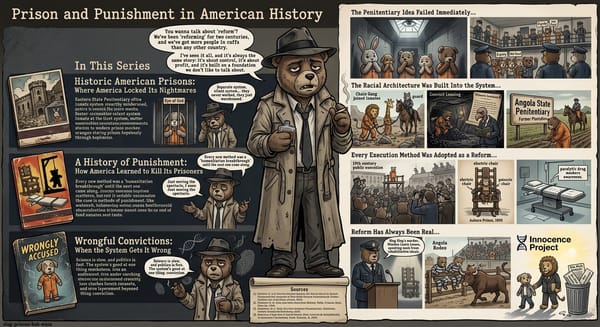
Prison and Punishment in American History
The US incarcerates more people than any country on earth. This section traces two centuries of deliberate choices — about who gets locked up, how they're punished, and what it costs.
Prison & Punishment
The US incarcerates more people than any country on earth. This section traces two centuries of deliberate choices — about who gets locked up, how they're punished, and what it costs.
Prison & Punishment
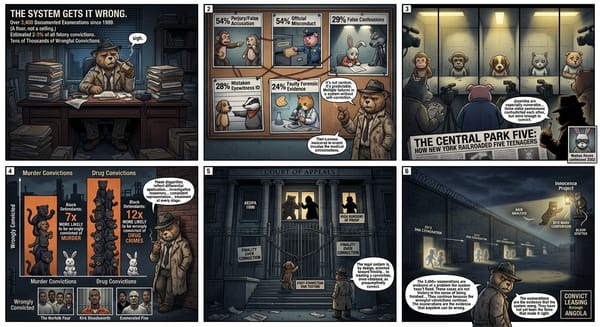
3400 documented wrongful convictions since 1989 — and that is only the cases that got reviewed. Black defendants are seven times more likely to be wrongly convicted of murder.

Prison & Punishment
More than 3400 people have been exonerated in the US since 1989. Randall Dale Adams spent 12 years on death row. The Norfolk Four were convicted despite DNA that excluded all four.
Prison & Punishment
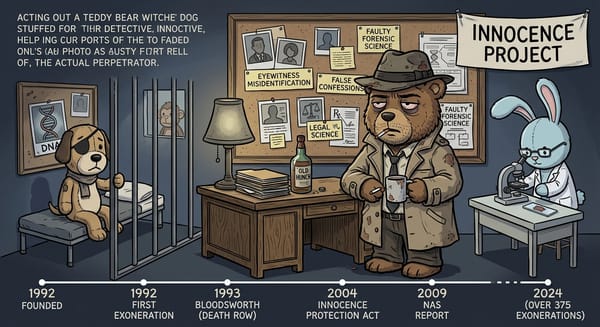
The Innocence Project has freed 375 wrongly convicted people since 1992 — including 21 from death row. Their data shows faulty forensic science contributed to nearly half the cases.

Prison & Punishment
Five teenagers were interrogated for up to 30 hours in 1989 and convicted of a rape the DNA excluded them from. The actual perpetrator confessed in 2002. No one was held accountable.
Prison & Punishment
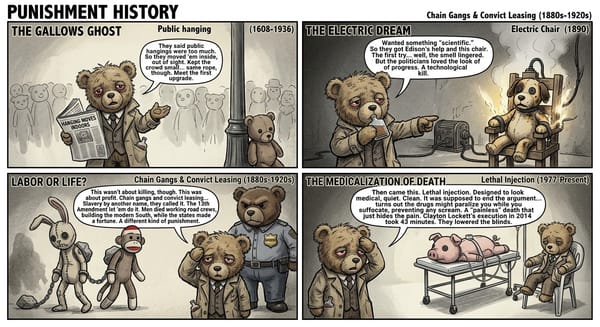
Every method in this series was introduced as an improvement. Public hanging gave way to the electric chair. The chair gave way to lethal injection. The act never changed — only the visibility.
Prison & Punishment
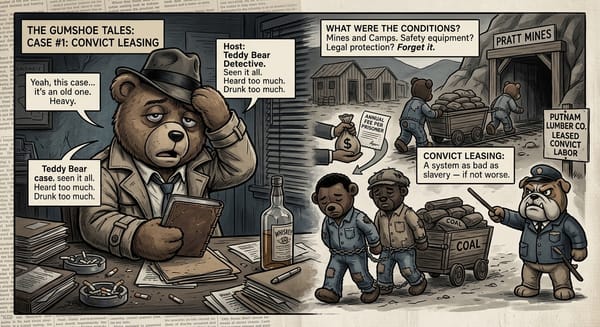
After 1865 Southern states leased Black prisoners to coal mines and lumber camps that worked them to death. Annual mortality at some Alabama operations exceeded 30 percent.
Prison & Punishment
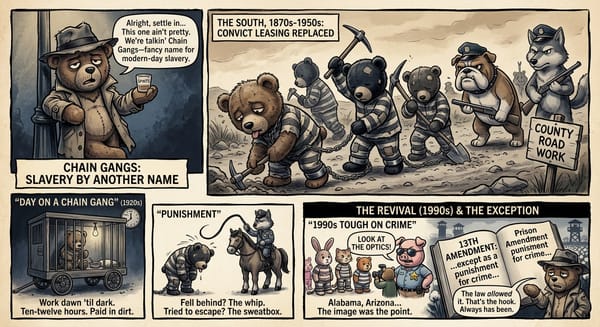
Chain gangs put shackled Black men on Southern roads from the 1870s through the 1950s — and again in the 1990s when Alabama brought them back for the press photos.
Prison & Punishment
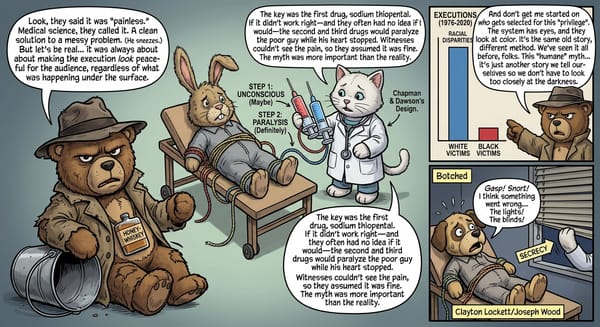
Lethal injection was designed in 1977 by someone who admitted he had no idea if it would work. A 2005 Lancet study found 43% of prisoners may have been conscious during execution.
Prison & Punishment
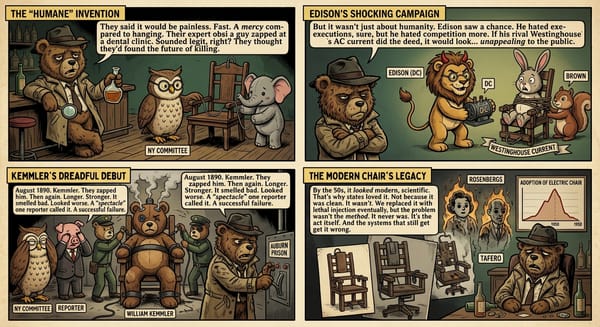
A Buffalo dentist had the idea, a state commission blessed it, and Thomas Edison's lab helped make sure his rival's current got the blame. The first man strapped into the chair took eight minutes to die.

Prison & Punishment
For most of American history executions were public events. The last one drew 20000 people to Owensboro Kentucky in 1936. The crowd's behavior ended the practice — not the act itself.

Prison & Punishment
Five institutions — Eastern State, Alcatraz, Angola, Sing Sing, Attica — each called a solution in its time. The pattern across all five is the same tools called by different names.