Eastern State Penitentiary: The Prison That Invented Solitary Confinement
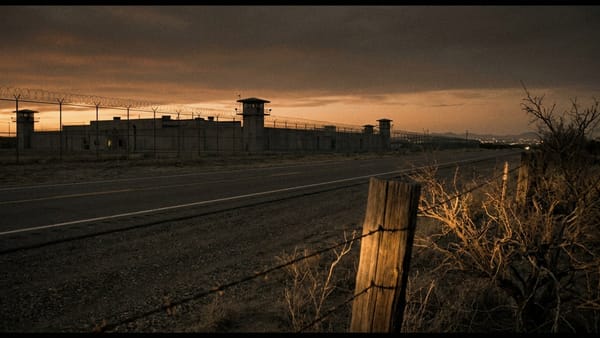
Eastern State opened in 1829 to cure crime through isolation. Dickens called it torture in 1842. The practice it invented now holds 80,000 Americans on any given day.
Eastern State Penitentiary: The Prison That Invented Solitary Confinement
Eastern State Penitentiary was built to cure crime — not deter it, cure it. In 1829, a Quaker-influenced reform organization called the Pennsylvania Prison Society had spent years arguing that silence, isolation, and sustained reflection were what broken men needed to become whole ones. Eastern State was built to test that theory on human beings. The experiment ran for more than a century. It did not work the way its architects imagined, and it produced a system of punishment that the rest of the world would eventually condemn as torture.
The Quakers Built a Prison They Believed Was Humane
Philadelphia’s Walnut Street Jail, the previous model for incarceration, was widely regarded as a disaster by the 1820s — crowded, chaotic, and producing worse criminals than it received. The Pennsylvania Prison Society wanted something different. Their model, called the Pennsylvania System or separate system, held that the root of criminal behavior was exposure to other criminals. The solution was to prevent all contact. A prisoner would enter Eastern State alone, remain alone for the duration of his sentence, work alone in his cell, eat alone, exercise alone in a small private yard attached to each cell, and never hear another human voice except a guard’s or a minister’s.^1^
The architect John Haviland designed the building accordingly. Seven cell blocks radiated out from a central hub like the spokes of a wheel, allowing a single guard in the center tower to survey all corridors. Each cell was 8 by 12 feet, with a small skylight in the vaulted ceiling — the “Eye of God,” Haviland called it, meant to focus a prisoner’s mind on divine judgment. Each cell had individual plumbing and a private exercise yard. This was 1829; most American homes had neither. The designers were not being cruel. They believed the physical environment would facilitate spiritual transformation, and they built accordingly.
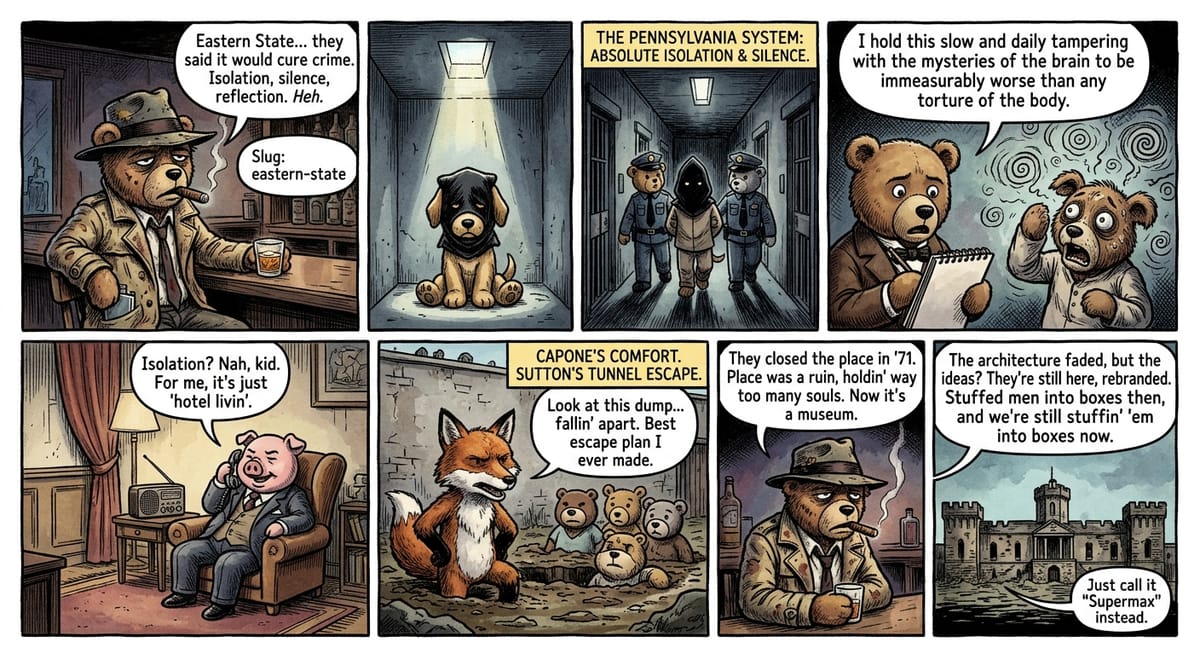
When prisoners moved through the facility at all, they wore hoods over their heads so they could not make eye contact with other inmates. Silence was absolute. The theory held that in such an environment, a man would inevitably turn inward, confront his sins, experience something like penitence — hence the word “penitentiary” — and emerge reformed. The word itself came from Eastern State.
What Did Total Isolation Actually Do to the Men Inside?
Charles Dickens visited Eastern State in 1842 and was appalled by what he found. He wrote about it at length in American Notes, published that year, describing the practice of solitary confinement as a slow mental deterioration that its practitioners had convinced themselves was rehabilitation. “I hold this slow and daily tampering with the mysteries of the brain to be immeasurably worse than any torture of the body,” he wrote.^2^ Dickens was not prone to understatement, but the evidence bore him out.
The mental toll of total isolation became visible quickly. Prisoners held under the separate system at Eastern State reported hallucinations, panic attacks, and a kind of psychological dissolution that made reintegration into ordinary life nearly impossible. Guards documented erratic behavior, self-harm, and breakdowns. The prison reformers who designed the system visited occasionally, observed men in evident distress, and interpreted it as penitence. They were seeing the early symptoms of what modern psychiatry would eventually diagnose as solitary confinement syndrome — cognitive impairment, anxiety, hypersensitivity to stimuli, distorted perception of time.
The separate system began breaking down in practice before it collapsed in theory. Eastern State was built for 250 prisoners. By 1866, it held over 800. Isolation became impossible at that scale. Prisoners were doubled up in cells designed for one. The silent system gave way to supervised congregate work. The original model was quietly abandoned, though the building remained in use.
Al Capone and Willie Sutton Revealed the Gaps in the Theory
Al Capone spent eight months at Eastern State in 1929 and 1930, convicted of carrying a concealed weapon in Philadelphia. He arrived as the most famous criminal in America and was given a cell that contemporaries described as a hotel room by comparison — rugs, furniture, a radio, lamps. The contrast with Eastern State’s founding philosophy was complete: the prison that invented the idea that all men deserved identical isolation had, a century later, become a place where celebrity could buy comfort.^3^
Willie Sutton, the bank robber who reportedly said he robbed banks “because that’s where the money is” (though he denied the quote), escaped from Eastern State in April 1945 with eleven other inmates. They dug a tunnel 97 feet long under the prison walls, emerging in the street outside. Sutton and the others were recaptured within the year, but the tunnel they built was a testament to what a century of overcrowding and institutional neglect had done to the prison’s physical integrity.
Overcrowding Killed the Experiment Before Reform Did
By the early twentieth century, Eastern State’s reputation had shifted from progressive innovation to Victorian relic. The separate system was an acknowledged failure; other states had adopted the Auburn model — congregate work during the day, separate cells at night — and Eastern State’s radical isolation had been abandoned even within its own walls. The building kept running because Pennsylvania had no other place to put its prisoners, not because anyone still believed the original theory.
The prison closed in 1971 after 142 years of operation, by then holding around 1,700 prisoners in a building designed for a fraction of that number, with deteriorating infrastructure and conditions that were the opposite of the careful, humane design its founders imagined. The city of Philadelphia acquired the property. Preservationists argued to maintain it as a historic site. Developers pushed to demolish it. The building survived.
The Punishment Eastern State Invented Outlasted the Building
Eastern State Penitentiary is now a historic site and museum in Philadelphia’s Fairmount neighborhood, open to the public since 1994. The building has been preserved in a state of “preserved ruin” — deteriorating plaster, collapsed roofs in some sections, vegetation growing through the cracked concrete floors — rather than restored to any particular historical moment. The effect is intentional: the ruins make visible what a century of institutional use does to a place.
The solitary confinement that Eastern State invented never went away. It evolved into the modern SHU — Special Housing Unit — and the supermax prison model. As of 2022, the ACLU estimated that approximately 80,000 people were held in solitary confinement in American prisons on any given day, in conditions that researchers have compared directly to Eastern State’s original separate system. The Quaker reformers who designed Eastern State believed they were building something humane. The punishment they invented has outlasted the building that housed it.
The isolation logic that failed at Eastern State was transplanted wholesale into Alcatraz, where extreme restriction continued to be marketed as effective management. The wrongful convictions series shows what happens when this system — built on theories about guilt and punishment — convicts the wrong people and refuses to reverse course.
─────────
Sources:
- Meranze, Michael. Laboratories of Virtue: Punishment, Revolution, and Authority in Philadelphia, 1760–1835. University of North Carolina Press, 1996.
- Dickens, Charles. American Notes for General Circulation. Chapman and Hall, 1842.
- Teeters, Negley K. The Cradle of the Penitentiary: The Walnut Street Jail at Philadelphia, 1773–1835. Temple University Press, 1955.
Part of Historic American Prisons — ← Back to series hub