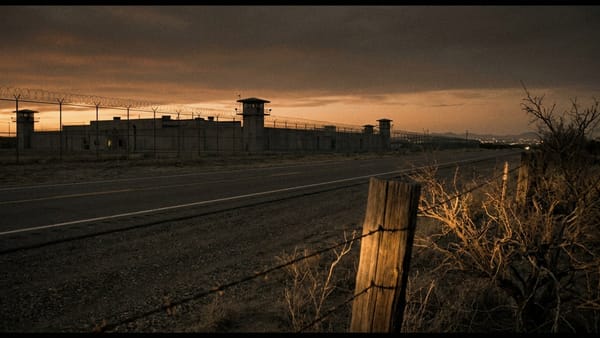
Angola: The Plantation That Became a Prison
Angola was a slave plantation before it was a prison. Today 73% of its 5700 inmates are Black and 75% will die there — on the same 18000 acres Isaac Franklin assembled in the 1850s.

Angola: The Plantation That Became a Prison
The Louisiana State Penitentiary sits on 18,000 acres of farmland in the bend of the Mississippi River, surrounded on three sides by water and on the fourth by the Tunica Hills. Its name is Angola, after the West African country from which many of the enslaved people who worked this land were taken. It was a plantation before it was a prison, and the men who run it have never entirely let go of that origin. Angola is the largest maximum-security prison in the United States, and it has operated, for most of its history, as an institution that manages Black men through forced agricultural labor — which is exactly what the plantation that preceded it did.
The Prison Was Built on a Slave Trader’s Land
The Angola plantation was assembled in the 1850s by Isaac Franklin, one of the largest slave traders in American history, who purchased several smaller farms and consolidated them into a cotton operation worked by enslaved people. After the Civil War, the land passed through several owners before being leased to a former Confederate officer named Samuel Lawrence James in 1870. James ran it as a convict lease operation — the state of Louisiana handed him the prisoners, and he put them to work on the land for profit. Most of the men he received were Black, convicted under the Black Codes that Louisiana and other Southern states had passed to re-criminalize Black life after emancipation.^1^
The state of Louisiana purchased the Angola plantation outright in 1901 and turned it into a state prison farm. The transition from lease operation to state-run facility changed the management but not the fundamental structure. Men — overwhelmingly Black men — grew crops on the former plantation under the supervision of armed guards on horseback. They lived in the converted plantation quarters. They were punished for disobedience in ways that echoed the punishments of slavery. The name “Angola” was not incidental. It was the name of the plantation, carried forward into the prison era as an administrative designation, but it pointed backward to the origin of the labor system the prison inherited.
Forced Labor and Federal Courts Defined a Century of Operations
For most of the twentieth century, Angola operated as a prison farm in the most literal sense. Inmates grew corn, soybeans, wheat, and cotton on the plantation land under the supervision of mounted guards called “freemen,” a title that was deliberately chosen to mark the distinction between those with freedom and those without. Prisoners who refused to work faced isolation in a sweatbox, a small metal cell that reached brutal temperatures in the Louisiana heat. Violence from guards and between inmates was routine and largely unreported.^2^
The disciplinary system at Angola through the 1950s and 1960s relied heavily on trustee prisoners — inmates given authority over other inmates, a model that produced predictable abuses. A federal investigation in the 1970s found conditions that a judge described as “completely unacceptable in a civilized society.” Warden C. Murray Henderson, who ran the prison from 1968 to 1975, oversaw a period of intense violence; in 1975, the year he left, 40 inmates were murdered inside Angola’s walls.
In 1975, Judge Frank Polozola of the U.S. District Court for the Middle District of Louisiana began a decades-long oversight of Angola following a class-action lawsuit brought by prisoners. The consent decrees that resulted forced significant changes to the physical conditions — better medical care, reduced use of solitary confinement, restrictions on trustee power. The court oversight continued until 2008.
Burl Cain Built a Public Image While the Structure Stayed the Same
Warden Burl Cain, who ran Angola from 1995 to 2016, became the most famous prison administrator in America on the strength of a very particular public image. He emphasized rehabilitation, invited journalists and documentary filmmakers inside, launched a rodeo that became a tourist attraction, and established a seminary program with the New Orleans Baptist Theological Seminary that allowed inmates to earn bachelor’s degrees in ministry. Angola under Cain became a case study in how a prison could market itself as reformed while maintaining the basic structure of its operations intact.^3^
The Angola rodeo, held since 1965 and expanded under Cain, charges admission to watch inmates — many of them serving life sentences — compete in events including “Convict Poker,” in which four inmates sit at a card table in an arena while a bull is released; the last man to stay seated wins. The rodeo generates significant revenue. Inmates who compete receive small prizes and the right to sell crafts at the accompanying fair. Critics pointed out that the spectacle, whatever its entertainment value, had roots in a tradition of treating incarcerated people as objects of public entertainment that stretches back to the public executions of the colonial era.
What Do the Numbers Actually Say About Who Angola Holds?
As of 2023, Angola held approximately 5,700 prisoners. The racial composition of its population reflects the state’s broader criminal justice disparities: roughly 73 percent of Angola’s inmates are Black, in a state where Black residents comprise about 33 percent of the general population. Approximately 75 percent of Angola’s population is serving life sentences, most without the possibility of parole — a consequence of Louisiana’s habitual offender laws and mandatory minimums that make Angola, in practice, a place people enter and do not leave alive.^4^
The death row at Angola held 58 men as of 2023. The execution chamber, used for lethal injections since the state abandoned the electric chair, is on-site. Louisiana had not carried out an execution since 2010, though the state government announced its intention to resume them in 2024.
The Plantation and the Prison Were Never Two Different Things
Angola’s 18,000 acres are still farmed. Inmates still grow crops under guard supervision. The mounted guards on horseback are still there — a visual continuity with the plantation that preceded the prison so complete that historians and journalists have been noting it for decades without the observation producing any particular policy change. The prison has a museum. It has a newsletter. It hosts a Christmas visitor program. Warden Darrel Vannoy, who succeeded Burl Cain, continued the institutional emphasis on rehabilitation programs as Angola’s public face.
None of this changes what Angola is: a prison built on a plantation, named after the country its enslaved workers came from, still farming the same land with the labor of imprisoned men, more than three-quarters of whom are Black, most of whom will die there. The line from Isaac Franklin’s cotton operation to the Louisiana State Penitentiary is not metaphorical. It is institutional, geographic, and continuous. The plantation became a prison, and the prison preserved the plantation — different paperwork, same function.
The convict leasing system that built Angola’s labor model was the direct continuation of slavery through criminal law — the same logic that the Black Codes in the racial terror section enforced at the street level. Together they form a chain that runs from 1865 to the present without interruption.
─────────
Sources:
- Baptist, Edward E. The Half Has Never Been Told: Slavery and the Making of American Capitalism. Basic Books, 2014.
- Oshinsky, David M. Worse Than Slavery: Parchman Farm and the Ordeal of Jim Crow Justice. Free Press, 1996.
- Ridgeway, James, and Jean Casella. “God’s Own Warden.” Mother Jones, July/August 2011.
- Louisiana Department of Public Safety and Corrections. Annual Report 2023.
Part of Historic American Prisons — ← Back to series hub