The Attica Uprising: When Prisoners Took the Prison
In September 1971, 43 people died at Attica — every one killed by state gunfire. The state blamed the prisoners. It was a lie documented before the tear gas cleared.
The Attica Uprising: When Prisoners Took the Prison
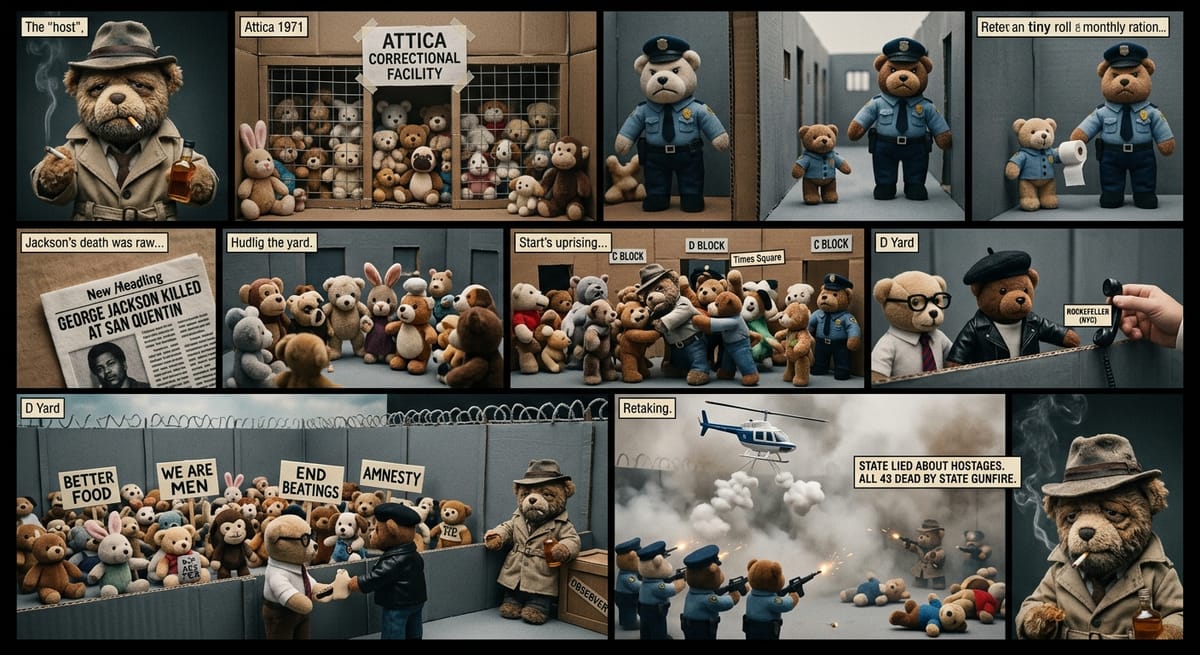
On September 9, 1971, the men incarcerated at Attica Correctional Facility in western New York took control of the prison. By the time the uprising was over, 43 people were dead — 33 prisoners and 10 hostages — and every single one of them had been killed by state police and corrections officers, not by the prisoners who’d seized the facility. Governor Nelson Rockefeller never visited the prison during the four-day standoff. He ordered the retaking by phone from his office in New York City. The official narrative for years blamed the prisoners for the deaths of the hostages. It was a lie, and the state of New York knew it was a lie before the tear gas cleared.
Attica in 1971 Was a Pressure Vessel Ready to Blow
Attica in 1971 held approximately 2,243 men in a facility designed for far fewer. The racial composition of the prison population was roughly 54 percent Black and 9 percent Hispanic; the corrections officer staff was nearly all white. Prisoners received 25 cents a day for work. They were allowed one shower per week and one roll of toilet paper per month. Their mail was read and often withheld. Medical care was minimal. Beatings by guards were common and went unreported.^1^
The political temperature inside Attica in 1971 was unusually high. The Black Power and prisoners’ rights movements had reached inside the walls. Many of the men had followed the trial of George Jackson, the Black Panther who’d been serving time at California’s San Quentin when guards shot and killed him on August 21, 1971 — 19 days before the Attica uprising. Jackson’s death was still raw on September 9 when a fight between two prisoners in the yard escalated, guards intervened, and a group of prisoners fought back, overpowering their keepers and seizing control of Times Square, the central junction of Attica’s four cellblocks.
By mid-morning, prisoners held D Yard and 42 staff members as hostages. The hostages were not harmed. A prisoner committee formed to negotiate and invited observers — including journalist Tom Wicker of the New York Times, lawyer William Kunstler, and Black Panther Party chairman Bobby Seale — to serve as mediators. The prisoners produced a list of 27 practical demands: better food, medical care, educational opportunities, an end to political censorship, a minimum wage for prison labor, and protection from reprisals for participating in the uprising.^2^
Rockefeller Refused to Visit and Chose Guns Over Negotiation
The negotiations that followed were genuine on the prisoners’ side and largely performative on the government’s. Commissioner of Correctional Services Russell Oswald agreed to many of the practical demands but refused two conditions the prisoners insisted on: complete amnesty for the uprising and transportation to a non-extradition country for those who wanted to leave. The amnesty demand was the sticking point. Rockefeller would not grant it.
The observer committee repeatedly urged Rockefeller to come to Attica in person. He refused. On September 12, the prisoner leadership proposed dropping the transportation demand; Oswald brought the proposal to Rockefeller, who declined. The negotiations had effectively ended before Rockefeller gave the order to retake the prison.
On the morning of September 13, state police helicopters flew over D Yard and dropped tear gas. Then the shooting started. Approximately 550 state police, corrections officers, and National Guard troops entered the prison firing. The assault lasted approximately nine minutes. When it was over, 39 prisoners and three hostages lay dying from gunshot wounds. A fourth hostage, William Quinn, had died from injuries sustained on September 9. In the immediate aftermath, prison officials told reporters that prisoners had slashed the hostages’ throats. The autopsies proved it was state gunfire that killed them.^3^
The State Lied About Who Killed the Hostages and Prosecuted the Victims
The official fabrication about how the hostages died was not a rushed error. Rockefeller and state officials had every reason to know within hours what the autopsies would show — that all 43 dead had been killed by gunfire, and that prisoners had no firearms. The throat-slitting story was a deliberate lie to justify what had happened.
A special commission chaired by Dean Robert McKay of New York University Law School, the McKay Commission, investigated and released a report in September 1972 that characterized the state police assault as “the bloodiest one-day encounter between Americans since the Civil War.” The commission found the state’s initial accounts to be false and documented the indiscriminate nature of the shooting. It recommended major reforms to the state’s prison system, almost none of which were implemented.
New York Attorney General Louis Lefkowitz convened a grand jury that indicted 62 prisoners on charges related to the uprising. No corrections officers or state police were ever charged with any crime related to the deaths. Herman Schwartz, a law professor who had served as a mediator, filed a federal civil rights suit on behalf of survivors; it was dismissed. A second civil rights suit filed in 1974 took 26 years to reach settlement. In 2000, New York agreed to pay $8 million to survivors and families of prisoners killed in the retaking — roughly $130,000 per death — explicitly not admitting liability.^4^
Frank “Big Black” Smith Was Tortured by Corrections Officers After the Shooting Stopped
What happened after the retaking is part of the Attica story that gets less attention than the uprising itself. For hours after the prison was secured, corrections officers subjected prisoners to torture. Men were forced to strip naked and run a gauntlet of guards who beat them with clubs and rifle butts. Some were burned with cigarettes. Frank “Big Black” Smith, a prisoner who had protected hostages during the four-day standoff, was forced to lay naked on a table in Times Square with a football wedged under his chin for hours, told that if he dropped the ball he would be killed. He held it.
Smith sued the state in 1974. His case, part of the larger civil rights litigation, took nearly three decades to resolve. In 2000, New York settled, and Smith received a portion of the $8 million. He became one of the most prominent Attica survivor advocates, working for decades with attorney Elizabeth Fink, who led the class action. Smith died in 2004, still seeking the public acknowledgment of what had been done to him that no settlement had provided.
Attica Produced Real Reforms That Left the Core Problem Untouched
Attica did produce prison reforms — eventually and inadequately. New York improved conditions in its facilities over the following years. The prisoners’ rights movement that Attica amplified led to a series of federal court decisions expanding constitutional protections for incarcerated people. The 1974 Supreme Court case Wolff v. McDonnell established that prisoners had due process rights in disciplinary proceedings, a direct response to practices documented at Attica.
But the larger lesson that Attica pointed to — that the conditions that produced the uprising were themselves the problem, not the men who rebelled against them — has never been fully absorbed. Prisons remain overcrowded, understaffed, and disproportionately populated by Black and brown men. The political conditions that led 1,281 men to take control of their prison on September 9, 1971 did not disappear when the tear gas settled. The state’s response to Attica demonstrated something important: when confronted with a demand to make prisons more humane, the government chose instead to make the prisoners an example.
The wrongful convictions series tracks what happens when the same government prosecutes the wrong people and refuses to correct the record. The racial composition of Attica’s prisoner population in 1971 mirrors the pattern that convict leasing and chain gangs built — deliberate targeting of Black men as the raw material of the prison system.
─────────
Sources:
- Thompson, Heather Ann. Blood in the Water: The Attica Prison Uprising of 1971 and Its Legacy. Pantheon Books, 2016.
- McKay Commission. Attica: The Official Report of the New York State Special Commission on Attica. Bantam Books, 1972.
- Wicker, Tom. A Time to Die: The Attica Prison Revolt. Quadrangle/New York Times Book Co., 1975.
- New York State Office of the Attorney General. Attica Settlement Documentation. 2000.
Part of Historic American Prisons — ← Back to series hub