Historic American Prisons: Where America Locked Its Nightmares
Five institutions — Eastern State, Alcatraz, Angola, Sing Sing, Attica — each called a solution in its time. The pattern across all five is the same tools called by different names.

Historic Prisons: Where America Locked Its Nightmares
Every prison in this series was, at some point, called a solution. Eastern State Penitentiary was going to rehabilitate men through reflection. Alcatraz was going to hold the untameable. Angola was going to turn prison labor into order. Sing Sing was going to modernize punishment. Attica was just a building that held the men New York had decided it couldn’t handle, and when those men reached a breaking point in September 1971, the state’s response revealed exactly what the prison had always been.
The pattern across these five places is not that America got cruel. The pattern is that America kept reaching for the same tools — isolation, labor, spectacle, violence — and calling them innovations.
In This Series
- Eastern State Penitentiary: The Prison That Invented Solitary Confinement
- Alcatraz: The Rock That America Built to Hold Its Worst
- Angola: The Plantation That Became a Prison
- Sing Sing: New York’s Most Famous House of Pain
- The Attica Uprising: When Prisoners Took the Prison
Every Innovation Was a Repackaging of the Same Tools
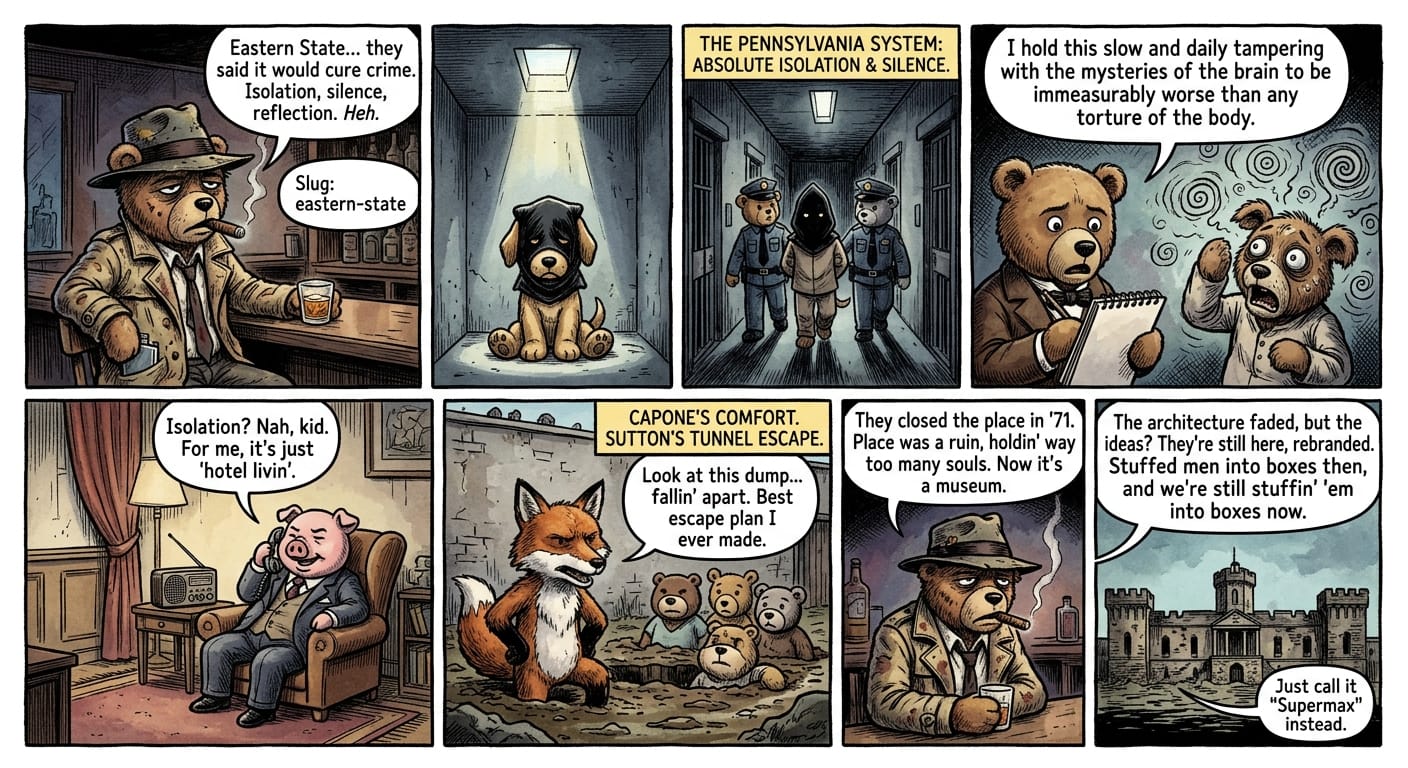
Eastern State Penitentiary opened in 1829 with a genuine theory: total isolation would force a man inward, produce penitence, and return him to society transformed. Charles Dickens visited in 1842 and described what he found as slow psychological destruction. The reformers who built it saw the same men Dickens saw and interpreted their deterioration as the beginning of reformation. This is the recurring structure: a system causes obvious harm, and its architects insist the harm is the mechanism.
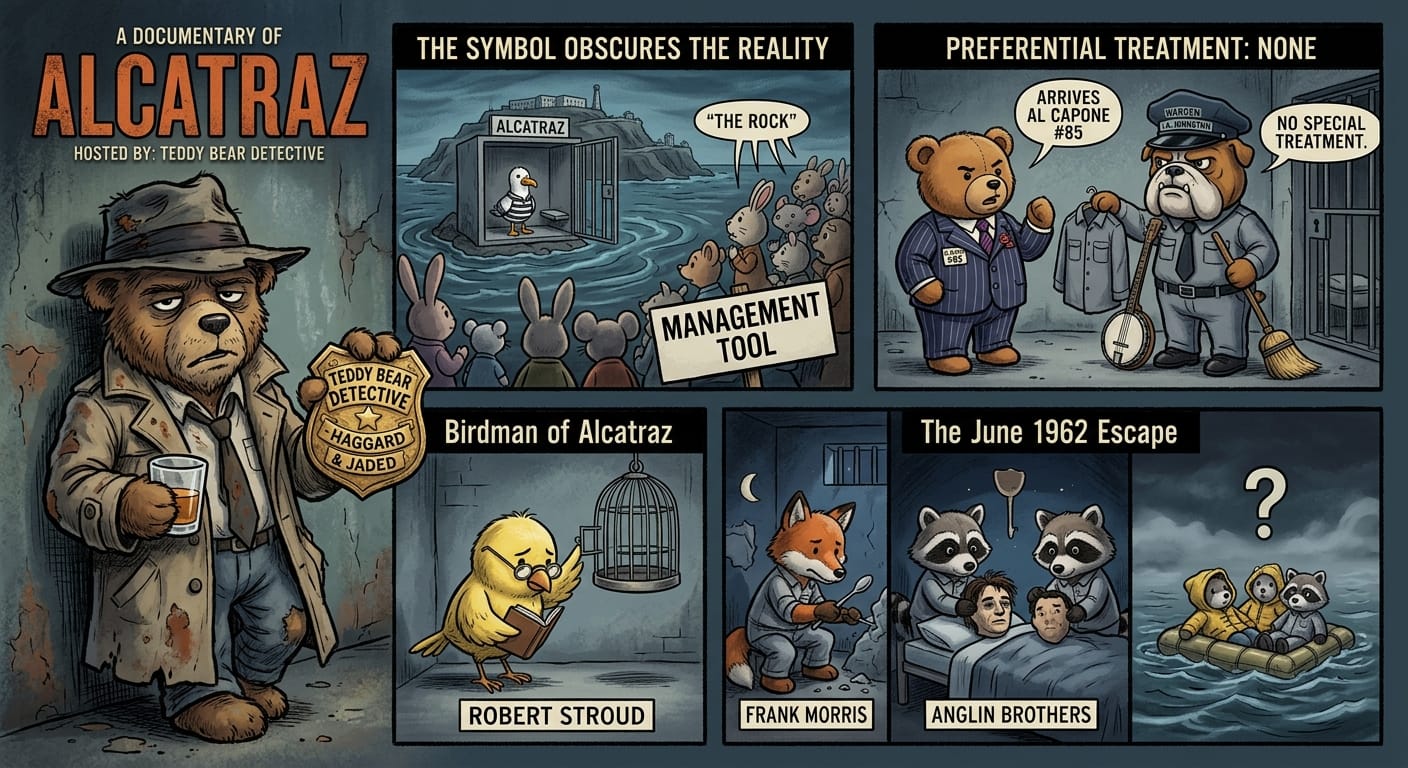
Alcatraz was sold as inescapable. Of the 14 escape attempts, the most famous — Frank Morris and the Anglin brothers, June 1962 — remains officially unsolved, with all three listed as presumed drowned after the FBI closed its case in 1979. The prison closed in 1963 not because it succeeded but because it cost three times more per prisoner than any other federal facility and the infrastructure was failing. The Rock was a management tool dressed as a symbol, and the symbol outlasted the institution.^1^
Angola Preserved the Plantation Without Changing the Name
Angola’s 18,000 acres were assembled as a plantation in the 1850s by Isaac Franklin, one of the largest slave traders in American history. The state of Louisiana purchased the land in 1901 and converted it to a prison farm. The structure of the operation — Black men, forced agricultural labor, mounted armed guards, the name carried forward from the West African country of origin of the enslaved people who worked the land first — was not metaphorical continuity. It was institutional continuity. The plantation became a prison and the prison preserved the plantation. As of recent counts, approximately 73 percent of Angola’s 5,700 prisoners are Black, in a state where Black residents are 33 percent of the general population, and roughly 75 percent are serving life sentences without parole.
Sing Sing executed 614 people between 1891 and 1963 in an electric chair that was adopted despite the first execution, in 1890, being so botched that witnesses described what appeared to be prolonged suffering. The state declared the first execution a success. The pattern holds: the institution defines the outcome it expected, and the evidence is made to fit.
Attica Demonstrated What the System Does When Challenged
The Attica uprising on September 9, 1971 involved 1,281 prisoners holding 42 staff members hostage for four days. The prisoners produced 27 practical demands. Governor Nelson Rockefeller refused to visit. When the retaking came on September 13, 43 people died — 33 prisoners and 10 hostages — every single one killed by state police gunfire. The state’s initial account blamed the prisoners for the hostages’ deaths. It was a lie, documented as such by the McKay Commission in 1972. No corrections officer or state police officer was ever charged with a crime. The inmates were indicted.^2^
Attica is the point where the underlying logic becomes undeniable. When prisoners organized and demanded basic human treatment, the state used overwhelming violence, blamed the prisoners for the deaths that violence caused, and declined to pursue accountability for anyone who held a badge. The prison’s function was not to rehabilitate or reform or even to deter. It was to hold, and when holding required killing, the state killed.
What These Prisons Have in Common Is Who They Held
None of these prisons was unique. Alcatraz held a few hundred people at any time; Sing Sing held a few thousand; Angola holds nearly 6,000 today. All of them reflect the same basic choices: who gets locked up, under what conditions, with what access to basic human needs, with what possibility of return. The population of all of them has been disproportionately Black, disproportionately poor, and disproportionately people who encountered the system without adequate legal resources.
The buildings change. The theory changes. The language changes — from penitentiary to correctional facility, from warden to superintendent, from cell block to housing unit. The underlying structure — using confinement and forced labor to manage a population the society has decided it can’t incorporate — has not changed in any fundamental way since Eastern State opened its gates in 1829.
← Back to Prison and Punishment in American History
─────────
Sources:
- Ward, David A. Alcatraz: The Gangster Years. University of California Press, 2009.
- Thompson, Heather Ann. Blood in the Water: The Attica Prison Uprising of 1971 and Its Legacy. Pantheon Books, 2016.
The Series