Cults in American History
America has produced more destructive cults than any other Western democracy. This section covers thirteen articles on seven groups — Jonestown Waco Heaven's Gate NXIVM and more — plus the mechanics of how cults control people.
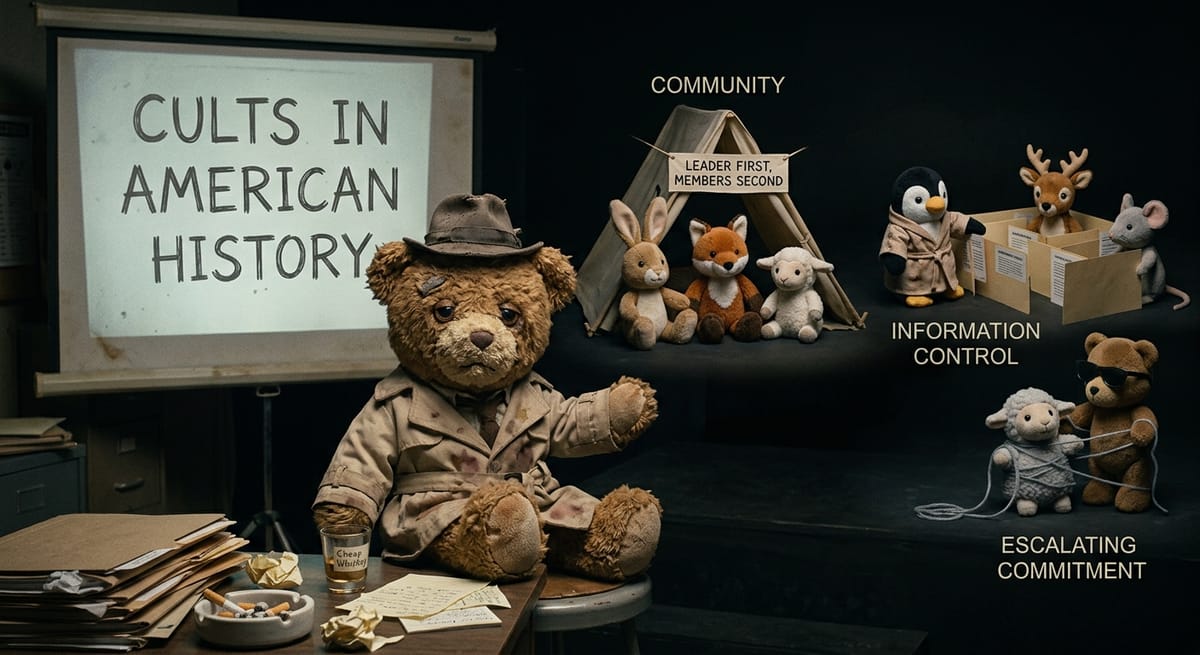
Cults in American History
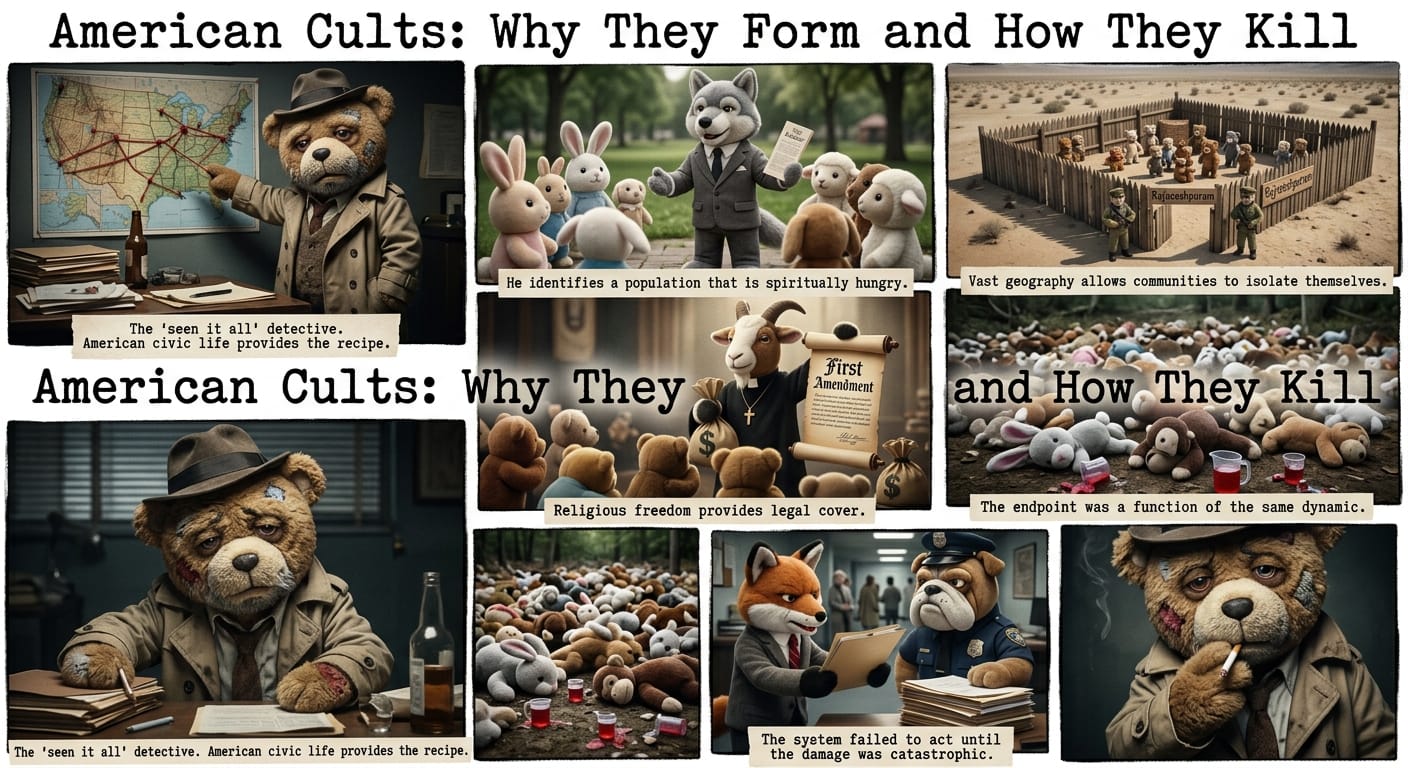
America has always been fertile ground for people who claim to speak for God, the cosmos, or the future and who build communities around that claim. The country was founded, in part, by religious separatists who crossed an ocean to practice their faith without interference, and that founding impulse — the conviction that spiritual authority supersedes secular authority, that community can be built around charismatic revelation, and that the government should stay out of it — has produced everything from the Quakers to Jonestown. The distance between a church and a cult is not theological. It’s structural: it’s the difference between an organization that serves its members and an organization that serves its leader at its members’ expense. And the structural conditions that allow the second type to flourish in America — religious liberty as a legal shield, geographic space for isolation, a culture that celebrates reinvention and distrusts institutional oversight — have produced a concentration of destructive cult activity that is without parallel in the Western world.^1^
This section examines the American cult phenomenon through thirteen articles across two series. The first series profiles seven groups whose names define the category: the Peoples Temple and the massacre at Jonestown, David Koresh and the siege at Waco, Heaven’s Gate and the Rancho Santa Fe suicides, the Manson Family and the Tate-LaBianca murders, NXIVM and the branding of women in an Albany suburb, the Children of God and the global sexual abuse of children, and the Rajneeshees and the bioterror attack on a small Oregon town. The second series examines the mechanics — the dynamics of recruitment, the warning signs of destructive control, the history of deprogramming and intervention, and the long process of recovery that cult survivors navigate after they leave.^2^
Why America Produces More Destructive Cults Than Any Other Western Democracy
The seven groups profiled in this section span fifty years of American history and represent a spectrum of cult typologies. Jonestown was the endpoint of a progressive social justice ministry that devolved into totalitarian control and ended in mass death. Waco was a government siege of a religious community that resulted in the deaths of the people the government claimed to be protecting. Heaven’s Gate was a quiet, disciplined group of adults who chose death with a composure that defied every assumption the public holds about cult victims. The Manson Family was a small commune that produced seven murders and a cultural mythology that has consumed more public attention than the crimes warranted. NXIVM was a corporate-branded exploitation scheme that operated in an office park. The Children of God was a global operation that institutionalized the sexual abuse of children across six continents. The Rajneeshees were a spiritual community that poisoned a town.^1^
The diversity of the profiles is the point. Destructive cults don’t share a theology, a geography, or a membership demographic. What they share is a set of structural dynamics — charismatic authority, information control, escalating commitment, isolation from outside perspectives, and the conflation of the leader’s interests with the group’s mission — that produce harm regardless of the specific content of the group’s beliefs.^3^
What the Mechanics of Cult Control Actually Look Like
The second series steps back from individual groups to examine the dynamics that make cult control possible. The recruitment article traces the process from initial contact through love-bombing, framework introduction, escalation, and isolation — a sequence that is consistent across every group profiled in this section and that exploits psychological needs (belonging, meaning, purpose, recognition) that are universal to the human condition. The warning signs article provides a practical framework for evaluating whether a group’s dynamics have crossed the line from demanding to destructive — focusing on the leader’s accountability, the group’s information practices, the exit costs, the financial structures, and the presence or absence of genuine checks on leadership power.^2^
The deprogramming article traces the history of cult intervention from Ted Patrick’s coercive extractions through the development of voluntary exit counseling, examining a debate that has never been resolved: how do you help someone who is being harmed by a group they believe is helping them, without violating the autonomy you’re trying to restore? The survivors article examines what happens after a member leaves — the disorientation, the grief, the practical challenges of rebuilding a life, and the long process of psychological recovery that the cult was designed to prevent.^1^
Is the American Cult Problem Getting Worse?
The American cult phenomenon is not historical. It is ongoing and evolving. The compound-based model that characterized mid-twentieth-century cults — Jonestown, the Rajneeshees, the Branch Davidians — has been supplemented by organizational models that are harder to identify and harder to address: corporate-structured groups like NXIVM, online communities that employ cult dynamics without geographic concentration, political movements that use the same mechanisms of information control and identity fusion that characterize religious cults, and therapeutic or self-help organizations that use the language of personal growth to mask the dynamics of exploitation.^2^
The mechanisms haven’t changed. The delivery systems have. And the population that is vulnerable to cult recruitment — people in transition, people seeking meaning, people whose social connections have been weakened by the forces that weaken social connection in twenty-first-century America — is as large as it has ever been, perhaps larger, in a cultural moment characterized by loneliness, institutional distrust, and the availability of charismatic authority figures on every platform.^3^
The Stakes Are Structural, Not Personal
The stories in this section are cautionary, but the caution they offer is structural rather than personal. The lesson isn’t “be careful not to join a cult.” The lesson is that the conditions which produce destructive cults — religious deference, geographic isolation, institutional reluctance to intervene, and a culture that treats personal autonomy as absolute even when that autonomy has been systematically compromised — are built into the American system, and the people who suffer the consequences are the people who trusted the leaders, the communities, and the institutions that were supposed to protect them.
918 dead in the jungle. Seventy-six dead in a fire. Thirty-nine dead on bunk beds. Seven murdered in Los Angeles. Women branded in Albany. Children abused on six continents. A town poisoned in Oregon. The names belong to the dead and the survivors, not to the leaders who exploited them. The question the section asks isn’t whether America produces cults. It’s what about America makes the production inevitable, and whether anything can be done about the assembly line.
In This Series
- American Cults: Why They Form and How They Kill — Profiles of seven groups across fifty years of American cult history
- Understanding Cults: The Psychology of Total Control — The mechanics of recruitment, warning signs, deprogramming, and recovery
─────────
Sources:
- Singer, Margaret Thaler and Lalich, Janja. Cults in Our Midst: The Continuing Fight Against Their Hidden Menace. Jossey-Bass, 2003.
- Hassan, Steven. Combating Cult Mind Control. 4th ed., Freedom of Mind Press, 2018.
- Lifton, Robert Jay. Thought Reform and the Psychology of Totalism. University of North Carolina Press, 1989.
- Reiterman, Tim and Jacobs, John. Raven: The Untold Story of the Rev. Jim Jones and His People. Dutton, 1982.
- ICSA (International Cultic Studies Association). Research reports and educational materials, 1979-present.
In This Section