Chain Gangs: Slavery by Another Name
Chain gangs put shackled Black men on Southern roads from the 1870s through the 1950s — and again in the 1990s when Alabama brought them back for the press photos.
Chain Gangs: Slavery by Another Name
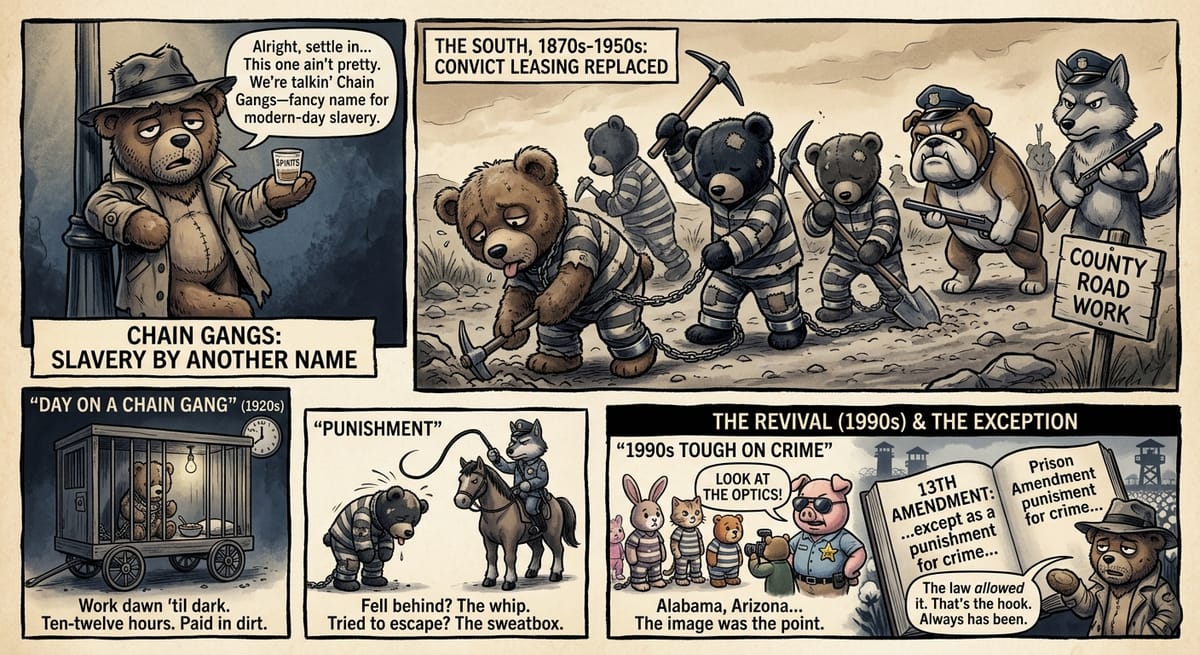
Chain gangs were exactly what they looked like. Men — almost always Black men in the South — shackled together at the ankles with iron chains, working road construction, ditch digging, and field labor under armed guard in all weather conditions, for no pay, with the threat of violent punishment for any slowing down. The practice operated across the American South from the 1870s through the 1950s and experienced a revival in the 1990s. It was legal. It was constitutional. The Thirteenth Amendment, which abolished slavery, explicitly allows involuntary servitude as punishment for crime. The chain gang was built on that exception, and it was designed to look as much like slavery as the law permitted.
Chain Gangs Were a Direct Replacement for Convict Leasing
The chain gang emerged directly from the collapse of the convict lease system. Under convict leasing, which flourished from the 1870s through the early twentieth century, states leased prisoners to private businesses — mining companies, railroad contractors, lumber camps — who worked them in conditions that routinely produced injury and death. The mortality rates at some convict lease operations exceeded 20 percent per year. Public pressure, eventually, forced most Southern states to abolish the practice.
Georgia abolished convict leasing in 1908 and replaced it with county-run chain gangs. The state that had pioneered the most brutal forms of convict leasing became the state most associated with chain gangs — a direct substitution of one form of coerced labor for another, with the state rather than a private contractor serving as the overseer. Other Southern states followed. By the 1920s, chain gangs were working roads across Florida, North Carolina, Alabama, and South Carolina, building and maintaining the highway infrastructure of the New South using the labor of imprisoned men.^1^
The racial composition of the chain gangs reflected the racial composition of Southern criminal justice, which was deliberately designed to criminalize Black life after emancipation. The Black Codes passed across the South after the Civil War made vagrancy, petty theft, and unemployment criminal offenses carrying prison sentences. Courts routinely convicted Black men on minimal evidence or no evidence. The men sent to the chain gangs were disproportionately those convicted under these laws — the criminal justice system as a machine for generating the labor force that the plantation economy could no longer legally demand.
What Did a Day on a Chain Gang Actually Look Like?
A chain gang prisoner in Georgia in 1925 woke at dawn in a rolling cage — a barred wagon that served as both transport and sleeping quarters — unlocked from his bed shackle, had his leg iron reattached to the gang chain, was fed a quick breakfast, and worked until dark. The typical workday was ten to twelve hours. Sundays were rest days, though the cage didn’t move. Prisoners who fell behind the pace of work faced the “lash” — a leather strap applied by a guard called the “whipping boss.” Guards rode horses or walked with shotguns. Escape attempts were common despite the chains; recaptures were followed by additional punishment including time in a sweatbox, a small metal cell left in the sun.^2^
The labor produced real infrastructure. The roads, bridges, and drainage ditches that the chain gangs built throughout the South in the early twentieth century are still in use in some places. The labor was essentially free — prisoners received no wages. The cost to the state was the guards’ salaries and the prisoners’ minimal food and housing. The economic value of chain gang labor to Southern counties and states was substantial, which was a significant reason the system lasted as long as it did.
Robert Burns, a white man who was sentenced to a Georgia chain gang in 1922 for a $5.80 grocery store robbery, escaped twice and wrote a memoir, I Am a Fugitive from a Georgia Chain Gang! published in 1932, which became both a bestseller and a film starring Paul Muni. Burns’s account brought national attention to chain gang conditions, but it was a white man’s account that generated the outrage — Black men had been describing the same conditions for decades to less effect.^3^
The Civil Rights Era Killed Chain Gangs — Until the 1990s Brought Them Back
By the 1950s, chain gangs were disappearing from most Southern states. Federal court decisions expanded prisoners’ constitutional rights. The civil rights movement made the spectacle of shackled Black men working public roads increasingly politically costly. North Carolina abolished the chain gang in 1955. Georgia phased out the practice in the early 1960s. Florida held on longer but quietly ended the practice in the 1970s.
The revival came in the 1990s, during a period of intense political competition over who could appear toughest on crime. In 1995, Alabama became the first state to reintroduce chain gangs since the civil rights era, under Governor Fob James. Corrections Commissioner Ron Jones photographed the first chain gang crews and distributed the photos to news organizations. The PR strategy was deliberate: the state wanted the image. Arizona followed within months. Sheriff Joe Arpaio of Maricopa County, Arizona established a female chain gang in 1996 — one of his many deliberately provocative uses of incarcerated people as theatrical props.^4^
The revival was short-lived. Alabama’s chain gangs produced a lawsuit by the Southern Poverty Law Center in 1996; a federal judge found the shackling practices constituted cruel and unusual punishment in certain applications. Alabama abandoned the program in 1996. Arizona wound down its chain gangs in subsequent years, though Arpaio’s county continued various theatrical punishments for years after.
The Constitutional Exception That Made All of This Legal Is Still There
The Thirteenth Amendment to the U.S. Constitution reads: “Neither slavery nor involuntary servitude, except as a punishment for crime whereof the party shall have been duly convicted, shall exist within the United States, or any place subject to their jurisdiction.” The italicized clause is the exception on which chain gangs, prison labor, and all forms of coerced prison work rest. It was placed in the Amendment deliberately, at the insistence of legislators who anticipated that the Southern states would find ways to reconstruct the labor system of slavery through criminal law.
That prediction was accurate. The chain gang was the most visible expression of it — men in irons, performing forced labor, in a system that targeted the same population slavery had targeted, using laws designed to criminalize the freedoms emancipation had supposedly granted. The constitutional exception to the abolition of slavery remains in place. The chain gang’s revival in the 1990s demonstrated that the political will to use it was never far from the surface.
The same logic that ran chain gangs also built Angola — a prison farm where forced agricultural labor under mounted guard has continued uninterrupted since the plantation era. The convict leasing system that preceded chain gangs produced the template; chain gangs were the state-run version of the same machine.
─────────
Sources:
- Oshinsky, David M. Worse Than Slavery: Parchman Farm and the Ordeal of Jim Crow Justice. Free Press, 1996.
- Lichtenstein, Alex. Twice the Work of Free Labor: The Political Economy of Convict Labor in the New South. Verso, 1996.
- Burns, Robert E. I Am a Fugitive from a Georgia Chain Gang! Vanguard Press, 1932.
- Dow, Mark. American Gulag: Inside U.S. Immigration Prisons. University of California Press, 2004.
Part of A History of Punishment — ← Back to series hub