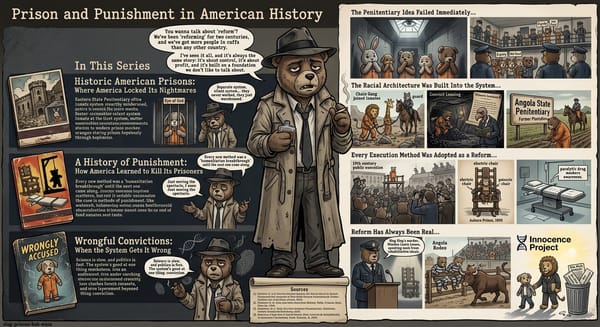
The Innocence Project: Fighting to Free the Wrongly Convicted
The Innocence Project has freed 375 wrongly convicted people since 1992 — including 21 from death row. Their data shows faulty forensic science contributed to nearly half the cases.
The Innocence Project: Fighting to Free the Wrongly Convicted
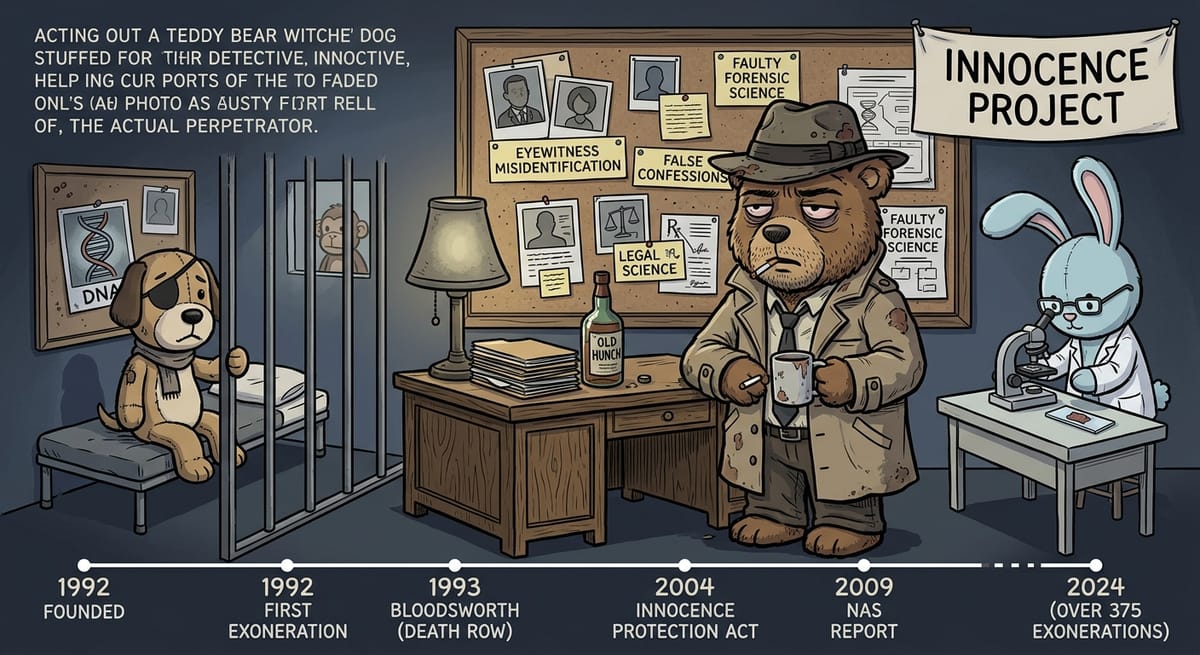
The Innocence Project was founded at Cardozo School of Law in New York City in 1992 by attorneys Barry Scheck and Peter Neufeld, with a specific premise: use DNA testing to review cases where biological evidence had been collected and preserved but where the convicted person maintained their innocence. The first exoneration came in 1992. By 2024, the organization and its affiliates had contributed to more than 375 DNA exonerations in the United States, including 21 people who had been on death row. The cases have revealed systematic failures in the criminal justice system that go far beyond individual bad actors.
The Project Only Takes Cases Where DNA Can Prove Innocence Conclusively
The Innocence Project accepts cases only from people who have already been convicted and exhausted their direct appeals. Applicants must meet several criteria: the conviction must have involved biological evidence; the evidence must still exist and be testable; the DNA test must be capable of producing a conclusive result; and the test result must prove, not merely suggest, innocence. The organization receives thousands of applications per year and can take on only a fraction of them. Cases can remain under review for years.^1^
When a case is accepted, law students working under attorney supervision review the trial record, locate the biological evidence in the custody of the state, negotiate or litigate for access to that evidence, and arrange for independent DNA testing. If the DNA test excludes the convicted person, the project files post-conviction motions arguing for vacation of the conviction. If those motions are denied — which happens — the project appeals. The legal process of exonerating someone who has already been convicted is often longer and more difficult than the original trial.
The cases require persistence partly because of institutional resistance. Prosecutors’ offices that obtained the original convictions often oppose post-conviction DNA testing even when there is no obvious reason to do so. A conviction, once obtained, has institutional defenders regardless of the underlying evidence.
What Did the First Exonerations Reveal About How Wrongful Convictions Happen?
The Innocence Project’s first exoneration, in 1992, was Marion Coakley, convicted in 1984 of rape in New York. The DNA evidence excluded him. The first exonerations quickly established a pattern: eyewitness misidentification was present in the majority of cases, false confessions appeared in a significant minority, and forensic science that had been presented at trial as definitive — hair analysis, bite mark evidence, blood typing — frequently turned out to be either scientifically invalid or misrepresented by expert witnesses.^2^
Kirk Bloodsworth was the first person on death row in the United States to be exonerated by DNA evidence, in 1993. He had been convicted in 1984 of the rape and murder of nine-year-old Dawn Hamilton in Maryland, based partly on eyewitness testimony and partly on bite mark analysis. DNA testing on biological evidence from the crime scene excluded him. He was released after nine years in prison, two of them on death row. The actual perpetrator, Kimberly Shay Ruffner, was identified through DNA matching in 2003.
The Bloodsworth case catalyzed federal legislation. The Innocence Protection Act of 2004, the first federal legislation addressing wrongful convictions, was largely shaped by advocacy from Bloodsworth and the Innocence Project. It expanded access to post-conviction DNA testing for federal prisoners and increased compensation for federal wrongful convictions to a cap of $50,000 per year of imprisonment and $100,000 per year on death row.^3^
Half of All Exoneration Cases Involved Faulty Forensic Science
One of the Innocence Project’s most significant contributions has been systematic documentation of what was wrong with the forensic science used in the cases it reviewed. The organization’s data on its first 200 DNA exonerations found that faulty forensic science had contributed to convictions in 47 percent of the cases. The specific methodologies that appeared most often — hair analysis, bite mark comparison, blood spatter interpretation — had been used in American courts for decades without adequate scientific validation.
In 2009, the National Academy of Sciences released a report titled Strengthening Forensic Science in the United States: A Path Forward that evaluated the major forensic disciplines. Its conclusions were devastating: only nuclear DNA analysis met the scientific standards required for reliable use in court; most other forensic techniques, including fingerprint analysis, hair and fiber comparison, bite mark analysis, and arson investigation, lacked scientific validation of their foundational assumptions. The report recommended the creation of an independent national forensic science commission. Congress never created one.^4^
The bite mark evidence problem is illustrative. Forensic dentists had testified for decades that they could match bite marks on crime victims to specific individuals with a high degree of certainty. This testimony had helped convict hundreds of people. When researchers actually tested the foundational claim — that bite marks are unique and can be reliably matched — they found that even trained forensic dentists misidentified bite mark evidence at significant rates. The Texas Forensic Science Commission recommended in 2016 that bite mark evidence be inadmissible in criminal trials; the recommendation was not binding and was not universally followed.
What Does 375 DNA Exonerations Actually Tell Us About the Scale of the Problem?
As of 2024, the Innocence Project and its affiliates had contributed to 375 DNA exonerations. The organization estimates that approximately 2 to 5 percent of felony convictions in the United States may involve innocent people — which would mean tens of thousands of wrongfully convicted people in the country’s current incarcerated population of roughly 2 million. These are estimates, not counts; there is no mechanism for identifying wrongful convictions at scale.
The exonerations the Innocence Project has achieved have come disproportionately in cases involving sexual assault, because sexual assault cases frequently produce biological evidence. Other crime categories are harder to address through DNA testing. The National Registry of Exonerations has documented more than 3,400 total exonerations, including many obtained through non-DNA evidence, but that figure includes only cases that were actually reviewed and reversed. The baseline assumption — that the criminal justice system convicts the right people unless demonstrated otherwise — remains the operating principle of the courts, despite the accumulated evidence that the system’s error rate is substantial and disproportionately affects certain populations.
The story the Innocence Project tells is not primarily a story about exceptional injustice. It is a story about the ordinary operation of a system that was built to convict and has limited capacity for self-correction. The people the project has freed were convicted by the system operating largely as designed. The project exists to catch what the system misses, and the system misses more than it acknowledges.
The Central Park Five case captures in a single set of convictions almost every failure mode the Innocence Project has documented at scale: false confessions, withheld evidence, and institutional resistance to reversal. The famous exonerations piece covers additional cases where the reversal came from outside the system — filmmakers, journalists, and advocates rather than the courts themselves.
─────────
Sources:
- Scheck, Barry, Peter Neufeld, and Jim Dwyer. Actual Innocence: Five Days to Execution and Other Dispatches from the Wrongly Convicted. Doubleday, 2000.
- Garrett, Brandon L. Convicting the Innocent: Where Criminal Prosecutions Go Wrong. Harvard University Press, 2011.
- Bloodsworth, Kirk, and Tim Junkin. Bloodsworth: The True Story of the First Death Row Inmate Exonerated by DNA. Algonquin Books, 2004.
- National Academy of Sciences. Strengthening Forensic Science in the United States: A Path Forward. National Academies Press, 2009.
Part of Wrongful Convictions — ← Back to series hub