The Central Park Five: How New York Railroaded Five Teenagers
Five teenagers were interrogated for up to 30 hours in 1989 and convicted of a rape the DNA excluded them from. The actual perpetrator confessed in 2002. No one was held accountable.
The Central Park Five: How New York Railroaded Five Teenagers
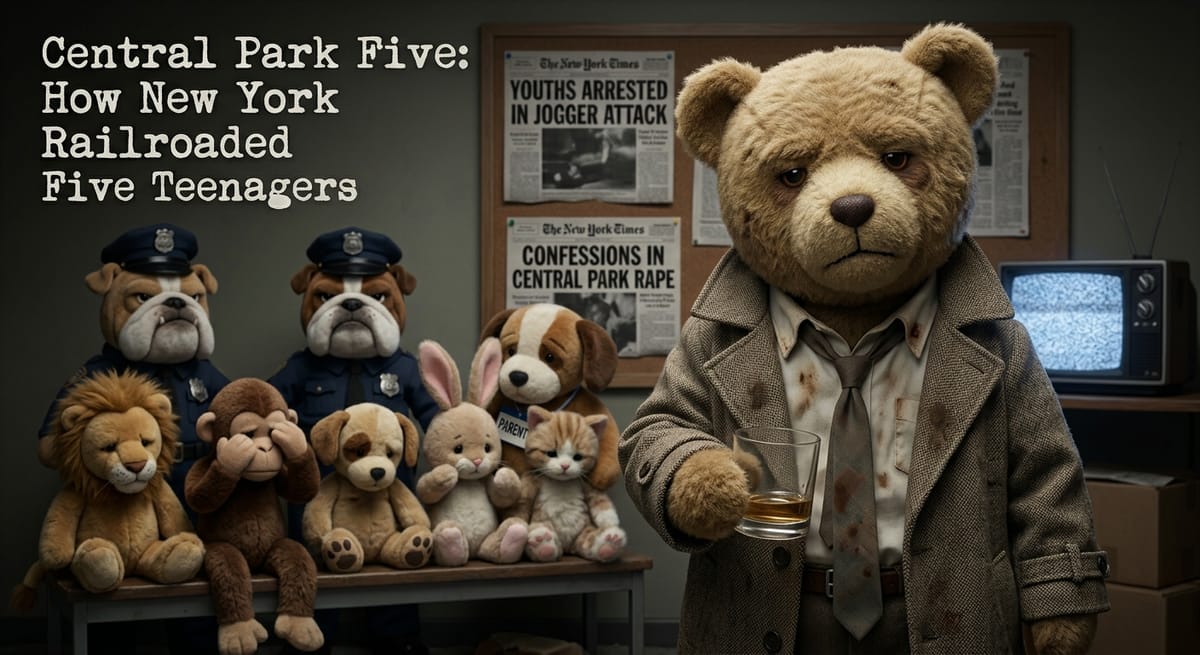
On the night of April 19, 1989, a 28-year-old investment banker named Trisha Meili was attacked, raped, and beaten nearly to death while jogging in Central Park. The New York City Police Department arrested five teenagers within days — Yusef Salaam, Kevin Richardson, Antron McCray, Raymond Santana, and Korey Wise, who were between 14 and 16 years old. They were interrogated for hours without adequate access to parents or lawyers, produced video confessions that contradicted each other and the physical evidence, and were convicted in 1990. Matias Reyes, a serial rapist and murderer who was actually responsible for the attack, confessed in 2002. DNA evidence confirmed his guilt. The five were exonerated. None of it should have happened, and all of it was preventable, and the system that produced the wrongful convictions was not corrected by their exoneration.
Police Interrogated Teenagers for Up to 30 Hours Without Meaningful Oversight
Central Park on the night of April 19, 1989 was the scene of what police would later describe as a “wilding” — a term that entered the public vocabulary from press accounts of that night, implying a gang of teenagers attacking random people in the park. The evidence for a coordinated attack was thin; there were groups of teenagers in the park that night, some of whom were throwing rocks at joggers and bicyclists, but the connection between those teenagers and the assault on Meili was never established. The five teenagers who were arrested were in the park that night but had no connection to each other before they were brought into the investigation.
Police took Santana into custody on the night of the attack. Richardson and McCray were brought in the following day. Salaam and Wise were brought in over the following 24 hours. All five were subjected to interrogations lasting between 14 and 30 hours. None of the interrogations were fully recorded; what was recorded were the videotaped “confessions” produced at the end of the process. Antron McCray’s father was present during part of his son’s interrogation and later said he had told his son to cooperate with police, believing that telling them what they wanted to hear was the only way to go home.^1^
Why Did Five Teenagers Confess to a Crime the DNA Said They Didn’t Commit?
The video confessions recorded by New York detectives were the prosecution’s primary evidence, because the physical evidence didn’t connect any of the five teenagers to the crime. No DNA from any of them was found on Meili’s body. No hair. No fingerprints. None of their clothing matched fibers found at the scene. The confessions contradicted each other in significant ways — they described different sequences of events, different roles, different details about the assault. They also contradicted established facts about the crime: one described an attack near a reservoir that was nowhere near where Meili was found. The prosecution proceeded anyway.^2^
False confessions in juvenile interrogations were well-documented in the criminology literature by 1989. Research had established that juveniles were significantly more susceptible than adults to suggestion during interrogation, more likely to capitulate to pressure, and more likely to believe that compliance would produce an immediate benefit — going home — even if it would cause long-term harm. The interrogators and prosecutors who handled the Central Park Five case knew or should have known this. The detectives who conducted the interrogations were experienced investigators who were not naive about interrogation psychology.
Korey Wise Served More Than a Decade in Adult Prison for a Crime He Didn’t Commit
All five teenagers were tried and convicted in 1990. Salaam, McCray, Richardson, and Santana — all under 16 at the time of the crime — were sentenced as juveniles to five to ten years. Korey Wise, who was 16 and tried as an adult, received a sentence of five to fifteen years. He served his time in adult facilities.
Wise’s years in the adult prison system were, by his account, characterized by violence and isolation. Because he was convicted of a sex crime, he was targeted by other prisoners. He spent significant time in protective custody. He served the full term — more than any of the others — and was still incarcerated when Matias Reyes made his confession in 2002.
The others were released in 1995 and 1996, after serving their full juvenile sentences. Upon release, they were still listed as convicted sex offenders and required to register. The convictions had not been overturned. The DNA evidence that would have exonerated them had been available from the beginning of the case; it had simply pointed away from them, which the prosecution had treated as an inconvenience rather than a conclusion.^3^
The Exoneration Came 13 Years Later and Carried No Accountability
Matias Reyes was already serving a life sentence for rape and murder when he told another prisoner at Auburn Correctional Facility in 2002 that he had committed the Central Park attack alone. His confession was passed to authorities. Reyes agreed to submit to DNA testing, and the results matched the DNA evidence from Meili’s body — DNA that had never matched any of the five convicted teenagers. On December 19, 2002, Manhattan Supreme Court Justice Charles Tejada vacated all five convictions.^4^
The vacatur came more than twelve years after the initial convictions. The exoneration did not come with an apology from the city, the police department, or the district attorney’s office. New York City’s Corporation Counsel initially resisted the civil lawsuit the five men filed. The city eventually settled in 2014 for $41 million — roughly $1 million per year of wrongful imprisonment — but only after a new mayor, Bill de Blasio, decided to settle the case that the Bloomberg administration had fought. Linda Fairstein, the chief of the Manhattan DA’s sex crimes unit who had supervised the prosecution in 1989, did not acknowledge wrongdoing. Donald Trump, who had taken out full-page ads in four New York newspapers in 1989 calling for the restoration of the death penalty explicitly in connection with the Central Park case, continued for years after the exoneration to suggest the five men might still be guilty.
What the Case Demonstrates About How the System Actually Works
The Central Park Five case is sometimes described as a cautionary tale about false confessions or juvenile justice. It is both of those things, but it is also something more specific: a demonstration of how New York City’s criminal justice system, in a moment of racial panic following a high-profile crime, efficiently processed five Black and Latino teenagers into prison in the absence of physical evidence, and then refused to reverse course even when the evidence made the error undeniable.
The techniques used to extract the confessions — prolonged interrogation of juveniles, denial of parental access, psychological pressure by multiple interrogators — were legal in 1989. Most of them remain legal today. The conditions that produced the wrongful conviction were not addressed by the exoneration. The five men — Kevin Richardson, Yusef Salaam, Antron McCray, Raymond Santana, and Korey Wise, now known as the Exonerated Five — have spent decades since 2002 speaking publicly about the case. The story isn’t over because the conditions that created it aren’t over.
The Innocence Project has documented similar patterns across hundreds of cases — the same false confessions, the same forensic failures, the same institutional resistance to correction. The famous exonerations article covers other cases where the system eventually reversed itself, though always too late and without accountability.
─────────
Sources:
- Burns, Sarah. The Central Park Five: A Chronicle of a City Wilding. Knopf, 2011.
- Kassin, Saul M., and Gisli Gudjonsson. “The Psychology of Confessions: A Review of the Literature and Issues.” Psychological Science in the Public Interest 5, no. 2 (2004).
- Dwyer, Jim, and Kevin Flynn. “New Light on Jogger’s Rape Calls Evidence Into Question.” New York Times, December 1, 2002.
- Manhattan District Attorney’s Office. Affirmation in Response to Motion to Vacate Judgments of Conviction. December 2002.
Part of Wrongful Convictions — ← Back to series hub