Wrongful Convictions: When the System Gets It Wrong
3400 documented wrongful convictions since 1989 — and that is only the cases that got reviewed. Black defendants are seven times more likely to be wrongly convicted of murder.
Wrongful Convictions: When the System Gets It Wrong
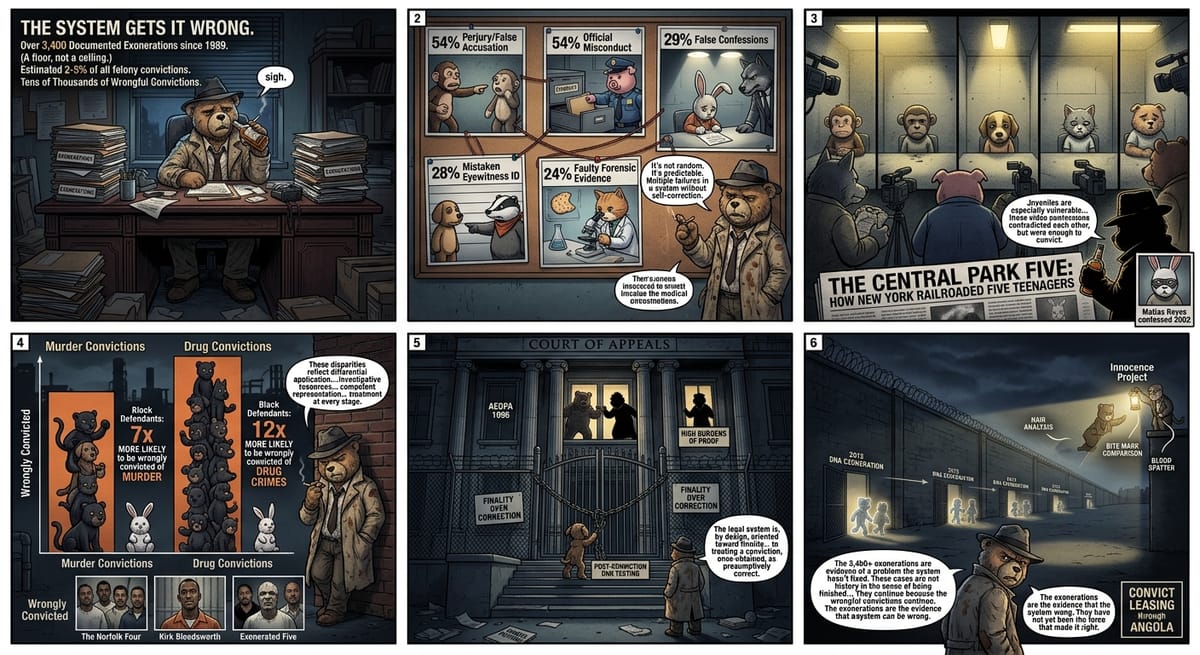
The National Registry of Exonerations, maintained by the University of Michigan Law School, has documented more than 3,400 wrongful convictions in the United States since 1989. That number is a floor, not a ceiling. It reflects only cases that were reviewed and formally reversed — which requires resources, surviving evidence, and usually an outside organization willing to invest years in the effort. The total number of wrongful convictions in the current incarcerated population of roughly 2 million people is unknown. Researchers estimate it at 2 to 5 percent of felony convictions, which would put the number in the tens of thousands.
What the documented exonerations reveal is not a system making random errors. They reveal a system making predictable errors, in predictable directions, affecting predictable populations, through mechanisms that are well understood and largely unaddressed.
In This Series
- The Central Park Five: How New York Railroaded Five Teenagers
- The Innocence Project: Fighting to Free the Wrongly Convicted
- Famous Exonerations: The Innocent People America Locked Up
The Causes of Wrongful Conviction Are Well-Documented and Largely Unaddressed
The Registry’s data is clear on the contributing factors. Perjury or false accusation appears in 54 percent of exonerations. Official misconduct appears in 54 percent. Mistaken eyewitness identification in 28 percent. False confessions in 29 percent. Faulty forensic evidence in 24 percent. These categories overlap — a single wrongful conviction typically involves multiple failures, each of which might have been caught at another point in a system with more self-correcting capacity.^1^
False confessions are the factor that surprises people most. The assumption that an innocent person would not confess to a crime they didn’t commit is wrong and has been known to be wrong since at least the 1970s, when researchers began systematically studying interrogation and confession. Juveniles are especially vulnerable — which is why all five members of the Central Park Five, ranging in age from 14 to 16 at the time of their 1989 interrogation, produced video confessions to a crime the DNA evidence excluded them from committing. Those confessions, which contradicted each other and contradicted established facts about the crime, were enough to convict all five. Matias Reyes confessed to the actual crime in 2002.
Eyewitness identification was considered essentially reliable in American courts until researchers demonstrated conclusively that it isn’t. Gary Wells of Iowa State University has been publishing on eyewitness memory since 1978; his work, and the work of dozens of subsequent researchers, established that witnesses consistently overestimate their certainty, that police lineup procedures systematically inflate false identifications, and that confidence expressed at trial correlates poorly with accuracy. More than 350 people have been exonerated by DNA evidence after being convicted partly on eyewitness testimony.
Black Defendants Are Wrongly Convicted at Dramatically Higher Rates
The distribution of wrongful convictions is not random. Black people are seven times more likely to be wrongly convicted of murder than white people, and twelve times more likely to be wrongly convicted of drug crimes, according to the Registry’s analysis. These disparities reflect differential application of investigative resources, differential access to competent legal representation, and differential treatment at every stage of the process. The Central Park Five were Black and Latino teenagers in 1989. The Norfolk Four — four Navy sailors wrongly convicted of a rape and murder in Norfolk, Virginia in 1997, despite DNA evidence that excluded all four — were of lower economic status and, in their initial interactions with investigators, had no access to attorneys. Kirk Bloodsworth, exonerated from Maryland’s death row in 1993, was a working-class white man in a community that had decided he was guilty before his trial began.
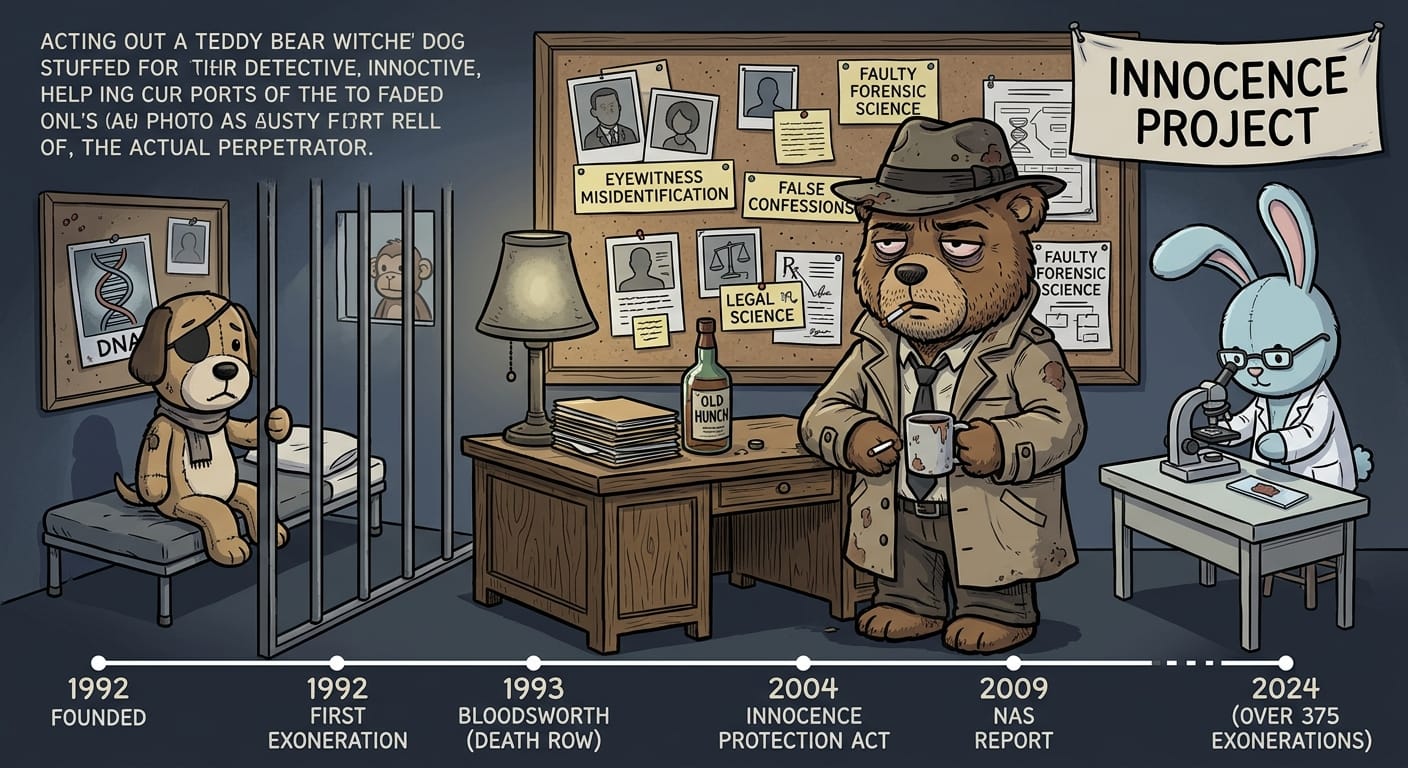
The Innocence Project, founded in 1992 by Barry Scheck and Peter Neufeld at Cardozo School of Law, had contributed to 375 DNA exonerations as of 2024, including 21 people who had been on death row. The organization’s work has revealed patterns in forensic science that had been used to convict people for decades without adequate scientific validation — hair analysis, bite mark comparison, blood spatter interpretation — and has helped force reforms to some of the worst practices. The reforms have been uneven and slow.^2^
The System Is Built to Resist Correction After a Conviction
The most consistent feature of wrongful conviction cases is the institutional resistance to correcting them. Prosecutors’ offices that obtained the original convictions routinely oppose post-conviction DNA testing. Courts impose high burdens on people seeking to prove actual innocence after conviction. The Antiterrorism and Effective Death Penalty Act of 1996 imposed strict time limits on federal habeas petitions, making it harder to bring new evidence before a federal court after state remedies are exhausted. The legal system is, by design, oriented toward finality — toward treating a conviction, once obtained, as presumptively correct.
This orientation is not simply an error in institutional design. It is a feature that serves specific interests: prosecutors who would face accountability for misconduct if their convictions were readily overturned have professional and political interests in maintaining high barriers to exoneration. Courts have dockets to manage. Legislatures have not found wrongful convictions to be a compelling political priority. The people who are wrongly convicted are, almost without exception, people without political power.
The 3,400 Exonerations Are Evidence of a Problem the System Hasn’t Fixed
The 3,400-plus people formally exonerated since 1989 have, in most cases, received minimal compensation and no systematic attempt at restoration. Several states have no compensation statutes for wrongful conviction; others have caps that amount to a fraction of what was taken from the wrongly convicted person. The five men now known as the Exonerated Five — Yusef Salaam, Kevin Richardson, Antron McCray, Raymond Santana, and Korey Wise — received $41 million from New York City in 2014, settled after the Bloomberg administration had spent years fighting the claim. The people who produced their wrongful convictions faced no professional consequences.
The wrongful convictions documented here are not history in the sense of being finished. The Central Park Five case exposed mechanisms that are still in use. The Innocence Project continues because the wrongful convictions continue. The forensic practices that produced some of these cases have been partially reformed but not eliminated. The conditions that produce wrongful conviction — racial disparity, inadequate legal representation, institutional resistance to error correction, and financial incentives aligned with conviction rather than accuracy — are ongoing. The exonerations are the evidence that the system can be wrong. They have not yet been the force that made it right.
The racial patterns in wrongful conviction connect directly to the architecture of American incarceration — from convict leasing through Angola to the present. These aren’t separate histories; they’re the same system at different points in time.
← Back to Prison and Punishment in American History
─────────
Sources:
- National Registry of Exonerations. Exonerations in the United States, 1989–2023. University of Michigan Law School, 2023.
- Scheck, Barry, Peter Neufeld, and Jim Dwyer. Actual Innocence: Five Days to Execution and Other Dispatches from the Wrongly Convicted. Doubleday, 2000.
The Series