The Electric Chair: America's Experiment in Humane Killing
A Buffalo dentist had the idea, a state commission blessed it, and Thomas Edison's lab helped make sure his rival's current got the blame. The first man strapped into the chair took eight minutes to die.
Part of A History of Punishment: ← Back to series hub
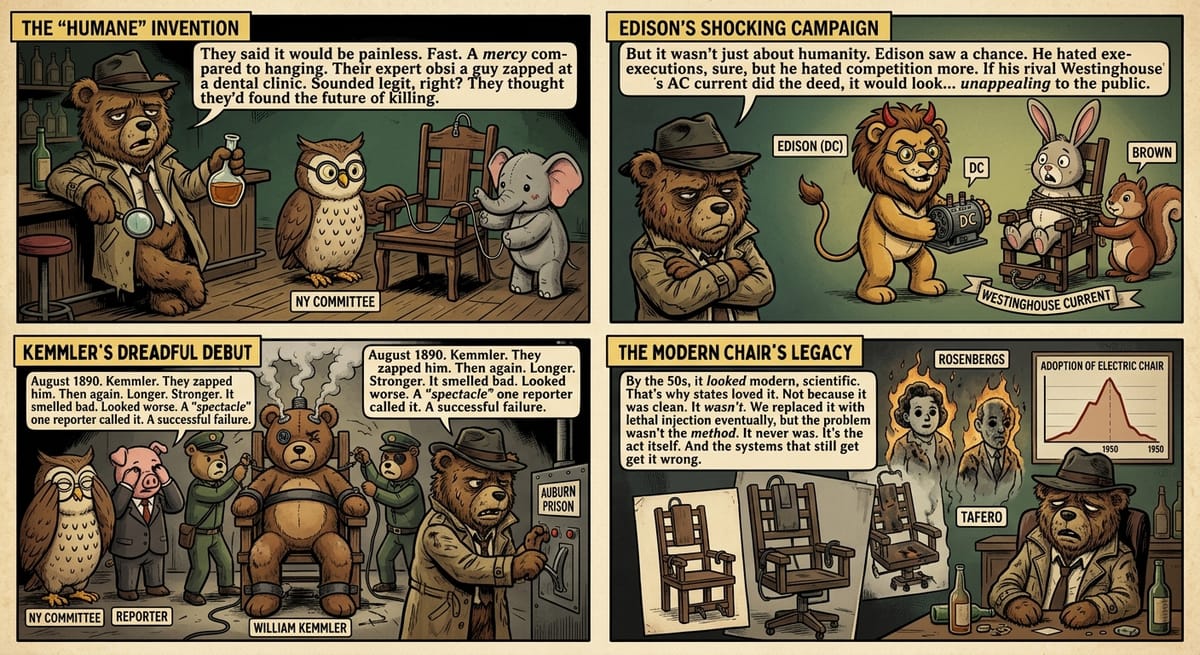
No single person invented the electric chair. It came out of New York in the 1880s: Buffalo dentist Alfred Southwick pushed electrocution as a kinder replacement for hanging, a state commission he sat on recommended it in 1888, and electrician Harold Brown, working with help from Thomas Edison's laboratory, made sure the chair ran on George Westinghouse's alternating current.1 2 The first electrocution, of William Kemmler at Auburn Prison on August 6, 1890, was botched badly enough that it took two jolts and about eight minutes.1 Today nine states still authorize the chair, mostly as a backup, and South Carolina is the only one where it is the default method.3
The chair was invented to be humane, and that is the whole problem
Every American execution method has been sold as an improvement on the last. The electric chair was the first sold as science. In the 1880s, after a run of botched hangings, the new high-voltage arc lights going up in American cities were killing linemen and passersby in a way that looked instant and left almost no mark.1
So who actually invented it? A dentist, a commission and an electrician
The story starts in Buffalo on August 7, 1881, when a drunk dock worker named George Lemuel Smith grabbed the terminals of a dynamo at an arc-lighting plant and died on the spot.1 Alfred Southwick, a dentist with an engineering background, heard about the case at a local scientific society and decided electricity could be used on purpose.1 4 With physician George Fell, he electrocuted hundreds of stray dogs to work out a repeatable method, then published his idea of replacing hanging with electricity in 1882 and 1883.1 He borrowed the restraint from his own trade: a modified dental chair.1
In 1886, New York governor David B. Hill appointed a three-man commission to find a more humane way to execute people. Its chair was the reformer Elbridge Gerry; its members were lawyer Matthew Hale and Southwick himself.1 The commission recommended electrocution in 1888, and Governor Hill signed the law on June 4, 1888, effective January 1, 1889.1
The law did not say what kind of current to use. That gap is where the trouble started.
Edison's war on alternating current ran straight through the death chamber
In the late 1880s, Edison's companies sold direct current (DC) systems, and Westinghouse was winning customers with alternating current (AC). The fight between them is now called the war of the currents.2
Edison's own position on the chair was awkward. When Southwick wrote to him in late 1887, Edison said he was against capital punishment and wanted nothing to do with it. Pressed, he wrote back in December 1887 that the surest current would come from "'alternating machines,' manufactured principally in this country by Geo. Westinghouse."2 Historians generally read that as a business move: a killing current would look too dangerous to wire into homes.
Harold Brown made that argument his crusade. In July 1888 he electrocuted dogs with AC at Columbia College to show it was deadlier than DC, with technical help from Edison's West Orange, New Jersey, laboratory.1 5 On December 5, 1888, at West Orange, with Edison and Gerry looking on, Brown killed four calves and a lame horse with 750 volts of AC.1 In August 1889, the New York Sun published letters taken from Brown's office that appeared to show him taking direction and money from the Edison company and from Thomson-Houston, another Westinghouse rival.5
When the testers could not buy a Westinghouse generator, Brown quietly acquired three used Westinghouse AC machines with help from Edison's people and Thomson-Houston.1 5 That guaranteed the first electric chair would run on Westinghouse equipment. (The earlier version said Menlo Park; the lab was at West Orange.)
What happened to William Kemmler on August 6, 1890?
Kemmler, a Buffalo produce peddler, killed his common-law wife, Tillie Ziegler, with a hatchet on March 29, 1889, and was sentenced to die under the new law.6 Westinghouse, by most accounts, paid for his appeal by hiring the prominent lawyer W. Bourke Cockran.6 The argument was that electrocution was cruel and unusual punishment. New York's courts disagreed.1
In May 1890 the U.S. Supreme Court refused to step in. In In re Kemmler, 136 U.S. 436, the Court said punishments are cruel "when they involve torture or a lingering death," but that the death penalty itself was not, and it accepted the New York courts' finding that electrocution was humane.7
Then they tried it. At Auburn Prison, state electrician Edwin Davis ran 1,000 volts of AC through Kemmler for 17 seconds. He was knocked unconscious but still breathing. Dr. Edward Spitzka reportedly shouted, "Have the current turned on again, quick, no delay," but the generator had to build back up. The second charge, at 2,000 volts, ruptured blood vessels under his skin and singed the skin around the electrodes, and some witnesses said his body caught fire. The whole execution took about eight minutes.1
Westinghouse's reported verdict: "They would have done better using an axe." The New York Times headline the next day read "Far Worse Than Hanging."1 (The earlier version credited that line to a reporter named Charles Durston, which we could not confirm.)
Why the chair spread anyway
New York officials called the execution a success, and the chair caught on. Ohio adopted it in 1897, Massachusetts in 1900, New Jersey in 1906 and Virginia in 1908.1 (The earlier version said this took three years.) Eventually 26 states, the District of Columbia, the federal government and the military had electrocution on the books or used it, and it stayed the country's most prominent method until the early 1990s.1
Our take: it spread because a switch and a wooden chair looked like progress next to a rope. Whether the condemned lose consciousness at once is still argued.1
Bruno Richard Hauptmann, convicted of the Lindbergh baby kidnapping and murder, was electrocuted at Trenton State Prison on April 3, 1936, still claiming innocence; his guilt has since been questioned and the police work in the case widely criticized.8 Julius and Ethel Rosenberg were executed at Sing Sing on June 19, 1953. Julius died after the first shock. Ethel survived the standard three; doctors found her heart still beating, two more shocks were given, and witnesses said smoke rose from her head.9 (The earlier version said three in total; see the Rosenbergs page.)
Botched executions pushed states toward the needle
The chair's slow fall started before its worst failures. On May 10, 1977, Oklahoma became the first state to adopt lethal injection, and on December 7, 1982, Texas used it for the first time, on Charles Brooks Jr.10
Then came the 1990s. In Florida on May 4, 1990, six-inch flames shot from Jesse Tafero's head, and it took three jolts to stop his breathing; officials blamed a synthetic sponge used in place of a natural one.11 In Virginia on August 22, 1991, a prison doctor twice announced that Derick Lynn Peterson "has not expired" before a second cycle of current was applied.11 Florida had a repeat in 1997, when foot-high flames rose from Pedro Medina's headpiece.11 Courts in Georgia (2001) and Nebraska (2008) later ruled that the chair violated their state constitutions.3
Since 1976, the United States has carried out 1,493 executions by lethal injection and 163 by electrocution.3
Where is the electric chair still legal?
As of October 10, 2026, according to the Death Penalty Information Center:3
| State | Status |
|---|---|
| South Carolina | Default method (inmates may choose lethal injection if available) |
| Florida, Kentucky | Authorized alongside lethal injection |
| Alabama, Arkansas, Louisiana, Mississippi, Oklahoma, Tennessee | Authorized as an alternative if other methods are found unconstitutional or are unavailable |
A few recent developments: Louisiana brought electrocution back into law in March 2024, and South Carolina's Supreme Court upheld the chair and the firing squad in July 2024.1 In 2025, North Carolina removed its bans on electrocution and lethal gas.3 In April 2026, the U.S. Justice Department proposed adding electrocution, along with firing squad and lethal gas, as federal execution methods.3
The last time it was actually used was February 20, 2020, when Tennessee electrocuted Nicholas Sutton, the fifth Tennessee prisoner in 16 months to choose the chair over lethal injection. The AP reported that Virginia had been the only other state to use it in recent years, and not since 2013.12 13 (The earlier version stopped at 2018.)
The chair was meant to end the spectacle of public executions and produced a century of its own. The Innocence Project page covers the problem no method solves: executing the wrong person.
Frequently Asked Questions
Who invented the electric chair? No one person. Buffalo dentist Alfred Southwick came up with the idea after an 1881 accident and promoted it; New York's Gerry Commission recommended it in 1888; and electrician Harold Brown, with help from Edison's lab, supplied the AC equipment.1
When was the first electric chair execution? August 6, 1890, at Auburn Prison in New York. William Kemmler, convicted of killing Tillie Ziegler, survived the first 17-second jolt and died after a second, stronger one. The whole thing took about eight minutes.1 6
Did Thomas Edison invent the electric chair? No. Edison said he opposed capital punishment, but he recommended Westinghouse's alternating current to New York's commission and his lab helped Harold Brown run animal tests. Historians generally see this as part of his commercial fight with Westinghouse.2 5
Is the electric chair still used? Rarely. Nine states still authorize it as of October 2026, and it is the default only in South Carolina.3 The most recent electrocution was Nicholas Sutton's in Tennessee on February 20, 2020.12
Why was the electric chair invented? To replace hanging, which reformers saw as cruel and unreliable. Supporters believed a strong electric current would kill instantly and painlessly, and the Supreme Court accepted that view in 1890.1 7
What happened to Topsy the elephant? Topsy was killed at Luna Park on Coney Island on January 4, 1903, more than a decade after Brown's experiments, with cyanide, 6,600 volts and a winch-tightened noose. An Edison Studios crew filmed it, which is why legend pins it on Edison, but he was not there and had no role.14 (The earlier version of this page wrongly listed Topsy among Brown's 1880s test animals.)
Part of A History of Punishment: ← Back to series hub
Related reading: Lethal injection · Public executions · Sing Sing · The Rosenbergs · The Innocence Project
─────────
Sources:
- "Electric chair." Wikipedia. en.wikipedia.org
- "War of the currents." Wikipedia. en.wikipedia.org
- Death Penalty Information Center. "Methods of Execution." Accessed October 10, 2026. deathpenaltyinfo.org
- "Alfred P. Southwick." Wikipedia. en.wikipedia.org
- "Harold P. Brown." Wikipedia. en.wikipedia.org
- "William Kemmler." Wikipedia. en.wikipedia.org
- In re Kemmler, 136 U.S. 436 (1890). Legal Information Institute, Cornell Law School. law.cornell.edu
- "Bruno Richard Hauptmann." Wikipedia. en.wikipedia.org
- "Julius and Ethel Rosenberg." Wikipedia. en.wikipedia.org
- "Lethal injection." Wikipedia. en.wikipedia.org
- Death Penalty Information Center. "Botched Executions." deathpenaltyinfo.org
- Loller, Travis. "Tennessee man gets electric chair for killing fellow inmate." Associated Press, February 20, 2020. apnews.com
- O'Brien, Brendan. "Tennessee executes convicted killer by electric chair." Reuters, February 21, 2020. reuters.com
- "Topsy (elephant)." Wikipedia. en.wikipedia.org
Further reading (books cited on the earlier version of this page):
- Brandon, Craig. The Electric Chair: An Unnatural American History. McFarland, 1999.
- Moran, Richard. Executioner's Current: Thomas Edison, George Westinghouse, and the Invention of the Electric Chair. Knopf, 2002.
- Radosh, Ronald, and Joyce Milton. The Rosenberg File: A Search for the Truth. Holt, Rinehart and Winston, 1983.