Wild West and Outlaws in American History
Jesse James had a publicist. Billy the Kid was 21. The outlaw mythology was built to serve cultural needs and required leaving out the Chinese miners the range war dead and the lynching statistics.
Wild West and Outlaws in American History
The outlaw legends of the American West are the most commercially durable mythology in American history — and they required the most aggressive management of what gets included and what gets left out. Jesse James was shot in the back of the head by a member of his own gang in 1882. Billy the Kid was shot in a dark room at 21. Butch Cassidy and the Sundance Kid died in a Bolivian mining village. Bonnie Parker was eating a sandwich when 130 bullets went through her car. John Dillinger was shot leaving a movie theater in Chicago. None of these endings are particularly heroic, and none of them stopped the legends from growing.
The Wild West and outlaw tradition is the most commercially durable mythology in American history — the source material for more books, films, television shows, and merchandise than any other domestic narrative. It’s also the mythology that has required the most aggressive management of what gets included and what gets left out.
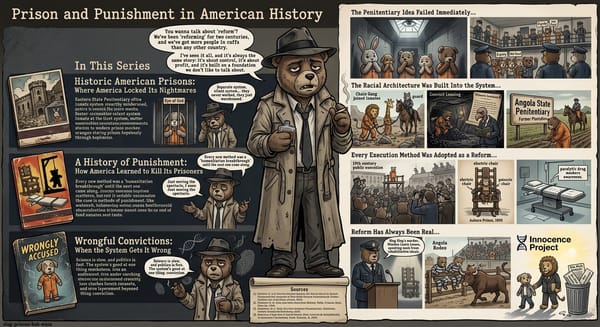
In This Series
- Frontier Violence: The Real Wild West — Range wars, mining camp massacres, Chinese immigrant killings, and vigilante justice
- Lawmen With Dark Sides — Wyatt Earp, Wild Bill Hickok, Pat Garrett, and the badge that didn’t guarantee justice
- Outlaw Legends — Jesse James, Billy the Kid, Butch Cassidy, and the mythology machine
- Depression-Era Outlaws — Dillinger, Bonnie and Clyde, Pretty Boy Floyd, and the FBI’s rise
How the Legend Machine Was Built
The outlaw legends were not naturally occurring phenomena. They were constructed, maintained, and commercially exploited by a sequence of actors who each had specific reasons to want the legends to exist in specific forms.
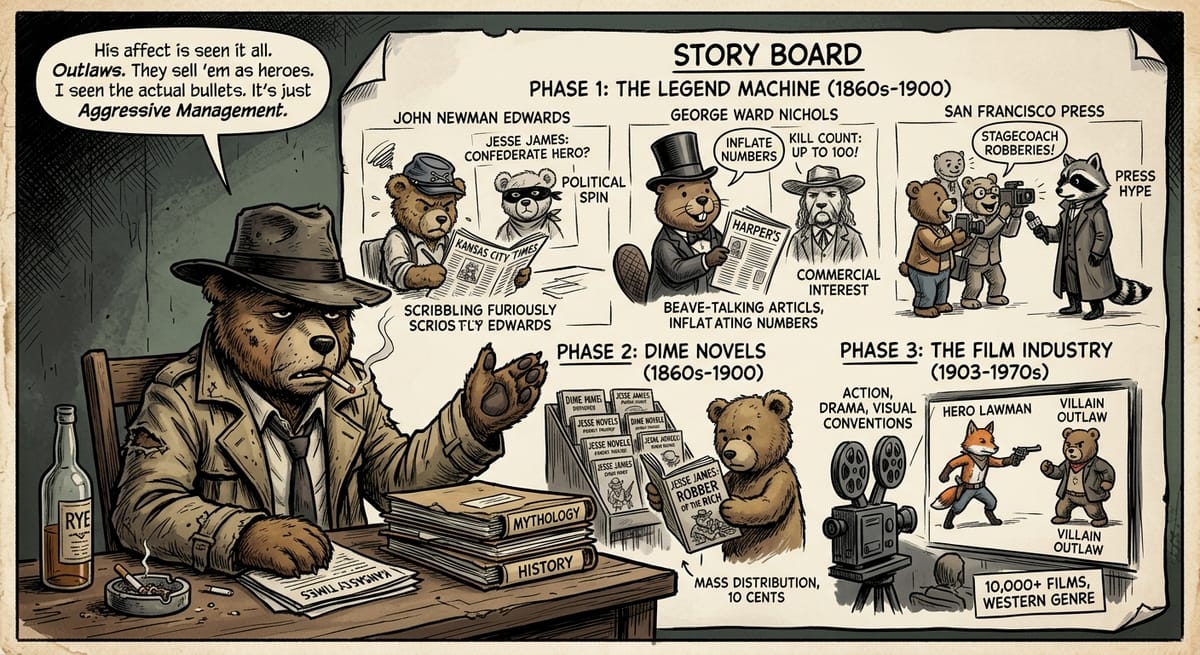
The first layer was the journalism of the 1860s and 1870s: John Newman Edwards’s Kansas City Times editorials presenting Jesse James as a Confederate hero; George Ward Nichols’s 1867 Harper’s piece inflating Wild Bill Hickok’s kill count by an order of magnitude; the San Francisco press covering Black Bart’s stagecoach robberies with the enthusiasm of a sports beat. These weren’t objective accounts — they were products shaped by editors’ political sympathies, commercial interests in selling newspapers, and the outlaws’ own media management, which was more sophisticated than it’s usually given credit for.
The second layer was the dime novel industry, which between 1860 and 1900 produced thousands of stories about frontier heroes — Buffalo Bill, Deadwood Dick, Jesse James — in a format designed for mass distribution at ten cents per copy. The outlaws in dime novels were simplified to the point of irrelevance as historical figures, but they established the character types that subsequent media would use. Jesse James in a dime novel robbed from the rich and gave to the poor. Jesse James in the historical record robbed trains and shot cashiers by mistake.
The third layer was the film industry beginning in 1903, which found the outlaw and lawman conflict perfectly suited to the visual requirements of cinema — clearly identified heroes and villains, action sequences, dramatic confrontations — and produced it relentlessly for 70 years. The Western was Hollywood’s most consistent genre from the silent era through the 1960s, generating more than 10,000 films and establishing visual and narrative conventions that became so familiar they required deconstruction in the revisionist Westerns of the 1970s.^1^
What America Needed the Outlaws to Mean
The persistence of the outlaw mythology is not simply a function of good marketing. It’s a function of a set of tensions in American identity that the outlaw story was well-positioned to address.
The first tension is between individual freedom and institutional authority. Americans have a cultural commitment to the idea that the individual can and should resist unjust authority — it’s built into the founding mythology of the Revolution. The outlaw enacts this commitment at the most literal level: he takes what the system won’t give him, operates outside the rules that the powerful enforce selectively, and refuses to submit. That this often means robbing and killing people who are not the powerful is a detail the mythology manages by carefully selecting which victims to mention.
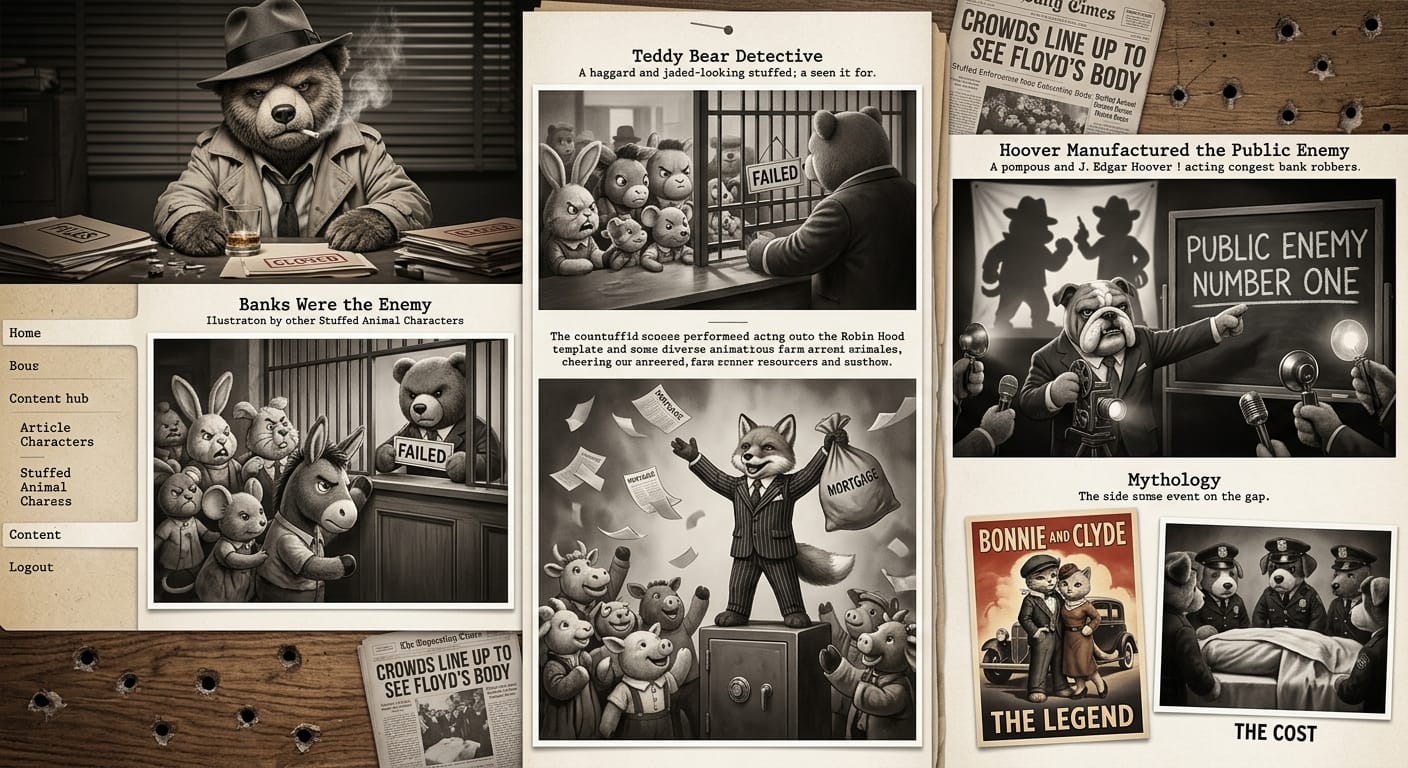
The second tension is between the mythology of meritocracy — you can make it if you work hard enough — and the reality of economic systems that produce outcomes independent of individual merit. The Depression-era outlaws made this tension explicit. John Dillinger robbed the banks that had taken people’s money. Bonnie and Clyde were products of West Dallas poverty. Pretty Boy Floyd came from eastern Oklahoma during the Dust Bowl. The folk hero framing attached their crimes to a structural critique of capitalism that the mainstream press couldn’t make directly in 1933, but could make by celebrating the criminals who were acting on it.
The third tension is specifically American and specifically racial: the ideology of the frontier as a place of freedom and self-determination coexisting with the reality of a frontier built on the removal of Native populations, the labor of enslaved people, and the systematic exclusion of non-white immigrants from the economic opportunities the mythology promised.^2^
The Violence the Mythology Excludes
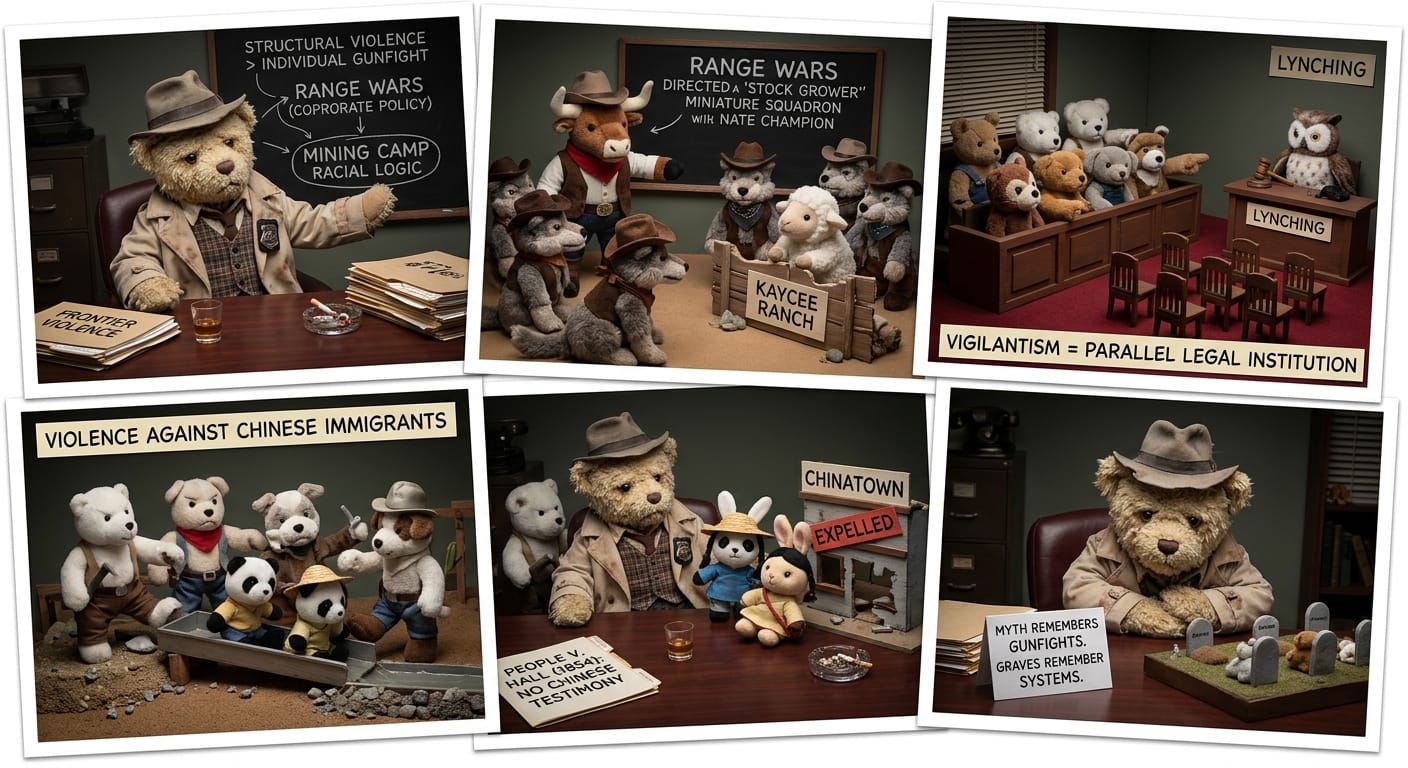
The outlaw mythology is a story told almost exclusively through white male protagonists, and the omissions this requires are structural, not incidental. The myth needs the West to have been a place where individual merit and courage determined outcomes. This requires excluding the Chinese miners killed at Rock Springs in 1885, whose deaths were produced by organized group violence with no legal consequence. It requires excluding the range war victims — Nate Champion, Nick Ray — who were killed by hired armies acting on behalf of corporate ranching interests. It requires excluding the vigilante killings of Black Americans across the South and West that overlapped temporally with the outlaw era and constituted a larger body count.
The mythology also excludes the Native American populations whose removal created the frontier in the first place. The Indian Wars that ran from the 1850s through the 1890s — the same period as the outlaw era — were conducted across the same geography, involved many of the same military personnel, and resulted in the deaths of thousands of Native people and the forced relocation of hundreds of thousands more. The outlaw mythology treats the land as empty except for the white settlers and their conflicts. It was not empty.
These exclusions are not accidents. They are the myth asserting its own definition of who matters.
The Lawmen and the Badge
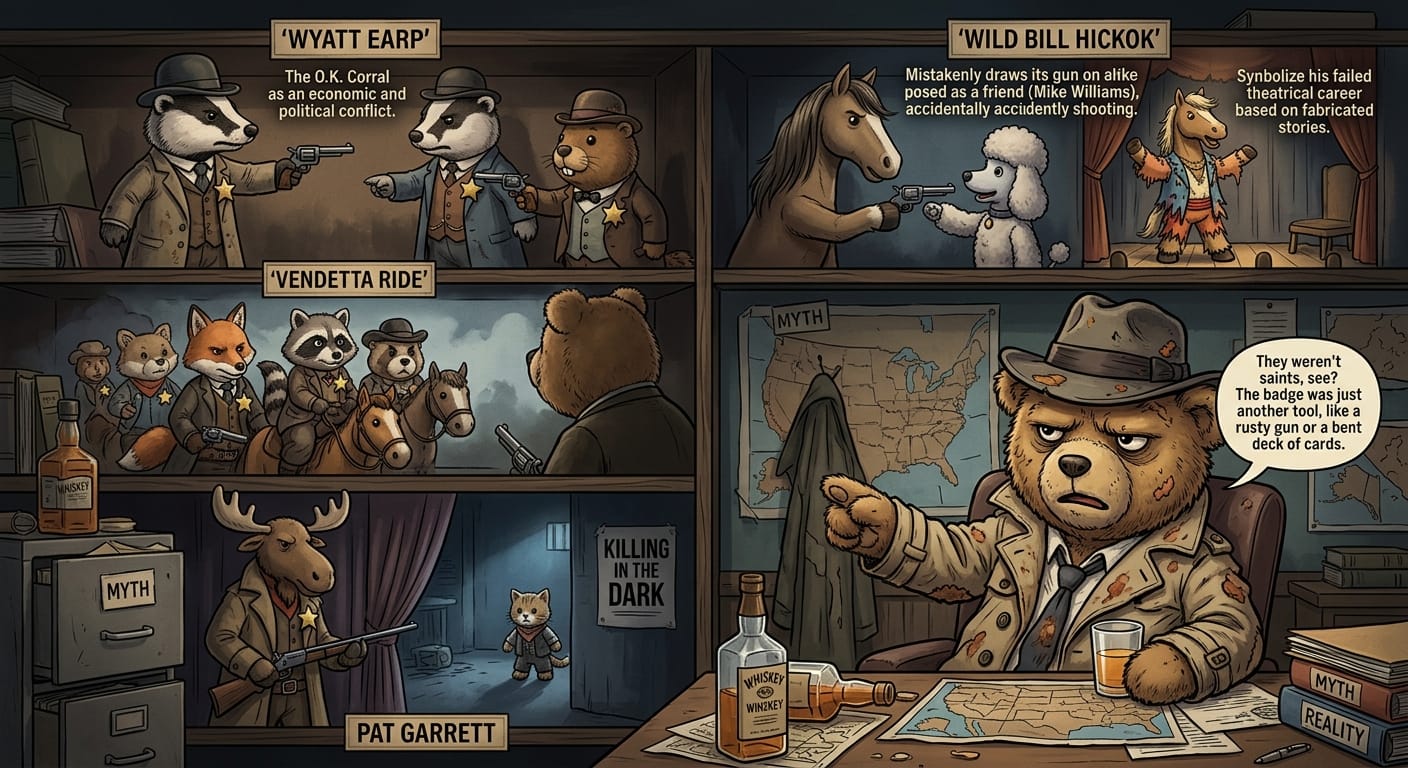
The lawman mythology is as constructed as the outlaw mythology, and it rests on the same suppression of complexity. Wyatt Earp’s Tombstone career combined law enforcement, gambling, and political faction-fighting in ways that don’t reduce to the uncomplicated hero of the 1881 gunfight. Pat Garrett killed Billy the Kid in the dark and was himself killed under disputed circumstances 27 years later. Wild Bill Hickok shot an innocent friend accidentally and spent his last years failing as a theatrical performer.
The badge, in frontier America, was a political tool as often as a legal one. Sheriffs were elected by the property holders who funded their campaigns and served those interests accordingly. The famous confrontations between lawmen and outlaws — the O.K. Corral, Coffeyville, the ambush at Gibsland — were frequently the culminating events of factional conflicts in which the legal and the extralegal had been intertwined for years.^3^
The Depression Era and the Modern Myth
The Depression-era outlaws — Dillinger, Floyd, Bonnie and Clyde, Baby Face Nelson, Ma Barker — are the bridge between the frontier mythology and the modern one, and they show how the myth adapts to new conditions. The frontier had closed by 1890. The automobile and the highway had replaced the horse and the mountain pass. The FBI had replaced the lone marshal. But the underlying tension — individual against institution, defiant criminal against corrupt system — remained available, and the Depression provided conditions that made it emotionally urgent again.
J. Edgar Hoover’s genius was recognizing that the outlaw mythology could be turned around: if the outlaws were folk heroes, the men who caught them were bigger folk heroes. The FBI’s crime wave coverage of 1933–1934 was theater, carefully managed, producing a narrative in which the Bureau was the protagonist and the outlaws were the obstacles it heroically overcame. The press releases, the crime lab publicity, the personal involvement of Hoover in high-profile arrests — all of it was the law enforcement version of the Edwards editorials for Jesse James. The FBI needed the outlaws to exist as Public Enemies because Public Enemies justified the FBI.^4^
What the Legend Reveals
The Wild West and outlaw mythology, taken in its full scope — from Jesse James to Bonnie and Clyde, from the OK Corral to the Rock Springs Massacre — reveals an America that has never been comfortable with its own legal institutions. The outlaw is necessary because he embodies the suspicion that the system is rigged, and the lawman is necessary because he embodies the hope that the system can be saved.
Both characters are fictions, in the sense that the real people behind them were more complicated, more compromised, and more human than the myths require. Jesse James was a Confederate guerrilla who killed indiscriminately and hired a publicist. Billy the Kid was a teenage orphan who attached himself to the wrong side of a land dispute and couldn’t find a way out. Wyatt Earp was a gambler who used a badge when it suited him and abandoned it when it didn’t. These are not myths. They are people.
The mythology suppresses the people in favor of the types because the types are more useful. They carry the cultural argument more efficiently. They can be deployed across a century and a half without the inconvenience of historical specificity dragging them back toward the reality of what actually happened — who was shot, in what circumstances, and who was standing behind the shooter.
The history is still there, in the court records and the newspapers and the diaries of men like Nate Champion, who wrote down what was happening to him while it happened. The history waits for anyone who wants it, and it’s more interesting than the myth. It always is.^5^
─────────
Sources:
- Slotkin, Richard. Gunfighter Nation: The Myth of the Frontier in Twentieth-Century America. Atheneum, 1992.
- Limerick, Patricia Nelson. The Legacy of Conquest: The Unbroken Past of the American West. Norton, 1987.
- White, Richard. “It’s Your Misfortune and None of My Own”: A New History of the American West. University of Oklahoma Press, 1991.
- Burrough, Bryan. Public Enemies: America’s Greatest Crime Wave and the Birth of the FBI, 1933–34. Penguin Press, 2004.
- Smith, Helena Huntington. The War on Powder River. McGraw-Hill, 1966.
In This Section