Pat Garrett: The Man Who Killed Billy the Kid
Pat Garrett shot Billy the Kid in a dark room without seeing his face then spent 27 years being remembered only for that moment before dying on a New Mexico road under disputed circumstances.
Pat Garrett: The Man Who Killed Billy the Kid
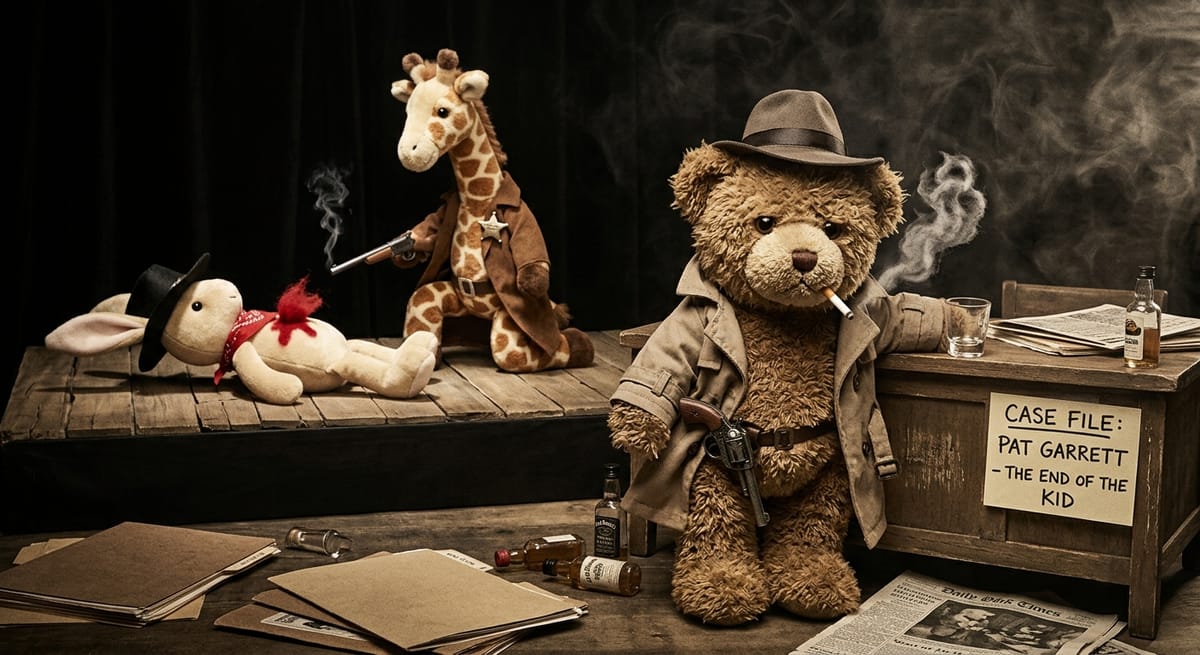
Pat Garrett killed Billy the Kid in a dark room, in the middle of the night, firing at a voice before he could see a face — and that killing defined his entire life, made him famous, and ultimately didn’t protect him from a similarly murky end. On July 14, 1881, Garrett walked into Pete Maxwell’s darkened bedroom in Fort Sumner, New Mexico Territory and shot Billy the Kid twice — once fatally — before he could identify who had entered the room. The Kid had come to Maxwell’s house in the middle of the night, barefoot and carrying a knife, apparently to get some beef from the butchering Maxwell’s men had done earlier. Garrett had been waiting in the darkness. He fired at a voice and a shape, not a face. Billy the Kid was dead before he hit the floor, and Pat Garrett had the most famous kill in the history of the American West.
It made him famous and, over time, ruined him.
A Lawman Elected to Serve Specific Economic Interests
Patrick Floyd Jarvis Garrett was born June 5, 1850, in Chambers County, Alabama, the son of a prosperous planter. The family moved to Louisiana after the Civil War, and Garrett headed west in 1869 after his father died, working as a buffalo hunter on the Texas panhandle in the early 1870s. He was 6 feet 4 inches — exceptionally tall for the period — lean, quiet, and competent at physical work in harsh conditions.
He arrived in Lincoln County, New Mexico Territory in 1878, one year after the Lincoln County War’s peak violence, and worked as a cowboy on Pete Maxwell’s ranch. He and Billy the Kid — William H. Bonney — were acquaintances and may have been friendly during this period. Both were young men working in the cattle economy of southeastern New Mexico, moving in overlapping social circles. The Fort Sumner area had a small, interconnected community, and the two men would have encountered each other regularly.^1^
Garrett was elected sheriff of Lincoln County in November 1880 on a platform of cleaning up the Kid’s cattle-rustling operations in the Pecos Valley. He won by a slim margin, supported by the cattle ranching establishment including John Chisum, whose herds the Kid’s associates had been raiding. The election was less about abstract law and order than about whose economic interests would be protected — the same pattern that drove the range wars throughout the West.
The Chase and the Capture That Didn’t Hold
Garrett moved quickly after taking office in January 1881. On December 19, 1880, before he was even formally sworn in, he intercepted the Kid’s gang at Stinking Springs, a rock house east of Fort Sumner. In the confrontation, Charlie Bowdre was shot and killed when he emerged from the building. The gang, without food or water, surrendered after a standoff. The Kid was taken to Mesilla, tried, convicted of the murder of Sheriff William Brady, and sentenced to hang.^2^
On April 28, 1881, the Kid escaped from the Lincoln County courthouse, killing deputies James Bell and Robert Olinger in the process. He used Bell’s own gun on Bell and a shotgun on Olinger, who was reportedly bringing prisoners their lunch when he heard the shot and came running. The Kid called down to Olinger’s body from the second-floor window. Multiple witnesses were present. The escape made the subsequent killing at Fort Sumner politically necessary for Garrett — he had caught the Kid, the court had sentenced him, and he had let him get away from a second-floor window. If the Kid wasn’t recaptured, Garrett’s career as a lawman was finished. He tracked leads for two months and got word that the Kid was still in the Fort Sumner area, returning repeatedly to visit friends and a girlfriend.^3^
The Night of July 13–14, 1881
Garrett arrived in Fort Sumner on July 13, 1881, with two deputies: John Poe and Tip McKinney. He sent Poe to make discreet inquiries while he waited. Poe returned with the information that the Kid had been seen in the area. That night, Garrett went to Pete Maxwell’s house to ask directly whether the Kid was around. He found Maxwell in his darkened bedroom, sat down beside him on the bed, and began asking questions.
The Kid came in through the door from outside. He had seen Poe and McKinney near the house and, not recognizing them, was asking Maxwell who they were when he sensed someone else in the room. He asked “¿Quién es? ¿Quién es?” — Who is it? — and Garrett fired twice before the Kid could identify him or Garrett could identify the Kid. One bullet hit the Kid in the chest, piercing his heart. He died on Maxwell’s floor.^4^
Garrett wrote his account of the killing in a book published the same year: The Authentic Life of Billy the Kid, co-written with journalist Marshall Ashman Upson. The book was designed to serve Garrett’s political interests — it established the killing as legitimate law enforcement rather than an ambush in the dark — but it also shaped the public record in ways that have influenced every subsequent account.
What Fame Didn’t Buy Him
Garrett’s subsequent career was, by most accounts, a long anti-climax. He was elected sheriff of Lincoln County twice more, served capably, and left office in 1884. He ranched in the Texas panhandle, returned to New Mexico, was appointed collector of customs in El Paso in 1901 by President Theodore Roosevelt, but his reappointment was blocked in 1905 reportedly over his association with a professional gambler named Tom Powers.
He returned to his ranch near Las Cruces in 1906, in debt, with failing cattle operations and a dispute with a neighboring rancher named Jesse Wayne Brazel over lease terms for his land. On February 29, 1908, Garrett and Brazel were returning from Las Cruces in a buckboard when Garrett was shot once in the back of the head and once in the stomach.^5^
Brazel said he had shot Garrett in self-defense during a confrontation. He was acquitted at trial in 1909, despite testimony that was inconsistent about whether Garrett had been shot in the back or the front. The possibility that a third party — another rancher named Carl Adamson, who was present at the scene and whose testimony changed between the initial inquiry and the trial — was the actual shooter has been raised by multiple historians. The case has never been conclusively resolved.
Pat Garrett was 57 when he died on the side of a New Mexico road, shot under circumstances as murky as the darkness at Pete Maxwell’s. He is buried in Las Cruces. The irony that the man who killed the most famous outlaw in the West was himself killed in suspicious circumstances and is largely remembered only in relation to the man he killed — this is the specific shape of his legacy, and it’s not a kind one.
─────────
Sources:
- Metz, Leon Claire. Pat Garrett: The Story of a Western Lawman. University of Oklahoma Press, 1974.
- Utley, Robert M. Billy the Kid: A Short and Violent Life. University of Nebraska Press, 1989.
- Garrett, Pat F. The Authentic Life of Billy the Kid. New Mexico Printing & Publishing, 1882.
- Nolan, Frederick. The West of Billy the Kid. University of Oklahoma Press, 1998.
- Jacobsen, Joel. Such Men as Billy the Kid: The Lincoln County War Reconsidered. University of Nebraska Press, 1994.
Part of Lawmen With Dark Sides — ← Back to series hub