Range Wars: Lincoln County Johnson County and the Fight for the West
In the Johnson County War of 1892 Wyoming cattle barons hired 52 gunmen to kill small ranchers. Nate Champion wrote his own death in a diary. Not one invader went to trial.
Range Wars: Lincoln County, Johnson County, and the Fight for the West
Range wars were land disputes settled by hired armies — and the side with more money never faced trial. The Johnson County War of April 1892 reached its climax when a force of 52 men — 25 hired Texas gunmen, the rest large ranching interests and their allies — was surrounded near the KC Ranch in Johnson County, Wyoming by approximately 200 armed local residents and law enforcement officers. The invaders were pinned down for two days before the 6th U.S. Cavalry arrived from Fort McKinney on April 13 and took them into protective custody. The Wyoming governor had telegraphed President Benjamin Harrison for military intervention. The cavalry’s arrival saved the invaders’ lives.
Two men were dead: Nate Champion and Nick Ray, small ranchers the invaders had killed in the opening move of the campaign. The 52 men were never tried. The witnesses who might have testified against them were intimidated out of Johnson County or otherwise unavailable. The large ranching interests lost the war militarily and won it legally.
This is how range wars worked.
How Property Became a License to Kill
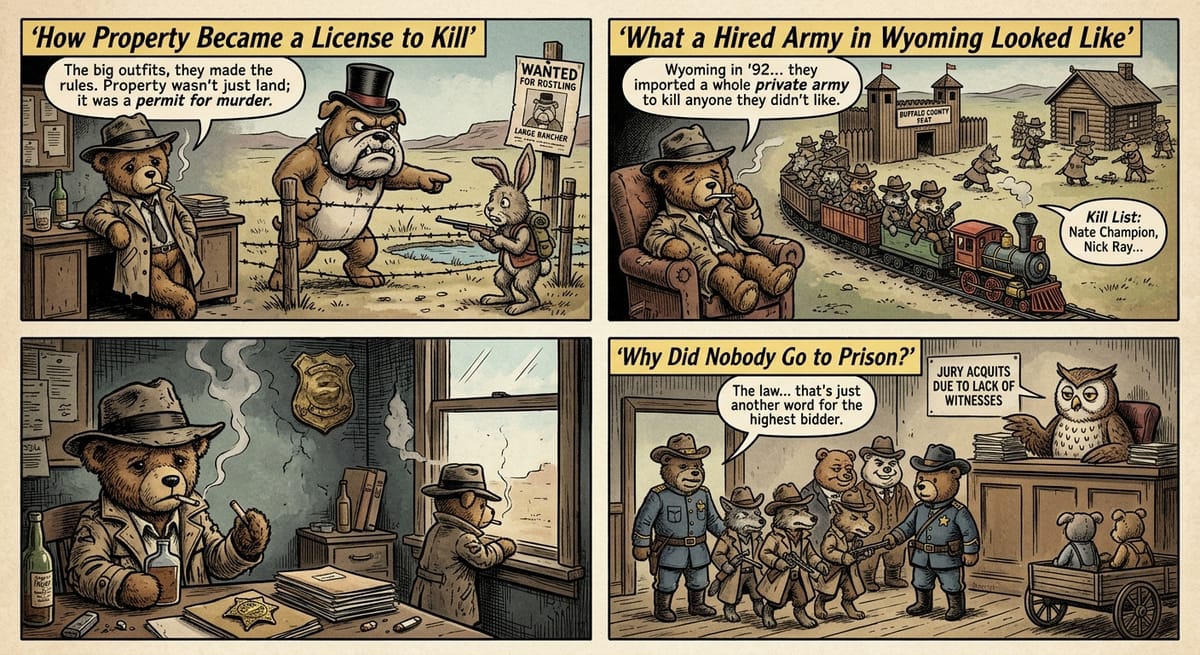
Range wars were not primarily about violence. They were about property — specifically about who controlled access to public grazing land, water rights, and cattle markets in the expanding West. The federal government had opened vast territories to homesteading and small ranching through the Homestead Act of 1862, but much of the best land — particularly the water access — was already occupied or controlled by large cattle operations that had arrived earlier.
The conflict played out in two overlapping ways. First, large ranchers claimed de facto ownership over public land through prior use, fencing, and intimidation of newcomers. Second, they accused small ranchers and homesteaders of cattle theft — sometimes accurately, sometimes not — and used that accusation as legal and extralegal cover for eliminating competition. The accusation of rustling served as both a genuine legal complaint and a political weapon that required no due process to deploy effectively.
The Lincoln County War of 1878 — which produced Billy the Kid, Sheriff Brady’s assassination, and the Regulators — followed this pattern exactly. The House, controlled by Murphy, Dolan, and Riley, held monopolistic control of Lincoln County’s beef contracts and commercial life through political connections with the Santa Fe Ring. When John Tunstall and Alexander McSween arrived in 1877 with a competing bank and mercantile operation, the House moved to destroy them through a combination of legal harassment and ultimately murder.^1^
What a Hired Army in Wyoming Looked Like
Johnson County, Wyoming in 1892 was settled enough to have elected officials, newspapers, and a functioning court system — all of which the large cattle associations found inconvenient because they tended to favor the small ranchers who were the majority of the population. The Wyoming Stock Growers’ Association, dominated by large outfits including the Powder River Cattle Company and operations backed by British investment, decided to resolve the conflict by importing a private army.
The plan, organized by Association member and future U.S. Senator Frank Canton among others, was to invade Johnson County with the Texas gunmen, kill a list of men designated as rustlers (the list included approximately 70 names), take control of Buffalo, the county seat, and install compliant officials. They arrived by special train from Cheyenne on April 6, 1892.
Nate Champion had been targeted for his suspected role in organizing small ranchers. On April 9, the invaders surrounded the KC Ranch cabin where Champion and Nick Ray were staying. Ray was shot when he stepped outside and died in the yard, dragged inside by Champion. Champion held off the invaders alone for hours, shooting from windows while writing notes about what was happening in a pocket diary. His diary entries, recovered after his death and published in Wyoming newspapers, are among the most remarkable documents of the period:^2^
“They are still shooting and are all around the house. Boys, there is bullets coming in like hail. Them fellows is in such shape I can’t get at them. They are shooting from the barn as well as the house… Nick is dead. He died about 9 o’clock.”
The invaders finally set a hay wagon on fire and rolled it against the cabin. Champion ran out and was shot repeatedly. He was found with 28 bullet wounds. A card was placed on his body reading “Cattle thieves, beware.”
Why Did Nobody Go to Prison?
The legal aftermath of the Johnson County War demonstrates with unusual clarity how property and political power shaped frontier justice. The 52 prisoners taken by the cavalry were transported to Cheyenne, where they were held under relatively comfortable conditions while the Association’s lawyers worked the case. The trial was moved out of Johnson County — correctly, since any jury there would have convicted — and then the case was dismissed in January 1893 when Arapahoe County, which now had venue, refused to pay the cost of keeping the prisoners.
Two witnesses whose testimony would have been essential — Jack Flagg and Arapahoe Brown, who had observed the invasion — were driven from the state. The Johnson County sheriff, William “Red” Angus, who had organized the resistance, was not reelected. The Association members returned to their ranches. No one was convicted of Nate Champion’s murder, or Nick Ray’s.^3^
Other Range Wars, Same Result
The pattern repeated across the West with local variations. The Pleasant Valley War in Arizona Territory, from 1882 to 1892, left approximately 50 people dead in a conflict between the Graham and Tewksbury families and their respective allies among cattlemen and sheepherders. The grazing conflict between cattle and sheep operators produced violence across Texas, New Mexico, Wyoming, and Oregon in the same period — sheepherders and their flocks were slaughtered by masked riders who left no witnesses.
The Fence Cutting Wars of 1883–1884 in Texas erupted when large ranchers fenced public land that small operators and homesteaders had used for access. An estimated 500 miles of fence were cut in a single year. The Texas Rangers were sent to stop the fence cutting — protecting the large ranchers’ property — and the legislature eventually passed laws prohibiting both illegal fencing of public land and the destruction of fences, a compromise that satisfied neither side fully.^4^
The People the Myth Didn’t Need
The range wars produced heroes on the large-rancher side who have largely been forgotten because the outcome they represented proved politically untenable, and victims on the small-rancher side who were forgotten for different reasons. Nate Champion’s diary survives in part because newspapers published it and because the story was spectacular enough to require documentation.
Less documented: the Chinese sheepherders killed in Oregon and Wyoming during anti-Chinese range violence in the 1880s, whose deaths combined racial violence with economic conflict and received minimal legal investigation. The unnamed homesteaders forced off their claims by intimidation and fence and water monopolization who appear only in land records, if at all. The families of “rustlers” who may have been falsely accused and were killed extrajudicially without any proceeding that could have tested the accusation.^5^
The range wars ended not because the violence became unacceptable but because the federal government gradually asserted control over public land management through the Forest Service, the Bureau of Land Management, and related agencies — administrative solutions that the large ranching interests eventually accepted because the alternative was continued instability. The Johnson County War’s political lesson was that private armies couldn’t hold counties indefinitely against organized resistance from a numerically superior local population with its own legal institutions, however compromised. The larger lesson, drawn from the legal aftermath, was that those legal institutions could be neutralized if you had enough money and connections. That lesson is older than the range wars and has outlasted them.
─────────
Sources:
- Larson, T.A. History of Wyoming. University of Nebraska Press, 1978.
- Smith, Helena Huntington. The War on Powder River. McGraw-Hill, 1966.
- Metz, Leon Claire. John Selman, Texas Gunfighter. Hastings House, 1966.
- Haley, J. Evetts. The XIT Ranch of Texas and the Early Days of the Llano Estacado. University of Oklahoma Press, 1953.
- Nolan, Frederick. The Lincoln County War: A Documentary History. University of Oklahoma Press, 1992.
Part of Frontier Violence — ← Back to series hub