Jesse James: America's Original Outlaw Celebrity
Jesse James robbed his first bank at 18 and spent a decade becoming famous — not for what he did but for the story Americans needed him to mean.
Jesse James: America’s Original Outlaw Celebrity
Part of Outlaw Legends — ← Back to series hub
Jesse James robbed his first bank at 18, killed a bystander on the way out, and spent the next decade becoming the most famous criminal in American history — not because of what he did, but because of the story Americans decided to tell about him. That story was largely fabricated. The fabrication tells us more about post-Civil War America than anything Jesse James actually did.
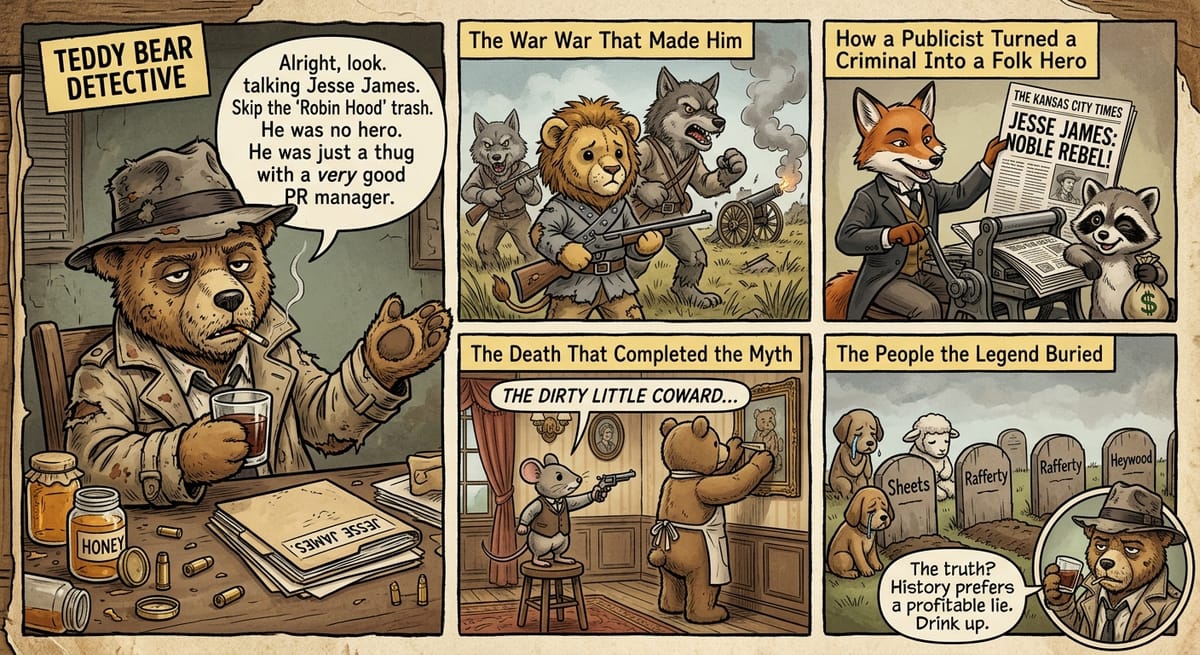
The War That Made Him
Jesse Woodson James was born September 5, 1847, in Clay County, Missouri. His father, Robert James, was a Baptist minister who died in California in 1850 when Jesse was three. His mother, Zerelda, was formidable enough to remarry twice and outlive Jesse by 29 years.
Clay County was border-state Missouri — deeply Southern in sympathy, officially Union during the Civil War, and full of men who felt betrayed by the outcome. Jesse’s older brother Frank joined William Quantrill’s Raiders in 1862. Jesse, at 14, was too young. He joined Bloody Bill Anderson’s Confederate guerrilla band in 1864 at 16, riding with men who were less soldiers than terrorists. On September 27, 1864, Anderson’s band massacred 24 unarmed Union soldiers at Centralia, Missouri. Jesse James was present.^1^
When the war ended in 1865, Confederate guerrillas were supposed to surrender and return to civilian life. Many Missouri guerrillas refused to take the loyalty oath. The James brothers were among them — outlaws before they robbed their first bank, already operating outside the legal order the Union had imposed on the defeated South.
The gang’s early robberies — Russellville, Kentucky in March 1868, the Gallatin, Missouri bank in December 1869 — were violent and chaotic. In Gallatin, Jesse shot and killed cashier John W. Sheets, apparently believing him to be a Union militia officer who had killed Bloody Bill Anderson. He was wrong about the identification. Sheets was just a cashier.^2^
How a Publicist Turned a Criminal Into a Folk Hero
What transformed Jesse James from violent criminal to romantic hero was journalism — specifically the Kansas City Times editor John Newman Edwards. Edwards, an unreconstructed Confederate, published sympathetic editorials presenting the gang as noble rebel resisters fighting Yankee oppression. He printed letters from Jesse James — literate, self-justifying, politically savvy — that Jesse himself may have written or helped compose. By the mid-1870s, the James-Younger Gang had a publicist.
The actual record was uglier. The gang robbed the Rock Island train near Adair, Iowa on July 21, 1873, derailing the locomotive and killing engineer John Rafferty. A robbery at Gads Hill, Missouri in January 1874 netted $2,000 and terrorized passengers for hours. The Northfield, Minnesota bank robbery on September 7, 1876 — the gang’s most ambitious job — ended in catastrophe. Citizens fought back. Two gang members were killed in the street. Cole, Jim, and Bob Younger were captured two weeks later in a swamp near Madelia, Minnesota, all three wounded. Only Frank and Jesse escaped.^3^
The Northfield disaster effectively ended the first James gang. Jesse spent three years in Tennessee under the alias Thomas Howard before reconstituting a new gang in 1879. This group was weaker, more desperate, less competent. They robbed a train near Glendale, Missouri in October 1879 and killed a passenger. The Missouri governor put a $10,000 bounty on Jesse’s head.
The Death That Completed the Myth
By 1882, Jesse James was living in St. Joseph, Missouri as Thomas Howard, a respectable-seeming man with a wife and two children. He was planning a bank robbery in Platte City. On April 3, 1882, a 20-year-old gang member named Robert Ford shot Jesse James in the back of the head while Jesse was straightening a picture on the wall.^4^
Ford had made a secret deal with Missouri Governor Thomas T. Crittenden: kill Jesse James in exchange for a pardon and the reward money. He got both. He also got a lifelong reputation as a coward and a traitor. The popular ballad circulated within weeks: “That dirty little coward that shot Mr. Howard / Has laid poor Jesse in his grave.” Ford spent the rest of his life cashing in on the notoriety — running a saloon in Creede, Colorado, where he was himself shot dead in 1892.
The shooting in the back confirmed what the Edwards editorials had been saying for years: Jesse James was persecuted, hunted down by corrupt authority, betrayed by one of his own. It didn’t matter that Jesse James had killed multiple people and terrorized civilians for 16 years. The story wrote itself.
Did Jesse James Really Rob From the Rich?
The Robin Hood narrative — Jesse robbing from the rich to give to the poor — has no documentary support. No historian has found evidence of James distributing money to struggling farmers. What the historical record shows is a man who robbed banks and trains for personal profit and political grievance, who killed when it served him, and who manipulated public opinion skillfully enough that people are still debating his legacy 140 years later.
What the legend accurately captures is the mood of post-Reconstruction Missouri. The state was flooded with carpetbaggers, railroad corporations buying up farmland, and federal Reconstruction policies that many white Missourians experienced as occupation. Jesse James gave that resentment a face. He was anti-railroad before anti-railroad was a mass political movement. That the face belonged to a violent criminal who shot a cashier in a case of mistaken identity didn’t matter to people who needed a symbol.
Frank James surrendered in October 1882, six months after Jesse’s death. He was tried twice for robbery and murder and acquitted both times — Missouri juries would not convict Frank James. He lived until 1915, giving tours of the family farm in Kearney, Missouri at 25 cents a head.
The James farm still operates as a tourist site. You can stand in the room where Jesse was born and the yard where he’s buried, and the interpretive materials will tell you that the truth was complicated. They’re right that it was complicated. They’re careful about what kind of complicated.
The People the Legend Buried
The most honest accounting of Jesse James requires naming the people who died because of his decisions. George Wymore, 19, was shot at Liberty in 1866 for no reason other than proximity to a bank robbery. John W. Sheets, a cashier in Gallatin, was shot in a case of mistaken identity in 1869. John Rafferty, a railroad engineer, was killed in the 1873 Adair derailment. At Northfield, Clell Miller and Bill Chadwell died in the street. Cashier Joseph Lee Heywood was shot in the head after refusing to open the vault.^5^
These were not casualties of a rebellion against oppression. They were victims of a series of robberies conducted by men who had decided that the war’s end didn’t apply to them.
Jesse James was not an outlaw who became a celebrity. He was an outlaw who hired a publicist, cultivated the press, and understood that in post-Civil War America, a Confederate guerrilla could be repackaged as a folk hero if the story was told right. The story was told right. That’s the actual legacy: not the robberies, but the PR campaign that outlasted them by 150 years. The Dalton Gang pulled the same move a generation later — lawmen who crossed the line and then needed a story to explain it. Billy the Kid had the Lincoln County War. John Wesley Hardin had Reconstruction. Every outlaw legend needs a grievance, and the more legitimate the grievance, the longer the legend lasts.
─────────
Sources:
- Stiles, T.J. Jesse James: Last Rebel of the Civil War. Knopf, 2002.
- Settle, William A. Jesse James Was His Name. University of Missouri Press, 1966.
- Koblas, John J. Faithful Unto Death: The James-Younger Raid on the First National Bank, Northfield, Minnesota, September 7, 1876. North Star Press, 2001.
- Yeatman, Ted P. Frank and Jesse James: The Story Behind the Legend. Cumberland House, 2000.
- Hale, Donald R. We Rode with Quantrill. Independence, 1975.