Frontier Violence: The Real Wild West
The Wild West wasn't gunfighters and saloons — it was range wars fought by hired armies massacres that killed by ethnicity and Chinese immigrant killings that nobody prosecuted.

Frontier Violence: The Real Wild West
The American West of popular mythology is a place of individual violence — the gunfight, the outlaw, the lawman, the quick draw. The actual American West was a place of structural violence: range wars fought with hired armies over land and water rights, mining camp massacres that killed people by ethnicity rather than individual conflict, vigilante committees that hanged men on lists compiled by economic rivals, and systematic campaigns against Chinese immigrants that killed hundreds and displaced thousands with no legal consequence.
The individual gunfight is a story with a hero. The structural violence is a story about systems, which is harder to sell and easier to forget.
In This Series
- Mining Camp Violence: The Lawless Towns That Built America
- Range Wars: Lincoln County, Johnson County, and the Fight for the West
- Vigilante Justice: When Americans Became Judge, Jury, and Executioner
- Violence Against Chinese Immigrants: The Massacres History Forgot
Frontier Violence Followed a Clear Hierarchy — and It Wasn’t Random
Frontier violence operated through a clear, if unacknowledged, hierarchy. At the top: organized violence conducted by or on behalf of property interests — range wars, fence cutting campaigns, vigilance committees — which was rarely prosecuted and often celebrated as civic order. In the middle: individual violence between white men, which was prosecuted selectively based on social standing and political alignment, and which forms the bulk of the outlaw and lawman mythology. At the bottom: violence against Chinese immigrants, against Native Americans, against Mexican border communities — which was almost never prosecuted and was frequently conducted with official support or tolerance.
The hierarchy isn’t incidental to the history. It’s the structure that shaped which violence produced legends and which produced graves with no markers.
Range Wars Were Corporate Policy, Not Frontier Chaos
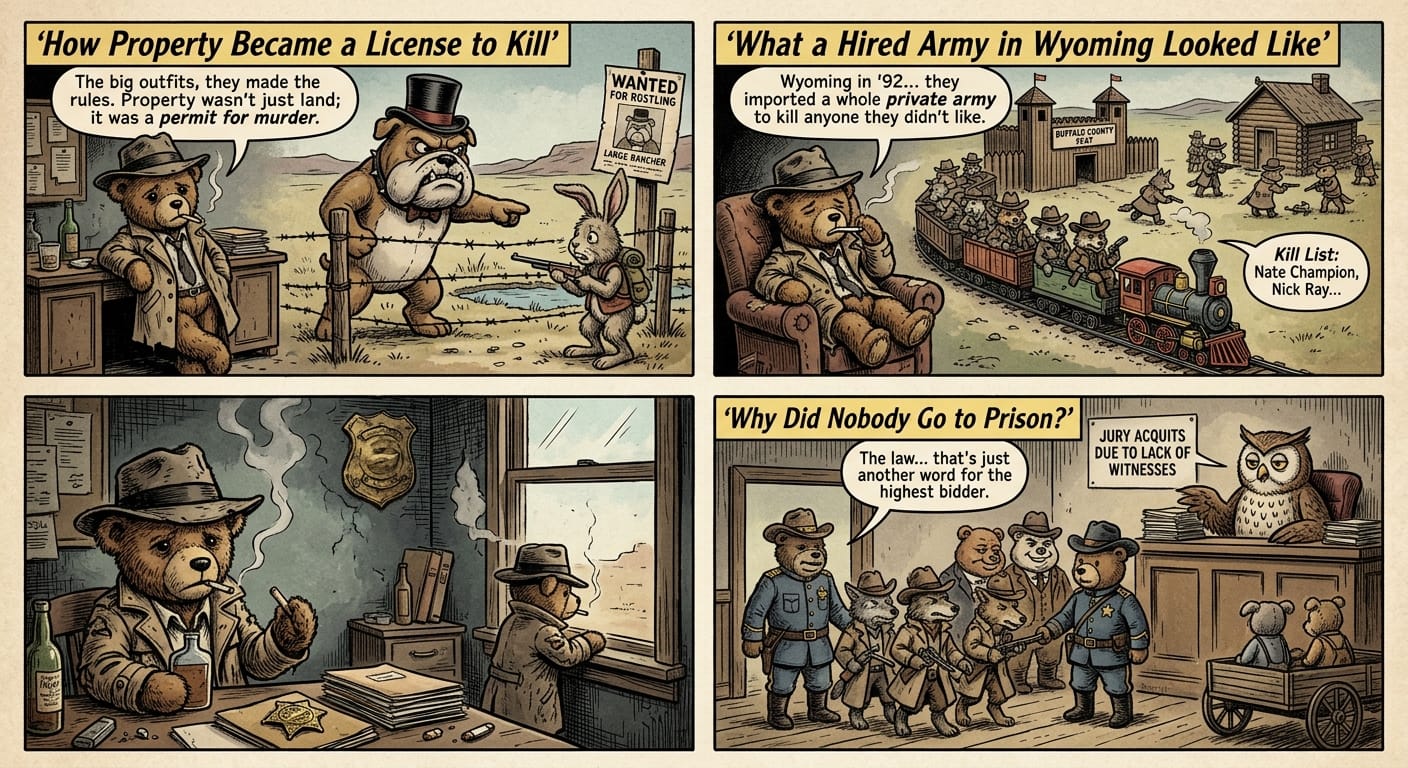
The Johnson County War of 1892 and the Lincoln County War of 1878 are frequently framed as conflicts between order and disorder, civilization and lawlessness. The framing inverts the actual power relations. In both cases, the organized economic power — the Wyoming Stock Growers’ Association, the Murphy-Dolan House — was the aggressor, and the “lawless” opposition was the local population defending its access to land and markets.
The Wyoming invaders arrived in Johnson County with a written list of 70 men designated for death and a special train arranged with the cooperation of the railroad. The Lincoln County killing of Tunstall was conducted by a pseudo-legal posse. These were not failures of order — they were the exercise of power by interests that had purchased enough of the legal system to use it against their opponents, and that fell back on private violence when the legal system wasn’t sufficient. The outcome in both cases: the perpetrators faced no criminal consequences. Nate Champion and Nick Ray were buried in Johnson County. The Association members went home.
Mining Camp Violence Had a Consistent Racial Logic
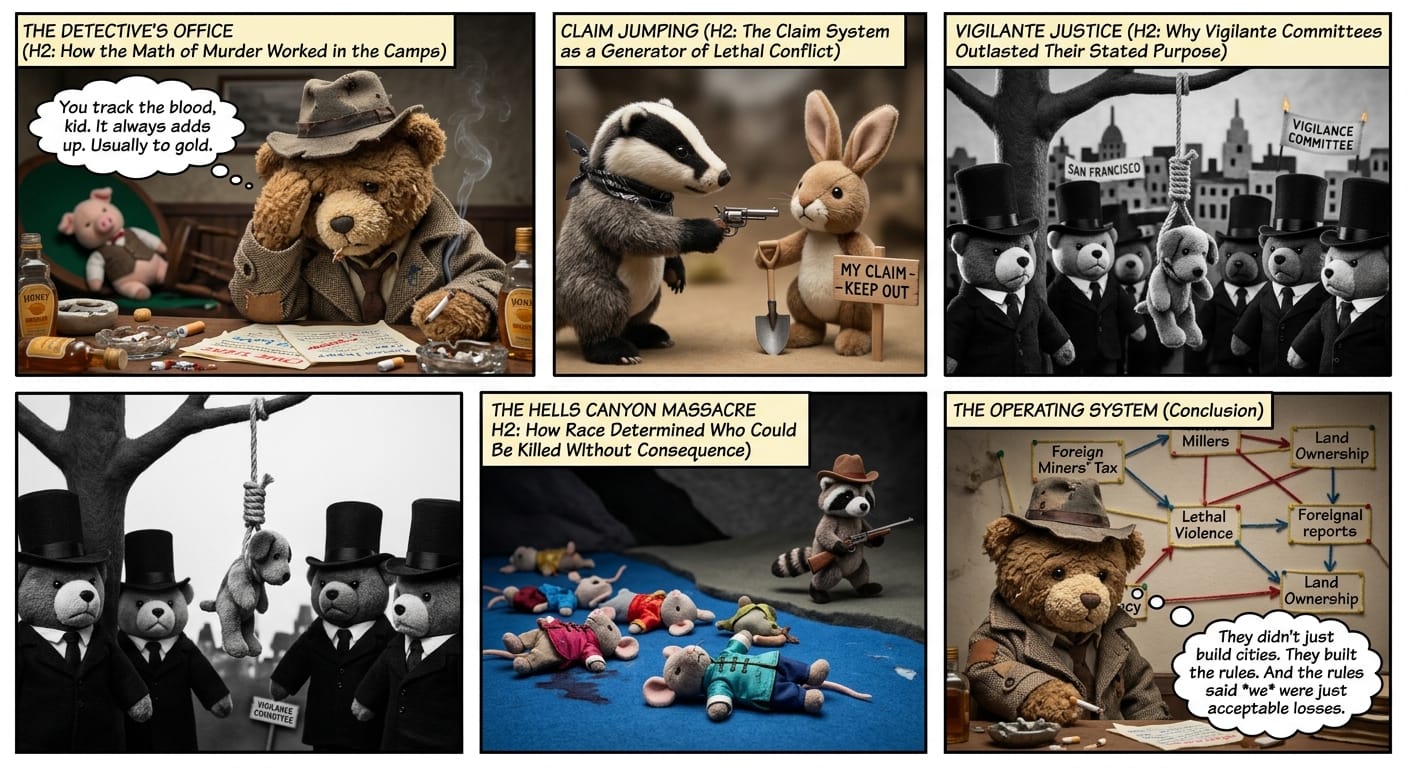
The mining camp violence that built California and the territories was not random disorder. It had a consistent racial logic: white miners got the richest claims, legal protection, and the capacity to testify against anyone who harmed them. Chinese miners paid discriminatory taxes, were excluded from testimony in cases involving white defendants, and were killed with effective legal impunity. The 28 Chinese miners killed at Rock Springs in 1885, the unknown number killed at Snake River in 1887, the 17 to 20 lynched in Los Angeles in 1871 — all of these produced legal outcomes of zero convictions.
This was the law functioning as designed, not failing. The California Supreme Court’s 1854 ruling in People v. Hall — that Chinese testimony was inadmissible against white defendants — was not a legal accident. It was a decision made by judges about whose violence against whom would be prosecutable. The massacres operated in the space that decision created.
Vigilantism Wasn’t a Substitute for Law — It Was Law With Different Rules
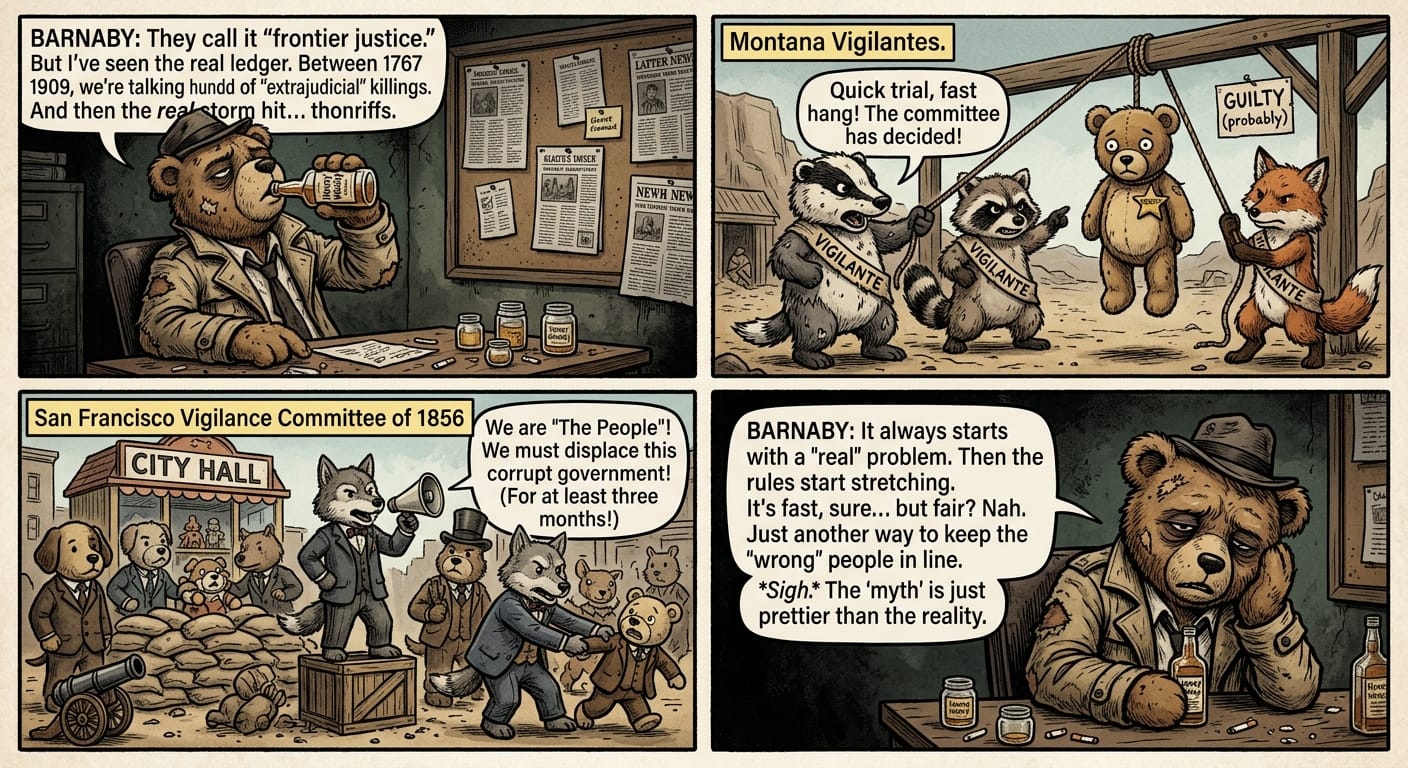
American vigilantism is consistently presented as a response to institutional absence — no courts, no sheriff, something had to be done. The Montana Vigilantes of 1863–1864 hanged 21 men because there were no courts in the mining camps. The San Francisco Vigilance Committee of 1856 acted because the existing government was corrupt. The argument has enough truth in specific cases to be credible, but it collapses when applied to the full vigilante record.
The Tacoma Method — organized expulsion of Chinese residents in 1885 — was conducted by the city’s elected mayor. San Francisco had courts in 1856; the Vigilance Committee used armed force to override them. Southern lynching operated alongside fully functional court systems, and the courts’ failure to prosecute lynchers was not a failure of institutional capacity but a deliberate choice made by officials who shared the lynchers’ racial politics. Vigilantism wasn’t a substitute for legal institutions — it was a parallel legal institution with a different set of eligible defendants.
The Names the Myth Left Out
The myth of the Wild West has specific victims it needs. The bystander killed in the crossfire of a famous gunfight. The bank employee terrorized during a romantic robbery. These appear occasionally in popular accounts because they give moral texture to the outlaw story without challenging its basic structure.
The victims the myth left out: Nate Champion, 28-year-old rancher, shot 28 times in Wyoming in 1892, whose pocket diary recorded his own death in real time. The 28 unnamed Chinese miners of Rock Springs, whose deaths generated a diplomatic cable and a financial settlement and whose names weren’t recorded with any official purpose. The Cherokee and Choctaw citizens dispossessed by the same frontier expansion that produced the outlaw legends. The Californios whose land grants were voided through the American legal system after the Mexican-American War, creating the landless laborers who then competed with incoming settlers.
These are the Wild West. The gunfights were real. The mythology built around them decided what to remember and what to bury.
─────────
Sources:
- Brown, Richard Maxwell. Strain of Violence: Historical Studies of American Violence and Vigilantism. Oxford University Press, 1975.
- Smith, Helena Huntington. The War on Powder River. McGraw-Hill, 1966.
- Pfaelzer, Jean. Driven Out: The Forgotten War Against Chinese Americans. Random House, 2007.
- McGrath, Roger D. Gunfighters, Highwaymen, and Vigilantes: Violence on the Frontier. University of California Press, 1984.
Part of the Outlaws & the Wild West section — ← Back to section hub
The Series