Bonnie and Clyde: America's Most Famous Criminal Couple
Bonnie and Clyde killed 13 people including 9 law enforcement officers. The 1967 film turned them into antiheroes. The officers they killed became footnotes.
Bonnie and Clyde: America’s Most Famous Criminal Couple
Part of Depression-Era Outlaws — ← Back to series hub
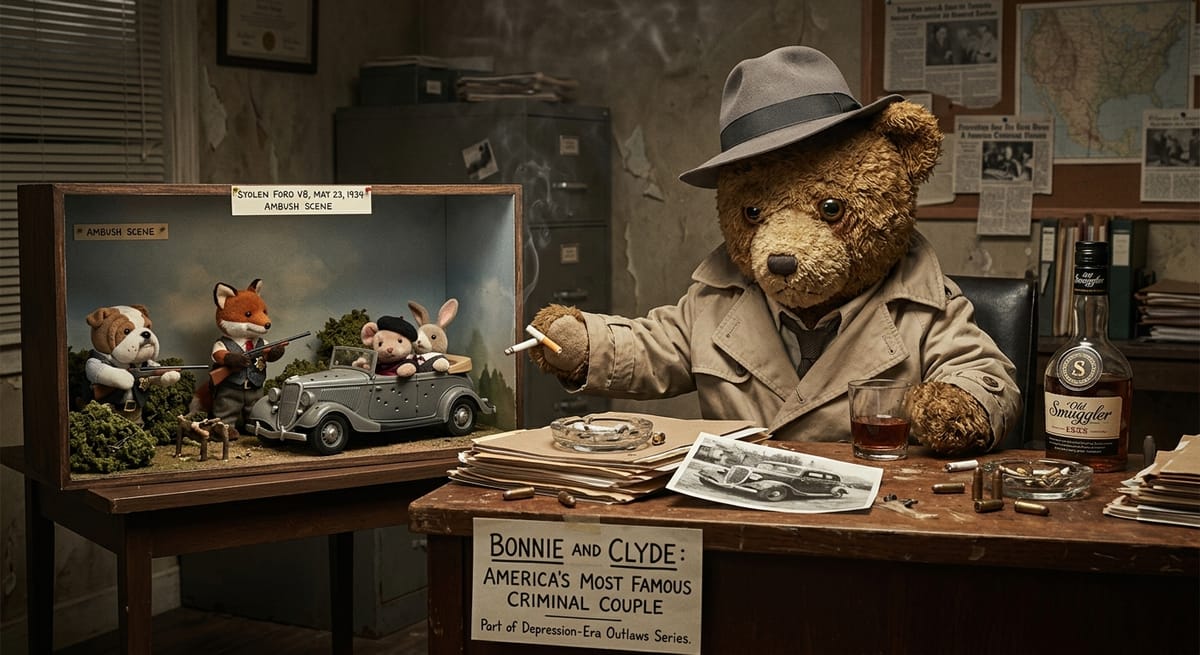
Bonnie Parker and Clyde Barrow killed 13 people — 9 of them law enforcement officers — during their two-year crime spree from 1932 to 1934. They were ambushed on May 23, 1934 near Gibsland, Louisiana by a six-man posse that fired approximately 130 rounds into their stolen Ford V8. The car was hit by 107 bullets. It was less an arrest than an execution, planned in advance, with no warning and no opportunity to surrender.
The couple became romantic icons. The people they killed became footnotes. The gap is worth examining.
Who They Were Before the Photographers Found Them
Bonnie Elizabeth Parker was born October 1, 1910, in Rowena, Texas. Her father died when she was four. She was an honor student at Cement City High School in Dallas, wrote poetry, and won a spelling contest. In 1926, at 15, she married Roy Thornton, a small-time criminal who spent most of their marriage in prison. She never divorced him. When she died at 23, she was technically still Mrs. Roy Thornton.
Clyde Chestnut Barrow was born March 24, 1909, in Ellis County, Texas, the fifth of eight children of a sharecropper who moved the family to West Dallas in a covered wagon in 1922. West Dallas in the early 1920s was a slum — no utilities, unpaved streets, grinding poverty. Clyde began stealing cars in his teens and was arrested for the first time in 1926. By 1929 he had a significant criminal record.^1^
They met in January 1930, when Bonnie was 19 and Clyde was 20. He was arrested six weeks later on outstanding warrants and sent to the Eastham Prison Farm. What happened to Clyde Barrow at Eastham is central to understanding what came next.
Eastham Made Clyde Barrow Into Something Specific
The Texas prison farms in 1930 were among the most brutal incarceration systems in the United States. Convicts worked in the fields under armed guards, were beaten for infractions, and were hired out as agricultural labor. At Eastham, Clyde Barrow was repeatedly sexually assaulted by an older convict named Ed Crowder. He eventually killed Crowder with a lead pipe — according to Barrow family accounts, this was the first person he killed, though the killing was covered up within the prison and Crowder’s death was attributed to other causes.^2^
Barrow arranged for another convict to chop off two of his toes with an axe to escape work detail. Six days later, his mother secured his parole. He was released in February 1932, walking with a limp he would carry the rest of his life. He was 22 years old and had been sexually brutalized for two years in a state institution. None of this excuses what came next. But it explains why Barrow reportedly swore he would never be taken alive and why, when he got out, he functioned as a man who believed the state had already done its worst to him and had nothing left to take.
The Barrow Gang Was Never Sophisticated — Just Dangerous
The gang that coalesced around Barrow and Parker was never large or professionally organized. Core members at various times included Ray Hamilton, W.D. Jones, Buck Barrow (Clyde’s brother), and Buck’s wife Blanche. They robbed gas stations, small-town grocery stores, and rural banks — rarely netting more than a few hundred dollars per job. They were not sophisticated criminals. They were desperate people with guns stealing from other desperate people during the worst economic depression in American history.
The law enforcement killings began almost immediately. On August 5, 1932, Barrow shot and killed two deputy sheriffs — Eugene Moore and Charles Maxwell — at a dance in Atoka, Oklahoma, apparently after being recognized. On January 6, 1933, Barrow killed Deputy Malcolm Davis during an ambush near Tarrant County, Texas. On July 18, 1933, after a shootout in Platte City, Missouri, Buck Barrow was mortally wounded; Blanche was captured; and W.D. Jones was shot through the side. Buck died on July 29, 1933.^3^
The gang killed Dallas Police detective Harry McGinnis and Tarrant County Deputy C.G. Davis. Highway patrolmen. Sheriffs. A constable named Cal Campbell, shot April 6, 1934, near Commerce, Oklahoma, was the last officer killed before the ambush.
Frank Hamer Didn’t Arrest Them — He Executed Them
Frank Hamer was commissioned by the Texas prison system on February 10, 1934, specifically to find and stop Barrow. He spent 102 days tracking the pair before setting the trap near Gibsland. The intelligence came from Henry Methvin, a gang member whose father, Ivan Methvin, cut a deal with Louisiana authorities: tip off the ambush location in exchange for his son’s consideration on criminal charges.
The six lawmen hid in the brush on Louisiana Highway 154 on the morning of May 23, 1934. Bonnie Parker had a sandwich in her lap and was reportedly eating when the posse opened fire without warning.^4^
This detail — the sandwich — appears in multiple accounts and is documented in the medical examiner’s report. She was 23. She had 17 bullet wounds.
The Ford V8 was towed to Arcadia, Louisiana, where a crowd formed immediately. People pulled at the car, tried to take souvenirs. A carnival operator offered Hamer $10,000 to exhibit the car. The bodies were taken to a Conroe, Texas funeral home, where thousands paid to view them. The funeral home charged 25 cents admission.
What the 1967 Film Required Suppressing
The 1967 Arthur Penn film with Warren Beatty and Faye Dunaway transformed Bonnie and Clyde into glamorous antiheroes of the counterculture, which required suppressing most of the actual record. The film’s Bonnie and Clyde rob from the rich, regret harming innocent people, and die beautifully in a spray of slow-motion cinematography. The actual Bonnie and Clyde robbed grocery stores and killed nine law enforcement officers, some of them in ambushes with no warning, and died riddled with bullet wounds eating lunch.
The mythology works because it needs something real to attach to. The Great Depression was real. The brutality of the Texas prison system was real. The Barrow family’s poverty was real. But the people who paid the cost of the mythology’s romance were the families of the nine officers killed, none of whom became characters in the film.^5^
Bonnie Parker is buried in Crown Hill Cemetery in Dallas. Clyde Barrow is buried in Western Heights Cemetery, also in Dallas — not together, as Clyde had requested. The graves are tourist destinations. The Ford V8 is displayed at the Whiskey Pete’s Casino in Primm, Nevada, still dented with bullet holes. Compare this to John Dillinger, whose grave in Indianapolis has been chipped down to the concrete by souvenir hunters — the celebrity afterlife of the Depression outlaw running parallel to the violence that created it, indefinitely.
─────────
Sources:
- Guinn, Jeff. Go Down Together: The True, Untold Story of Bonnie and Clyde. Simon & Schuster, 2009.
- Knight, James R. and Jonathan Davis. Bonnie and Clyde: A Twenty-First Century Update. Eakin Press, 2003.
- Treherne, John. The Strange History of Bonnie and Clyde. Stein and Day, 1984.
- Milner, E.R. The Lives and Times of Bonnie and Clyde. Southern Illinois University Press, 1996.
- Fortune, Jan I., ed. Fugitives: The Story of Clyde Barrow and Bonnie Parker. Ranger Press, 1934.