Vigilante Justice: When Americans Became Judge Jury and Executioner
American vigilante groups conducted at least 326 documented extrajudicial executions before 1910 — and that number doesn't include the 4743 racial lynchings documented by the Tuskegee Institute.
Vigilante Justice: When Americans Became Judge, Jury, and Executioner
American vigilantism was not a substitute for legal institutions — it was a parallel legal institution with a different set of eligible defendants. Between 1767 and 1909, American vigilante groups conducted at least 326 documented extrajudicial executions — hangings, shootings, and burnings — in actions that were organized, planned, and in many cases celebrated in the local press. This is the count assembled by historian Richard Maxwell Brown in his landmark 1975 study; subsequent research has raised the number significantly, and the count does not include the racially targeted lynchings that peaked between 1882 and 1930, which the Tuskegee Institute documented at 4,743 separate incidents.
Vigilantism in the American West is often presented as a practical response to institutional absence — the sheriff was too far away, the courts were corrupt, something had to be done. The historical record supports this framing only partially. American vigilantism also operated where legal institutions existed and functioned, where it served economic and political rather than law enforcement purposes, and where its targets were selected by ethnicity and race as much as by criminal record.
The First Regulators Showed the Pattern Early
The first organized vigilante group in American history was the South Carolina Regulators, active from 1767 to 1769 in the backcountry of colonial South Carolina. The Regulators formed in response to a genuine problem: the colonial government in Charleston had failed to establish courts or law enforcement in the backcountry, leaving settlers with no mechanism for dealing with criminal gangs that had formed after the Cherokee War of 1760–1761. The Regulators caught gang members, flogged them, burned their crops, and drove them out of the region.^1^
Their methods then expanded. Having dealt with the outlaw gangs, the Regulators turned to regulating what they considered immoral or unproductive behavior among the local population: punishing people they deemed lazy, enforcing work discipline on the poor, and targeting anyone who challenged their authority. By 1769 a counter-movement called the Moderators was fighting back against the Regulators. The colonial government finally established backcountry courts to end the conflict. The South Carolina pattern — legitimate law enforcement need, organized response, expansion beyond the original mandate, use against political opponents — repeated throughout American history with striking consistency.
Montana 1863: How a Vigilante Committee Actually Operated
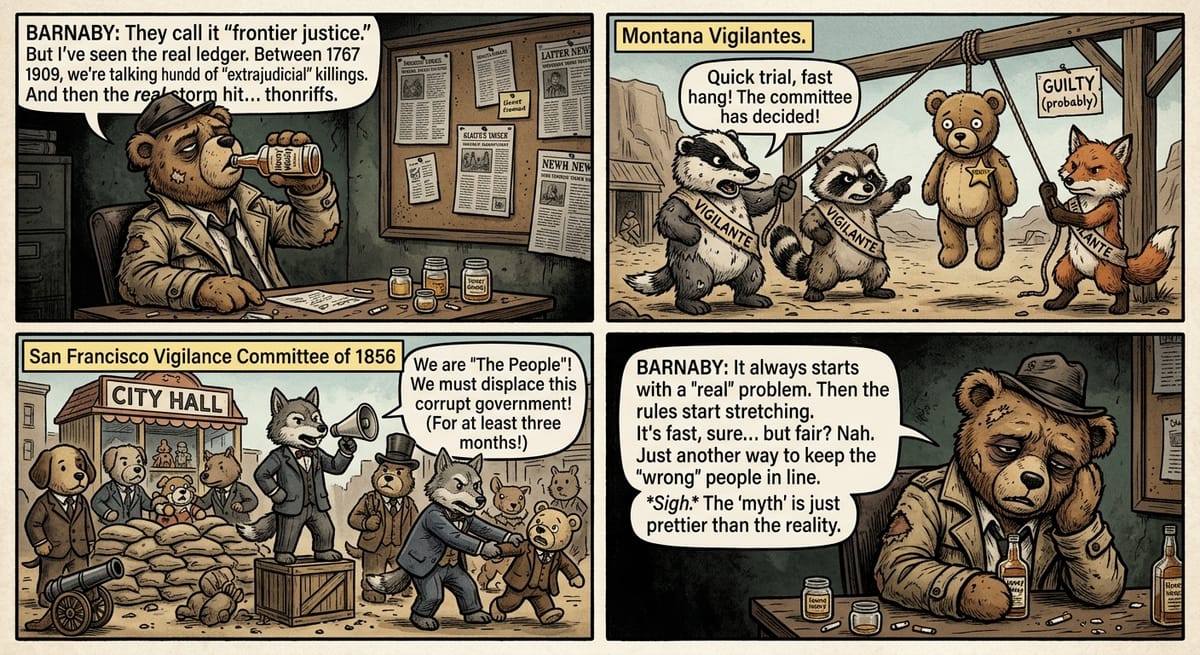
The Montana Vigilantes of 1863–1864 are the most extensively documented frontier vigilante action and provide the clearest picture of how the process worked in practice. Virginia City, Nevada City, and Bannack were mining camps with no territorial court, no jail, and no law enforcement beyond whatever informal arrangements miners could make among themselves. A network of road agents — robbers who targeted travelers on the roads between camps — had killed somewhere between 40 and 100 people in a period of approximately two years. Sheriff Henry Plummer of Bannack was accused by vigilante leaders of being the road agents’ secret leader.^2^
The vigilante committee, organized in late December 1863, hanged 21 men in approximately six weeks. The speed was both the point and the problem: investigations took hours or less, trials didn’t exist, and the decisions were made by a small committee whose members were not disinterested parties in the economic life of the camps. Several of the men hanged had no clear connection to the road agents. Plummer was hanged on January 10, 1864, maintaining his innocence; historian Frederick Allen concluded in 2004 that the evidence against him was thinner than the vigilante record claimed. The vigilante committee published a proclamation afterward asserting that their actions were necessary and just — it was printed in the Montana Post and reprinted in newspapers across the country, which was standard procedure.
San Francisco’s Vigilance Committee Rewrote American Political Culture
San Francisco’s Vigilance Committees of 1851 and 1856 were the most politically consequential vigilante organizations in American history, not because of the men they killed — eight hanged across both committees — but because of their model of organized, middle-class, respectable vigilantism that targeted enemies defined as much politically as criminally.
The 1856 committee was organized after the shooting of James King, a newspaper editor, by James Casey, a city supervisor with a criminal record. Casey was tried and convicted by the committee and hanged, along with Charles Cora, a gambler who had killed a U.S. Marshal. But the committee then maintained itself in power for three months, armed, governing the city in parallel with the elected government, deporting political opponents, and positioning itself as the representative of “the people” against corruption.^3^
Governor J. Neely Johnson declared the city in a state of insurrection. The state supreme court ruled the committee illegal. None of this stopped it. The committee demobilized on its own schedule and left behind an organization called the People’s Party that dominated San Francisco politics for six years. The precedent — that organized business interests could override elected government through the threat of armed force, and that this was a legitimate exercise of popular sovereignty — echoed through subsequent American political culture in ways that are still visible.
Lynching Was Vigilantism, and the Numbers Prove It
The Tuskegee Institute’s documentation of 4,743 lynchings between 1882 and 1968 (with the peak years from 1882 to 1930) represents the largest and most systematically organized form of American vigilantism and the one most consistently omitted from celebrations of frontier self-help. The victims were 73 percent Black Americans. The stated justifications were overwhelmingly criminal allegations — rape, murder, assault — that were either unproven, false, or described conduct that would not have resulted in lynching if committed by a white person.
Ida B. Wells, who began documenting lynchings systematically in 1892 after three of her friends were murdered in Memphis, Tennessee on March 9, 1892, demonstrated in her 1895 pamphlet A Red Record that the rape accusation used to justify the majority of Southern lynchings was frequently fabricated or described consensual relationships between Black men and white women that threatened the racial economic order.^4^ Her research was methodologically rigorous and her conclusions were suppressed by the mainstream press for decades.
The lynching era overlaps temporally with the frontier vigilantism period, and both drew on the same ideological tradition — the idea that “the people” had a right to enforce their own standards of order outside legal institutions. The difference in how they are remembered is not about the quality of the evidence for the violence but about which victims are considered sympathetic.
Why the Vigilante Myth Survives Despite the Record
The vigilante tradition survives in American political culture precisely because it addresses a real problem — institutional failure — while offering a solution that bypasses the constraints that make legal institutions fair. Courts require evidence. Due process takes time. Vigilantism is fast, certain, and satisfying in a way that legal proceedings are not.
What the historical record shows consistently is that vigilante groups begin with legitimate grievances and reliable targets, then expand to apply the same fast, certain methods to targets whose guilt is less clear, and then tend to be captured by the economic and political interests of the organized groups that sustained them. The Montana vigilantes protecting mining camps and the San Francisco committee protecting business interests used the same rhetoric of popular justice. The difference in their targets — road agents vs. Irish Catholic Democrats — was not a difference in method or self-conception.^5^
The Reconstruction-era night riding of the Ku Klux Klan, founded in Pulaski, Tennessee in December 1865, and the anti-Chinese violence of the 1870s and 1880s operated in the same tradition, understood themselves in the same terms, and cited the same frontier precedents. The vigilante heritage is not separable from these applications of it; it’s the same heritage, differently aimed.
─────────
Sources:
- Brown, Richard Maxwell. Strain of Violence: Historical Studies of American Violence and Vigilantism. Oxford University Press, 1975.
- Allen, Frederick. A Decent, Orderly Lynching: The Montana Vigilantes. University of Oklahoma Press, 2004.
- Mullen, Kevin J. Let Justice Be Done: Crime and Politics in Early San Francisco. University of Nevada Press, 1989.
- Wells, Ida B. A Red Record. Donohue & Henneberry, 1895.
- Pfeifer, Michael J. Rough Justice: Lynching and American Society, 1874–1947. University of Illinois Press, 2004.
Part of Frontier Violence — ← Back to series hub