Pretty Boy Floyd: The Outlaw Oklahoma Loved
Pretty Boy Floyd robbed banks across Oklahoma and killed officers. Woody Guthrie wrote him into folk legend. The song left out the people he killed.
Pretty Boy Floyd: The Outlaw Oklahoma Loved
Part of Depression-Era Outlaws — ← Back to series hub
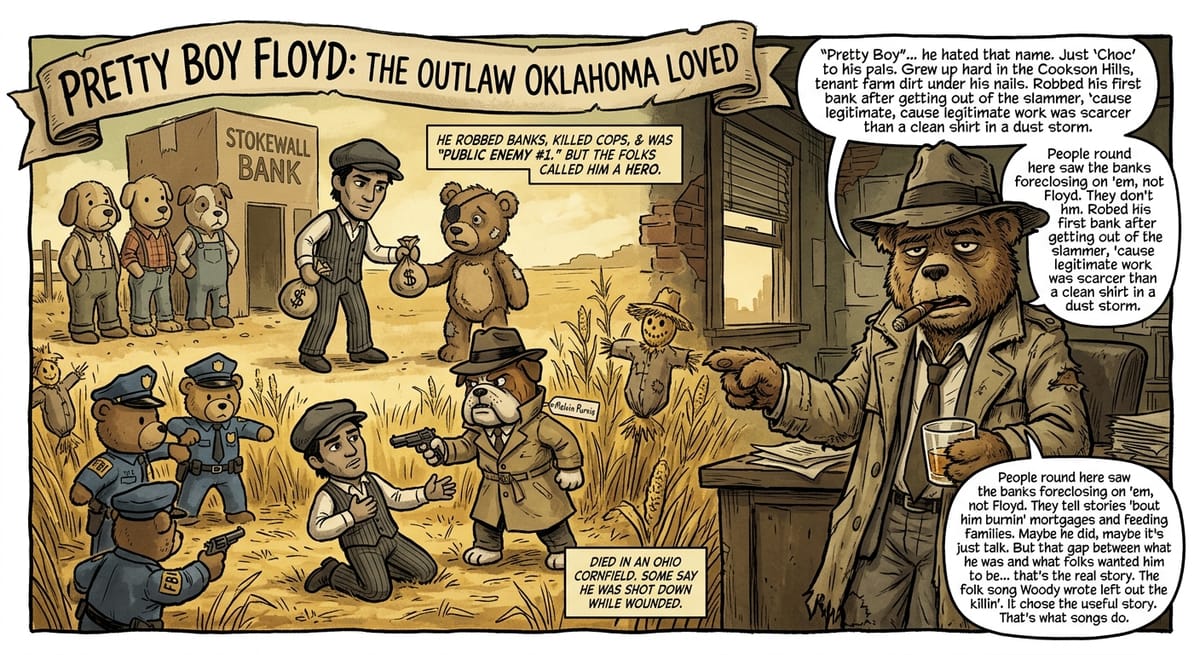
Pretty Boy Floyd robbed banks, killed people including at least one during the notorious Kansas City Massacre of 1933, and was shot by FBI agents in an Ohio cornfield at age 30. Within weeks, Woody Guthrie had written a ballad that cast him as a Robin Hood who burned mortgages and fed hungry families. The song doesn’t mention the killing. That gap between the documented Floyd and the folk song Floyd is the tension that makes the story worth examining.
Charles Arthur Floyd was killed on October 22, 1934, near East Liverpool, Ohio. The folk song became one of Guthrie’s most enduring works. These two facts coexist without contradiction if you understand what folk songs are for.
Eastern Oklahoma Made Outlaws Out of Tenant Farmers
Charles Floyd was born February 3, 1904, in Georgia, but his family moved to the Cookson Hills of eastern Oklahoma when he was a child. Sequoyah County, Oklahoma in the early twentieth century was economically desperate — the Cherokee and Creek allotments that had brought settlers had been consolidated by speculation, and tenant farming and poverty were widespread. Floyd grew up in a large farming family and, by his account and those of neighbors who knew him, was a normal farm kid until his mid-twenties.
His first arrest came in September 1925, in St. Louis, for robbing a Kroger payroll of $11,500 with two others. He was convicted and served three and a half years in the Missouri State Penitentiary at Jefferson City. When he came home to Oklahoma in 1929, he was 25 with a prison record in a region where legitimate work was scarce and getting scarcer as the Depression deepened.^1^
He began robbing banks in Oklahoma in 1930. The first confirmed banks include the Stonewall, Oklahoma bank and at least three Tulsa-area institutions through 1930 and 1931. The FBI eventually credited him with robbing 30 banks in a four-year period, though not all attributions are equally documented.
The Nickname He Hated Made Him a Target
The “Pretty Boy” nickname reportedly originated with an Akron, Ohio prostitute named Beulah Baird in 1925, who described him that way to police investigators — or possibly with a Kansas City madam, accounts vary. Floyd hated the name and refused to respond to it. Newspapers used it anyway because it sold papers. His family and criminal associates called him Choc, short for Choctaw Beer, a local homebrew he reportedly favored.^2^
The name created a marketing problem: it suggested something that wasn’t quite right about the man it described. Floyd was 5 feet 8 inches, lean and hard-featured, and had a temper that produced violence with modest provocation. He killed his first man — a former sheriff named Erv Kelley — in April 1932 in Bixby, Oklahoma, in circumstances that Floyd claimed were self-defense and witnesses described differently.
He killed again in August 1932, shooting officer Ralph Castner during a bank robbery in Elliston, Ohio, and killing Castner’s partner City Marshal Emmet Counts the same day. Two officers, one day, one robbery. These killings are not in the Woody Guthrie song.
The Kansas City Massacre Tied His Name to Federal Murder Charges
On June 17, 1933, at the Union Station in Kansas City, Missouri, federal and local officers were escorting convicted bank robber Frank Nash back to Leavenworth Federal Penitentiary. In the parking lot outside the station, gunmen opened fire. Four law enforcement officers were killed — Special Agent Raymond Caffrey, Kansas City Police Chief Otto Reed, and two other officers — along with Nash himself, apparently shot by his would-be rescuers.^3^
The FBI identified Floyd and his associate Adam Richetti as two of the shooters. Floyd denied it until his death. The attribution has been contested by historians; some believe the shooters were Verne Miller and possibly two others, with Floyd’s involvement overstated by the FBI. J. Edgar Hoover used the Kansas City Massacre as a defining case for expanding FBI authority and kept Floyd’s name attached to it regardless of the evidentiary complications.
Floyd’s guilt in the Kansas City Massacre cannot be confirmed with the documentary evidence that survives. What can be confirmed is that the FBI believed he was guilty, pursued him on that basis, and that the case became central to Hoover’s political campaign for enhanced federal law enforcement powers.
Did Melvin Purvis Order Floyd Shot While Wounded?
By October 1934, the FBI had named Floyd Public Enemy Number One following Dillinger’s death. Floyd and Richetti were captured near Wellsville, Ohio on October 20, 1934 — Richetti was arrested; Floyd escaped on foot. Two days later, FBI agents led by Melvin Purvis and local officers caught up with Floyd in a field near East Liverpool.^4^
Floyd was shot twice in the torso during the confrontation. He was alive on the ground when Purvis arrived. In an exchange that Purvis and others present described differently in subsequent accounts, Floyd either refused to answer questions about Kansas City before dying, or was shot while wounded on the ground. Agent Chester Smith later told an interviewer in 1974 that Purvis ordered Floyd shot as he lay wounded. The precise circumstances of his death remain disputed.
He was carried to a funeral home in East Liverpool. Within 24 hours, 20,000 people filed past the body. Back in Akins, Oklahoma, where his family lived, another 20,000 attended his funeral — one of the largest in the state’s history. The crowd was paying respects to someone they considered a neighbor and a local hero.
What the Mortgage-Burning Legend Actually Preserves
The Robin Hood stories about Floyd — that he burned mortgage documents during bank robberies, freeing indebted farmers from their obligations; that he paid for Christmas dinners for poor families; that he left cash on porches in poor neighborhoods — cannot be fully documented but cannot be entirely dismissed either. Multiple contemporaneous accounts from the Cookson Hills describe him giving money to families who needed it. Whether this was systematic charity or occasional generosity that grew in the retelling is impossible to determine.^5^
What’s clear is that the Depression created conditions where robbing a bank carried a different moral valence in the communities Floyd operated in than it had in more prosperous times. The banks that held the mortgages were the same institutions that had extended credit recklessly in the 1920s and were now foreclosing on tenant farmers who had no capacity to repay in a collapsed agricultural economy. Floyd’s neighbors knew exactly who he was and what he did, and many of them thought he was on their side.
Woody Guthrie’s song, written in 1939, five years after Floyd’s death, crystallized that sentiment into something portable and lasting. It ends with Floyd as a commentary on the whole economic system: “Some will rob you with a six-gun / And some with a fountain pen.” The documentary Floyd — with his two dead Ohio officers and his possible role in Kansas City — is harder to sing about. Guthrie chose the story that was useful, which is what folk songs do. That same selective use of the record is what made Ma Barker into a criminal mastermind and what kept Baby Face Nelson from getting a sympathetic ballad at all.
─────────
Sources:
- Wallis, Michael. Pretty Boy: The Life and Times of Charles Arthur Floyd. St. Martin’s Press, 1992.
- Burrough, Bryan. Public Enemies: America’s Greatest Crime Wave and the Birth of the FBI, 1933–34. Penguin Press, 2004.
- Unger, Robert. The Union Station Massacre: The Original Sin of J. Edgar Hoover’s FBI. Andrews McMeel, 1997.
- Helmer, William J. with Rick Mattix. Public Enemies: America’s Criminal Past, 1919–1940. Facts on File, 1998.
- Guthrie, Woody. Bound for Glory. E.P. Dutton, 1943.