Wild Bill Hickok: Hero Killer Myth
Wild Bill Hickok's legend claimed hundreds of kills. The documented record shows 7 to 12. He accidentally shot a friend killed a man through a window and died playing poker at 39.
Wild Bill Hickok: Hero, Killer, Myth
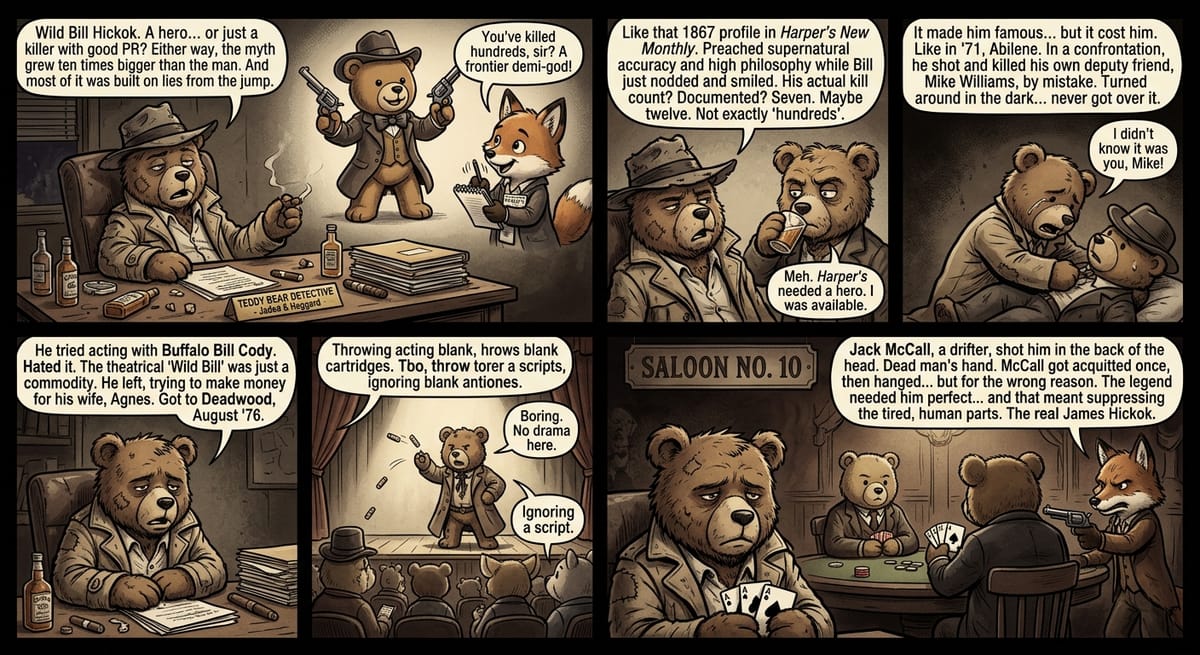
Wild Bill Hickok was genuinely dangerous, genuinely skilled with a revolver, and built into a legend that multiplied his kill count by a factor of ten and suppressed the details that made him human. James Butler Hickok was shot in the back of the head while playing poker in the No. 10 Saloon in Deadwood, Dakota Territory on August 2, 1876. He was 39 years old, holding two pair — black aces and black eights — which has been known as the Dead Man’s Hand ever since. The man who shot him was a drifter named Jack McCall, who was acquitted at a hasty miners’ court trial the next day and then arrested again when it was established that a miners’ court had no jurisdiction over murder. McCall was tried in federal court in January 1877, convicted, and hanged in Yankton, Dakota Territory on March 1, 1877.
Hickok had been famous for a decade before he died. The problem is that most of what made him famous was either false or so heavily embellished that the facts underneath had become decorative.
The 1867 Magazine Profile That Started Everything
In February 1867, Harper’s New Monthly Magazine ran a piece by Colonel George Ward Nichols titled “Wild Bill,” which presented Hickok as a frontier demigod who had killed “hundreds” of men and who demonstrated supernatural accuracy with revolvers while delivering baroque philosophical meditations on violence. Hickok cooperated with the interview and did not correct the exaggerations. The piece was an enormous popular success and established the template for frontier hero coverage that would be used for decades.
The actual documented record of Hickok’s killings runs to 7 or 8 confirmed deaths, with some disputed cases that might push the number to 10 or 12. This is still a remarkable number — Hickok was genuinely dangerous and genuinely a good shot — but it differs by an order of magnitude from the mythology, and the circumstances of the killings are more complicated than the legend suggests.^1^
What Actually Happened at Rock Creek Station
The confrontation that first established Hickok’s reputation occurred on July 12, 1861, in Rock Creek Station, Nebraska. David McCanles, a former owner of the station, arrived with two companions — James Woods and James Gordon — in a dispute over unpaid rent. The encounter ended with all three dead. The official version, which Hickok provided and which the Harper’s piece dramatized, had McCanles leading a gang of outlaws in an ambush that the outnumbered Hickok repelled single-handedly. The available evidence suggests it was less dramatic: McCanles was shot through a window or doorway, and the other two were killed in the subsequent pursuit. McCanles’s 12-year-old son Monroe was present and survived to give a different account.^2^
Hickok worked as a Union Army scout during the Civil War, serving at the Battle of Wilson’s Creek in August 1861, and continued as a scout and spy through the war. He developed his skills with revolvers in this period and gained a deserved reputation as someone who could shoot accurately under pressure. His work as a lawman in Hays City, Kansas (1869–1871) and Abilene, Kansas (1871) involved several killings, including two in Abilene where Hickok shot and killed two men — one of them, Mike Williams, accidentally.^3^
The accidental killing of Mike Williams on October 5, 1871, is the detail that doesn’t make it into most Hickok biographies prominently. Williams was a friend of Hickok’s who ran toward the scene of a confrontation, and Hickok, turning at the sound of movement, shot him before recognizing him. Hickok reportedly carried that killing heavily and resigned as Abilene marshal shortly after. The town had also decided it didn’t want the cattle trade that brought the violence; both parties moved on.
The Theatrical Career He Was Terrible At
Hickok joined Buffalo Bill Cody’s touring theatrical production, Scouts of the Prairie, in the winter of 1872–1873. He was terrible at it. He refused to play his scenes straight, fired his blank cartridges in the wrong directions, once turned a spotlight into the audience to see who was watching, and walked off stage during performances when bored. Buffalo Bill remembered him fondly and later built much of his own show around the template Hickok refused to execute.
The theatrical period matters because it’s where the divide between Hickok and his legend became explicit. He understood that he was being sold as a performance of himself, that “Wild Bill Hickok” was a commodity, and he was apparently unwilling to commit to it. He returned to the frontier, prospected for gold in the Black Hills in 1875, and came to Deadwood in the summer of 1876 apparently trying to make enough money to return to Agnes Lake Thatcher, a circus owner he had married in Cheyenne in March 1876 and with whom he had had a relationship for years.^4^
Jack McCall and the Murder That Went to Trial Twice
Jack McCall shot Hickok on August 2, 1876. His stated motive — that Hickok had killed his brother in Kansas — appears to have been false; investigators found no record of a McCall killed in Kansas by Hickok or anyone else. The likelier explanation, supported by the timing, is that McCall was hired by gamblers who resented Hickok’s presence at the poker tables or feared his reputation as a lawman. No one was ever charged with conspiracy.
The miners’ court that acquitted McCall the day after the killing was an irregular proceeding with no legal standing. When the Dakota territorial authorities prosecuted McCall for the same crime, he argued double jeopardy, which a federal court rejected on the grounds that the miners’ court verdict had no legal force. He was hanged in Yankton at 24 years old for a killing that had already been adjudicated in his favor by a court that didn’t legally exist.^5^
What the Legend Had to Suppress
Hickok understood his own mythology better than most of its subjects did. He cooperated with favorable coverage when it suited him and was contemptuous of it otherwise. He knew that “Wild Bill” was a character, that George Ward Nichols had made up most of the Harper’s piece, and that the frontier press needed heroes for commercial reasons. He made himself available as the raw material without fully buying into the product.
What the mythology required was suppression of the complexity — the accidentally killed friend, the mining camp gambling, the failed theatrical career, the chronic eye problems that plagued him by his late thirties and may have been gonorrhea-related, the fact that he spent his last months trying to make enough money to go home to his wife. The legend needed a man who was always exactly what the legend said he was. The actual James Hickok was older, more tired, and more human. He is buried in Mount Moriah Cemetery in Deadwood, South Dakota, next to Calamity Jane, who requested to be buried near him. The Dead Man’s Hand is a registered trademark of the city of Deadwood — which tells you something about how the myth has been managed since he left.
─────────
Sources:
- Rosa, Joseph G. Wild Bill Hickok: The Man and His Myth. University Press of Kansas, 1996.
- DeMattos, Jack. Mysterious Gunfighter: The Story of Dave Mather. Creative Publishing, 1992.
- O’Connor, Richard. Wild Bill Hickok. Doubleday, 1959.
- Chrisman, Harry E. The Ladder of Rivers: The Story of I.P. Olive. Sage Books, 1962.
- McLaird, James D. Calamity Jane: The Woman and the Legend. University of Oklahoma Press, 2005.
Part of Lawmen With Dark Sides — ← Back to series hub