Wyatt Earp: The Reality Behind the Legend
Wyatt Earp had a horse theft indictment he never discussed conducted an illegal vendetta that killed four men and left Arizona when the governor ordered his arrest. The icon hid the record.
Wyatt Earp: The Reality Behind the Legend
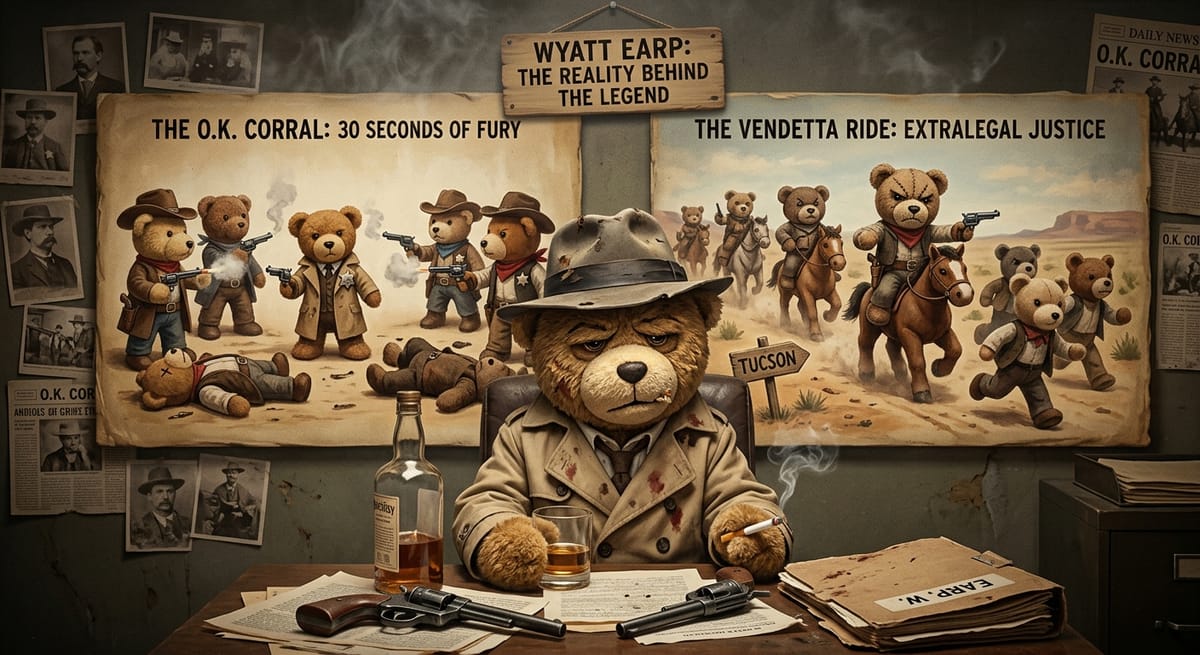
Wyatt Earp was a capable peace officer, a competent gambler, and a man who conducted targeted killings outside legal authority — and his transformation into a frontier icon required erasing most of that to leave a clean hero. On October 26, 1881, in a vacant lot behind the O.K. Corral in Tombstone, Arizona Territory, Wyatt Earp, his brothers Virgil and Morgan, and their friend Doc Holliday exchanged gunfire with a group of cowboys that included Billy Clanton, Frank McLaury, and Tom McLaury. The fight lasted approximately 30 seconds. Billy Clanton and both McLaury brothers were killed. Virgil and Morgan Earp were wounded. Wyatt and Holliday were untouched.
It was the most famous gunfight in American history. And within days of its occurrence, Tombstone was debating whether it was a lawful act of peace officers or a political assassination conducted by men with personal vendettas. That debate has never fully resolved, which is why Wyatt Earp’s legend requires examining rather than simply repeating.
A Career Built on Gambling, Badges, and a Horse Theft Charge
Wyatt Berry Stapp Earp was born March 19, 1848, in Monmouth, Illinois. He spent his early adulthood drifting through Kansas cattle towns — Wichita, Dodge City — working as a buffalo hunter, a brothel bouncer, a policeman, a gambler, and at least briefly as a horse thief. The horse theft, which occurred in 1871 in the Indian Territory, resulted in an indictment in Fort Gibson, Arkansas; Earp jumped bail and the charge was eventually dropped. He never discussed it publicly.^1^
His law enforcement career in Wichita from 1875 to 1876 and Dodge City from 1876 to 1879 produced a reputation as a capable peace officer who was willing to pistol-whip troublemakers into submission rather than shoot them. This was standard Dodge City practice — the goal was to get armed men to comply without shooting up the town. Earp was effective at it. He was also involved in the city’s gambling economy, which was not unusual for frontier lawmen but complicated the idea of a clear moral line between the law and the money.
He arrived in Tombstone, Arizona Territory in December 1879 with his brothers James, Virgil, and Morgan, and their common-law wives. The Earps came to make money — in mining, real estate, and gambling — not primarily to enforce law. Virgil was appointed town marshal in 1880. Wyatt was appointed deputy sheriff under County Sheriff Charlie Behan, then lost the elected sheriff’s race to Behan in November 1880.^2^
The Political Conflict That Produced the O.K. Corral
The shooting at the O.K. Corral was the culmination of a months-long conflict between the Earp faction and a loose confederation of cattle ranchers and rustlers known as the Cowboys, which included the Clanton and McLaury families. The conflict had political and economic dimensions: Behan was aligned with the Cowboys and the Democratic political establishment; the Earps were Republican, backed by the business interests of Tombstone’s commercial core.
On October 25, 1881, the day before the gunfight, Ike Clanton got drunk and made loud threats against the Earps around various Tombstone saloons. Virgil Earp pistol-whipped him and had him fined in the morning. Tom McLaury was also pistol-whipped by Wyatt Earp on October 25th for an unclear reason. The next day, when the Earps and Holliday approached the Cowboys in the lot behind the O.K. Corral, there were witnesses who said Ike Clanton and Tom McLaury were unarmed.^3^
The coroner’s inquest found that Tom McLaury had no gunshot residue on his hands and may not have fired a weapon. Billy Clanton, 19 years old, was shot multiple times. The legal proceedings that followed — a territorial hearing before Justice Wells Spicer — cleared the Earps and Holliday, ruling that Virgil had acted as a peace officer suppressing armed lawbreakers. The hearing was politically charged; Spicer was associated with Tombstone’s business establishment. The testimony conflicted sharply on who drew first.
The Vendetta Ride Was Extralegal Targeted Killing
The gunfight did not end the feud. On December 28, 1881, Virgil Earp was ambushed outside the Oriental Saloon and shot with a shotgun, permanently damaging his left arm. On March 18, 1882, Morgan Earp was shot through a window while playing billiards at Campbell and Hatch’s saloon in Tombstone and died about an hour later. Both attacks were attributed to the Cowboy faction.
Wyatt organized what he called a posse and conducted what historians call the Vendetta Ride. Between March 20 and April 15, 1882, Wyatt’s group killed at least four men: Frank Stilwell was shot at the Tucson train station on March 20th. Florentino Cruz was killed at a wood camp on March 22nd. Curly Bill Brocius — the acknowledged leader of the Cowboys — was reportedly killed at Iron Springs on March 27th, though his body was never recovered, and some historians question whether the killing occurred.^4^
The Vendetta Ride was extralegal. Wyatt did not have authority to operate a posse outside Tombstone’s jurisdiction. He was conducting targeted killings of suspected assassins based on his own investigation and his own judgment. The Arizona territorial governor ordered his arrest. He left the territory and never returned. He was never prosecuted.
How a Complicated Man Became an Uncomplicated Icon
Wyatt Earp lived until January 13, 1929, dying at 80 in Los Angeles. He spent decades trying to get his story told on his own terms, cooperating with writer Stuart Lake on a biography published in 1931 as Wyatt Earp: Frontier Marshal. The book was substantially fictionalized — Lake invented dialogue, compressed events, and turned the O.K. Corral into a clean moral confrontation between civilization and lawlessness.
The Lake biography became the source material for hundreds of movies and television productions, including the long-running 1955–1961 television series The Life and Legend of Wyatt Earp, the first adult dramatic Western on American television. By 1960, Wyatt Earp was a national icon of frontier justice, brave and righteous and uncomplicated.^5^
The actual record is of a man who was a capable peace officer and a competent gambler with a complicated relationship to legal authority, who conducted a vendetta after his brothers were attacked, who killed men whose guilt he assessed himself without legal process, and who spent his last decades in Los Angeles trying to turn all of this into something his biographer could sell. The complications don’t make him a villain. They make him human — which is harder to sell, but more honest. The mythology of the West needed him to be something simpler, and he was willing, at the end, to provide it.
─────────
Sources:
- Tefertiller, Casey. Wyatt Earp: The Life Behind the Legend. John Wiley & Sons, 1997.
- Roberts, Gary L. Doc Holliday: The Life and Legend. John Wiley & Sons, 2006.
- Barra, Allen. Inventing Wyatt Earp: His Life and Many Legends. Carroll & Graf, 1998.
- Turner, Alford E., ed. The O.K. Corral Inquest. Creative Publishing, 1981.
- Lake, Stuart. Wyatt Earp: Frontier Marshal. Houghton Mifflin, 1931.
Part of Lawmen With Dark Sides — ← Back to series hub