John Dillinger: Public Enemy Number One
John Dillinger robbed 24 banks in eleven months and was shot outside a Chicago theater. Hoover used him to build the FBI — the folk hero story came later.
John Dillinger: Public Enemy Number One
Part of Depression-Era Outlaws — ← Back to series hub
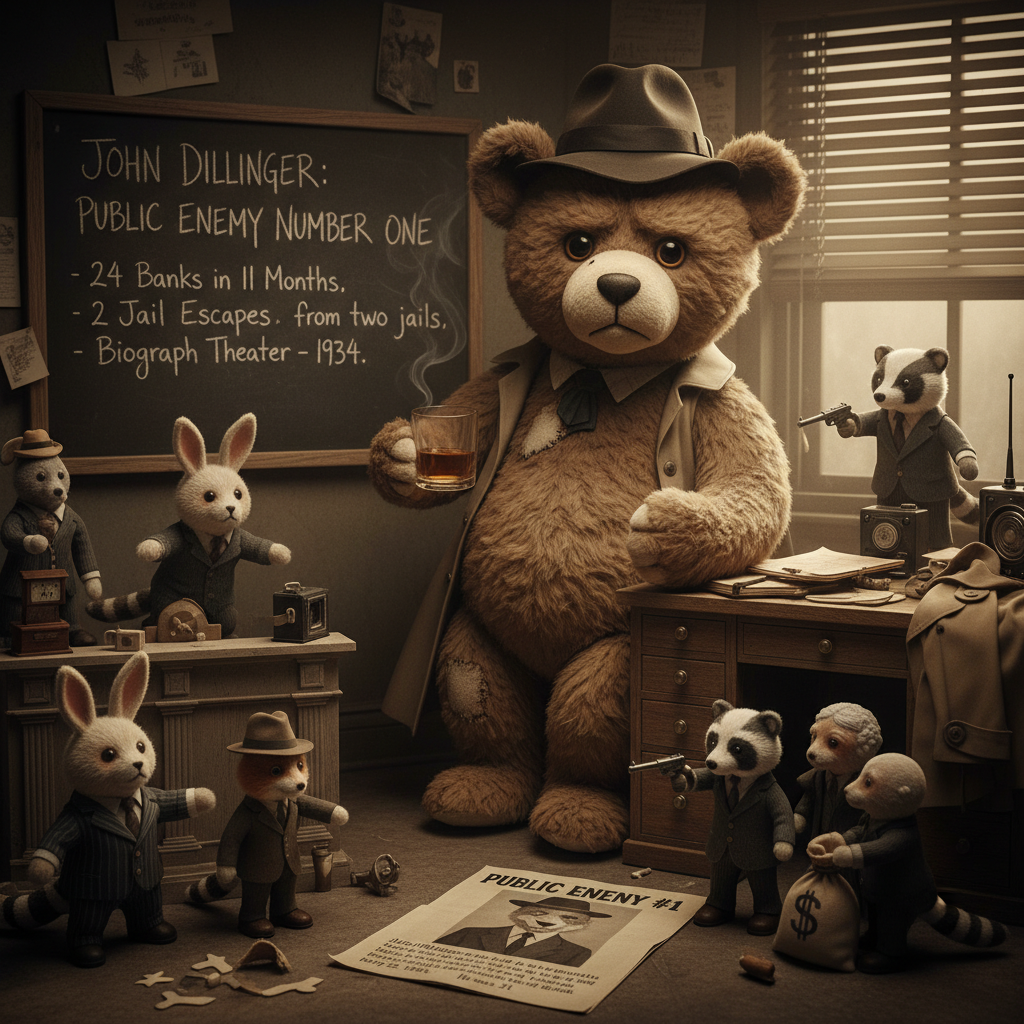
John Dillinger robbed 24 banks in eleven months, escaped from two jails, and was shot dead by FBI agents outside a Chicago movie theater on July 22, 1934. He was 31. J. Edgar Hoover made him the first official “Public Enemy Number One,” and the designation served Hoover’s political agenda at least as much as it described a genuine threat. Both things were true simultaneously.
He was dead before the summer ended, but the legend was just getting started.
Nine Years in Prison Built the Criminal That Hoover Needed
John Herbert Dillinger was born June 22, 1903, in Indianapolis, Indiana. His mother died when he was three. His father, John Wilson Dillinger, was a strict disciplinarian who remarried in 1912 and moved the family to the farming town of Mooresville, Indiana, where John Jr. grew up in a house that his biographers describe as emotionally cold. He dropped out of school, enlisted in the Navy in 1923, deserted, and came home to Mooresville in 1924, where he met a pool hall operator named Ed Singleton.
In September 1924, Dillinger and Singleton tried to rob a Mooresville grocery store owner named Frank Morgan. The robbery went wrong. Dillinger was arrested, confessed, and his father — acting on a lawyer’s advice that a guilty plea would produce a lighter sentence — told him to throw himself on the court’s mercy. It did not work. He was sentenced to 2 to 14 years in the Indiana State Prison at Michigan City.^1^
He was 21 when he went in. He was released in May 1933 at 30, having spent nine years in a system that introduced him to the most skilled bank robbers in Indiana. Homer Van Meter, Harry Pierpont, Charles Makley, John Hamilton, and others were his prison associates and classmates. He walked out with a graduate-level criminal education he hadn’t arrived with.
The Gang Robbed Banks Like a Production Line
The Dillinger gang’s operational period — from September 1933 to July 1934 — was one of the most compressed and intense in bank robbery history. The methods were theatrical: gang members would leap over teller counters while others held the lobby at gunpoint, someone announced the amount of time they had, and they were out in under five minutes. They also robbed police arsenals, twice, to acquire weapons.
The Central National Bank in Greencastle, Indiana on October 23, 1933, netted $74,782. The American Bank and Trust Company in Racine, Wisconsin on November 20, 1933 added another $27,789. A police sergeant named Wilbur Hansen was pistol-whipped during the Racine job. By the end of 1933, the gang had hit banks in Indiana, Wisconsin, and Ohio, and several police departments.
J. Edgar Hoover made Dillinger the centerpiece of his campaign to federalize law enforcement. The FBI (then called the Division of Investigation) had limited jurisdiction over bank robbery until Congress expanded federal statutes in the early 1930s. Hoover used Dillinger’s notoriety to argue for a national police presence — every front-page Dillinger robbery was a political argument for more FBI funding and authority.^2^
The Escapes Were Good Propaganda — and Mostly True
Dillinger’s two jail breaks added to the mythology substantially. On September 22, 1933, ten prisoners escaped from the Indiana State Prison in Michigan City using guns that Dillinger had arranged to be smuggled in. Dillinger himself was in the county jail in Lima, Ohio at the time — he’d been arrested in Dayton — but was liberated on October 12, 1933, when members of his own gang killed Sheriff Jesse Sarber during a breakout attempt. The gang walked in claiming to be state officers; Sarber asked for their credentials; Harry Pierpont shot him twice.^3^
The second escape was more famous. On March 3, 1934, Dillinger used a fake gun — carved from wood and blackened with shoe polish, or possibly a real gun smuggled in, accounts differ — to bluff his way out of the Crown Point, Indiana jail, which had been described by the local press as “escape-proof.” He stole the Sheriff’s car and drove it across state lines into Illinois, which was a federal offense and gave the FBI jurisdiction. The wooden gun story, which Dillinger himself promoted, was almost certainly exaggerated; the physical evidence doesn’t fully support it.
The Woman in Red Set the Trap
The FBI tracked Dillinger through a Romanian immigrant named Ana Cumpănaș, known to history as “the Woman in Red” (she was actually wearing an orange dress). Cumpănaș operated a brothel in Chicago and had provided Dillinger’s girlfriend Polly Hamilton with work. Facing deportation for her criminal record, she contacted FBI Special Agent Melvin Purvis and offered Dillinger’s location in exchange for help with her immigration status. The FBI agreed.^4^
On July 22, 1934, Cumpănaș called the FBI and told them Dillinger would attend the Biograph Theater that evening. Purvis and 16 agents waited outside. When Dillinger emerged, Purvis lit a cigar as a signal. Agents fired. Dillinger took three bullets — two to the body, one to the back of the neck — and died in the alley beside the theater.
The FBI delivered on none of its promises to Cumpănaș. She was deported to Romania in April 1936.
The Folk Hero Problem
Dillinger was presented in Depression-era coverage as a Robin Hood figure — a man who robbed banks that had foreclosed on farmers, who tipped hat boys and returned women’s purses during robberies. Some of these details appear to be documented; most are apocryphal. What’s documented is that the gang’s robberies produced violence: officers were killed and wounded in multiple incidents, bank employees were terrorized, hostages were taken.
The folk hero framing worked because it matched an existing need. Banks had failed. The Federal Reserve had contracted the money supply. Millions of Americans had lost savings and homes in the early 1930s. A man who robbed banks was, in a certain light, doing something that felt symbolic even if the money went directly into his own pocket.^5^
What the folk hero narrative requires is the suppression of the people who died. Sheriff Jesse Sarber, killed in Lima, Ohio while asking to see someone’s credentials. The FBI agents’ conduct at the Biograph has been questioned: multiple bystanders were wounded in the crossfire. None of this appears in the mythology.
Dillinger’s grave in Crown Hill Cemetery in Indianapolis draws thousands of visitors per year. The gravestone has been chipped at for souvenir pieces so many times that the family has replaced it repeatedly. The current marker is set in concrete. The same Depression grievances that made Dillinger a folk hero also shaped Pretty Boy Floyd in Oklahoma and Bonnie and Clyde in Texas — all of them operating in the same eighteen-month window, all of them handled by the same FBI under the same political framework Hoover was building.
─────────
Sources:
- Toland, John. The Dillinger Days. Random House, 1963.
- Burrough, Bryan. Public Enemies: America’s Greatest Crime Wave and the Birth of the FBI, 1933–34. Penguin Press, 2004.
- Matera, Dary. John Dillinger: The Life and Death of America’s First Celebrity Criminal. Carroll & Graf, 2004.
- King, Jeffrey. The Rise and Fall of the Dillinger Gang. Cumberland House, 2005.
- Powers, Richard Gid. Secrecy and Power: The Life of J. Edgar Hoover. Free Press, 1987.