Dark Lawmen: When the Badge Didn't Mean Justice
Wyatt Earp was a gambler. Wild Bill Hickok shot a friend by accident. Pat Garrett was himself killed under disputed circumstances. The badge in frontier America was a political tool not a moral one.
Dark Lawmen: When the Badge Didn’t Mean Justice
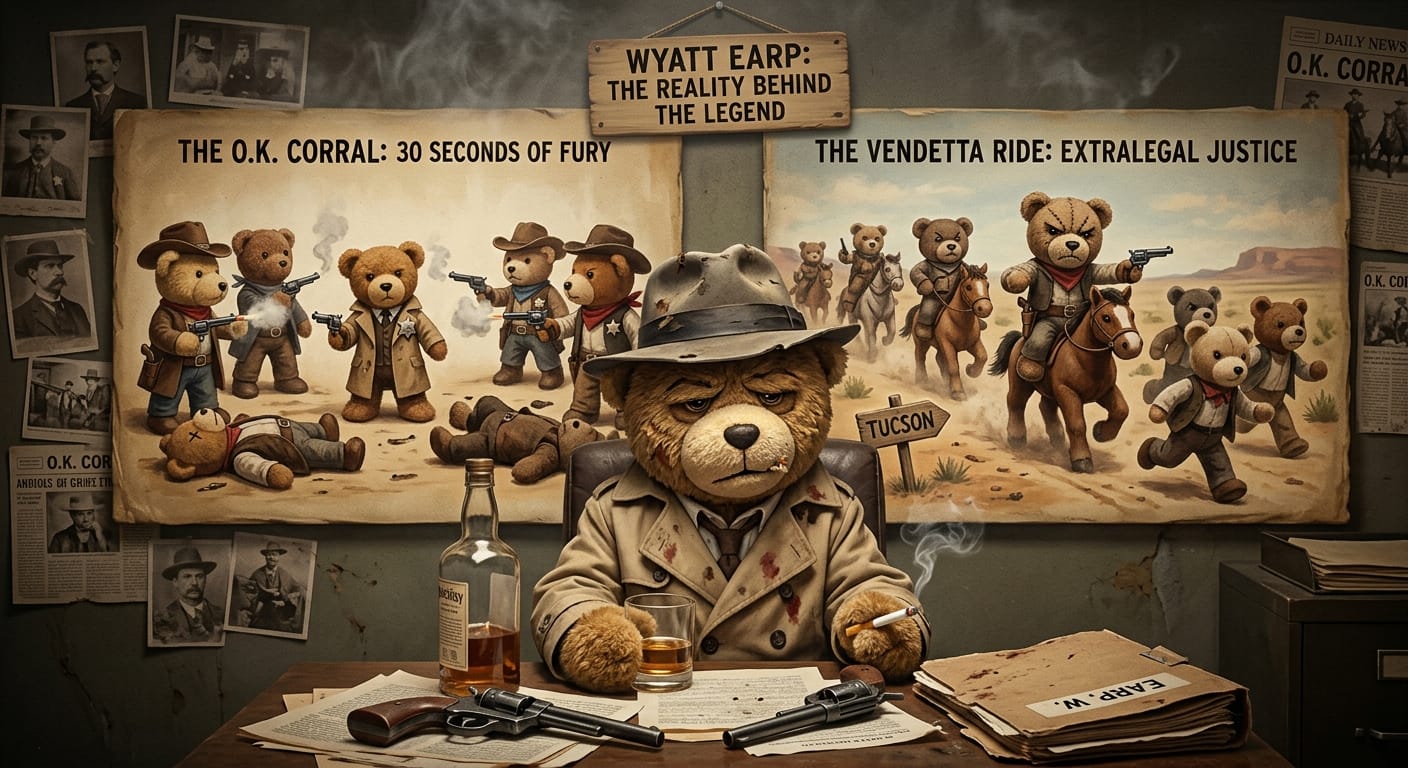
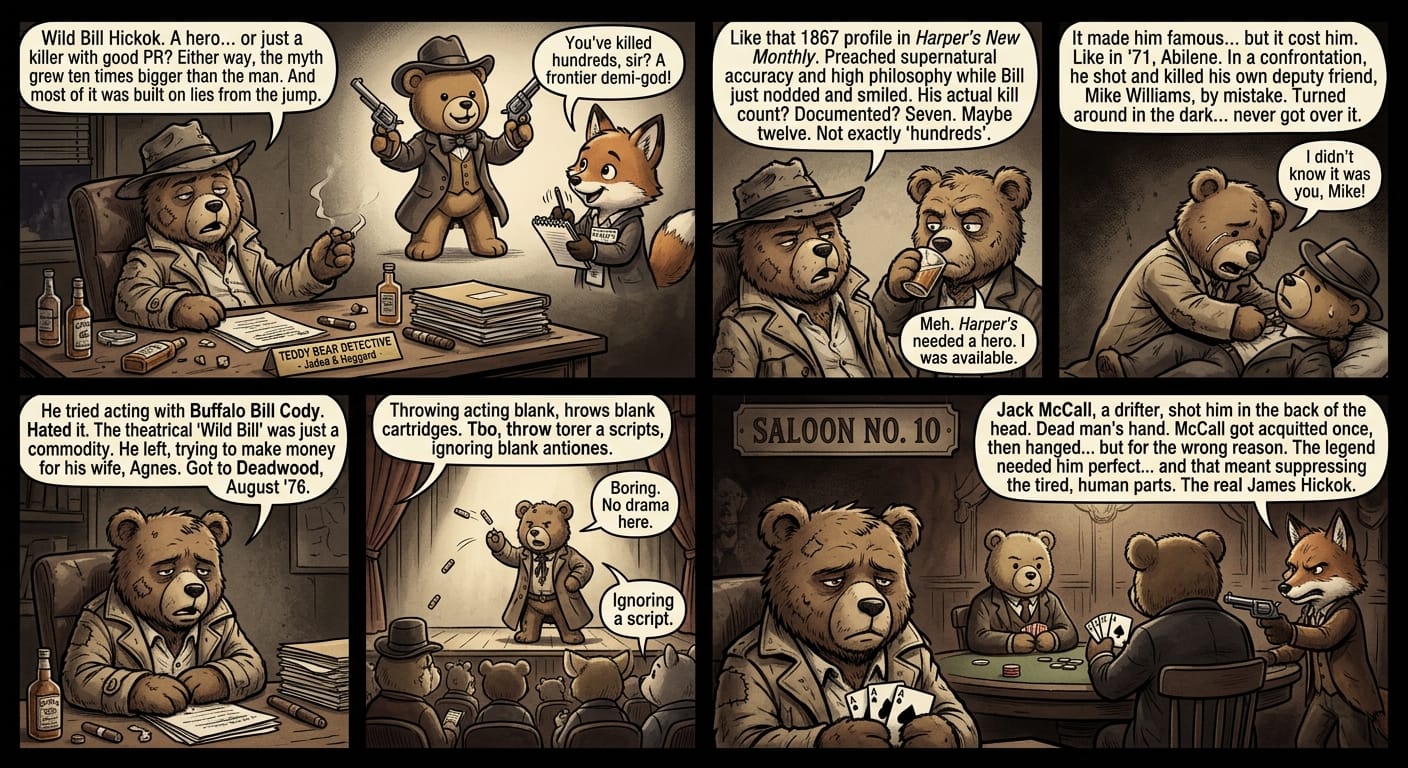
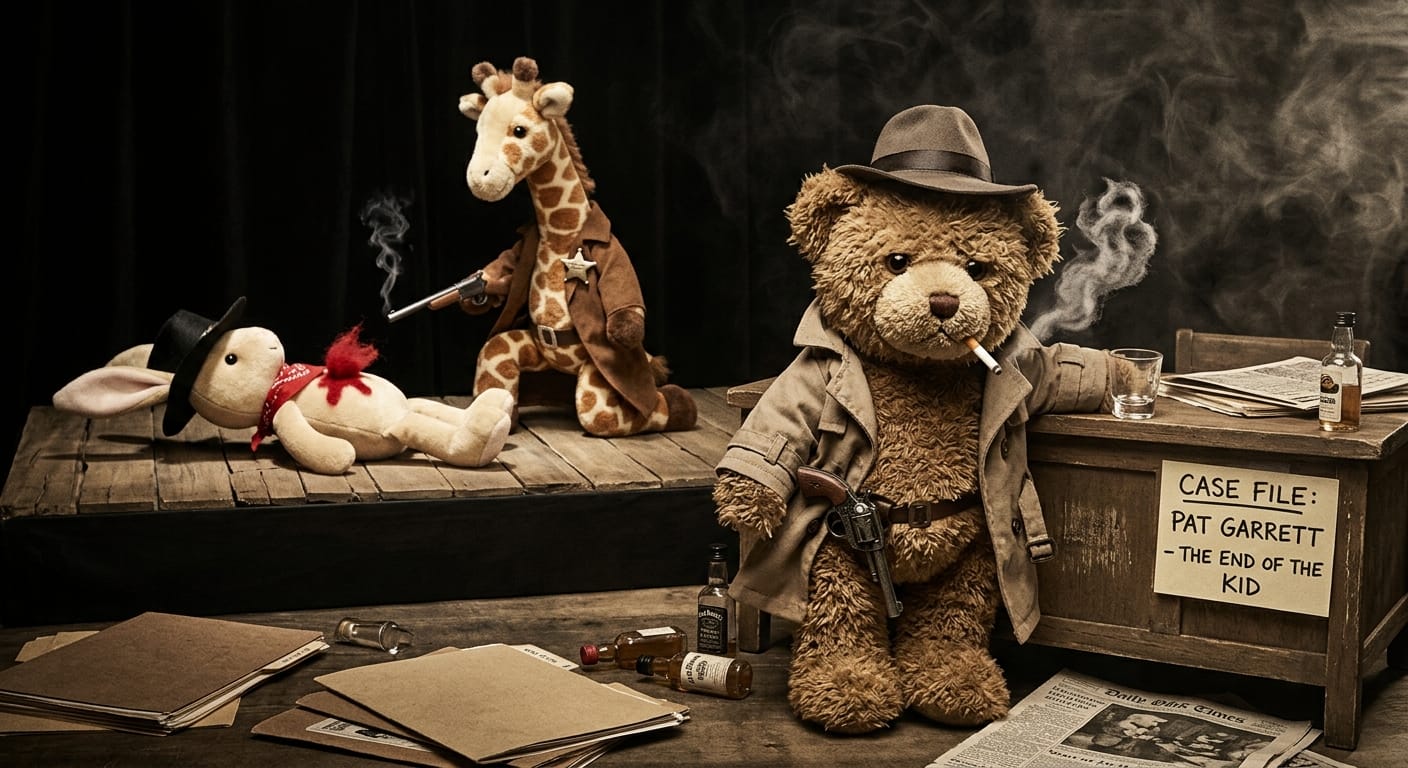
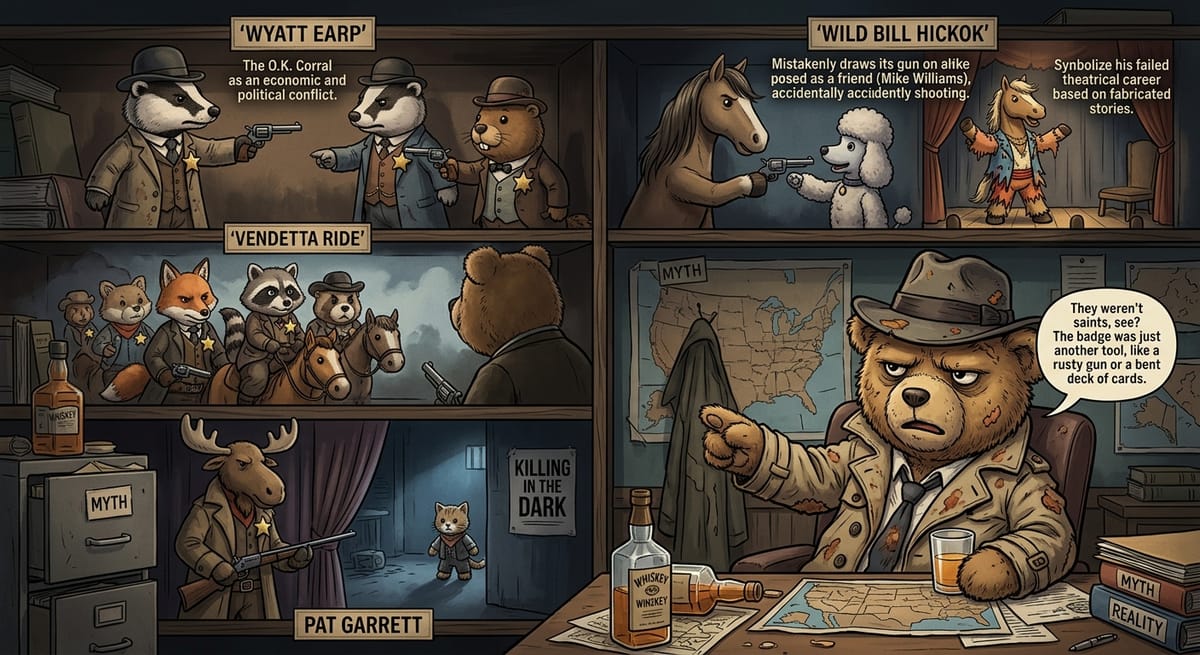
The most celebrated lawmen of the American West had careers that don’t fit the legend assigned to them — and the gap between badge and justice was a feature, not a bug. Wyatt Earp was a gambler who used a law enforcement position to advance his economic interests in Tombstone and conducted an extralegal vendetta against the men who shot his brothers. Wild Bill Hickok killed an innocent friend by accident and spent his later career as a failed theatrical performer trying to commercialize a reputation built mostly on an 1867 magazine profile. Pat Garrett killed Billy the Kid in the dark without warning, was himself killed under disputed circumstances 27 years later, and is remembered primarily in relation to the man he shot.
The gap between the badge and what the badge actually meant in frontier America is one of the most consistently suppressed facts in the mythology of the West.
In This Series
- Wyatt Earp: The Reality Behind the Legend
- Wild Bill Hickok: Hero, Killer, Myth
- Pat Garrett: The Man Who Killed Billy the Kid
What a Frontier Lawman Actually Was
The first thing to understand about frontier law enforcement is that it was not a profession in any modern sense. Town marshals and county sheriffs in 1870s and 1880s Kansas, Arizona, or New Mexico were elected officials with minimal training, minimal pay, and broad discretionary authority. They hired deputies on a fee-or-political basis. They enforced laws selectively according to the economic interests of the property holders who supported their elections. They sometimes ran illegal operations — gambling, saloons, brothels — on the side, or tolerated such operations run by allies in exchange for political and financial support.
The line between this kind of law enforcement and organized crime was often a question of which side of the political ledger a given operator was on. Wyatt Earp in Tombstone was simultaneously a deputy sheriff, a gambler with interests in several saloons, and a political ally of the commercial establishment that opposed Sheriff Behan’s faction. His famous enforcement of law at the O.K. Corral was inseparable from the political conflict between these factions. Pat Garrett’s election as sheriff of Lincoln County was funded by ranching interests that wanted the small ranchers and rustlers — Billy the Kid’s allies — cleared out of the Pecos Valley.
The Vendetta Showed Where the Badge Actually Ended
The vendetta — extralegal targeted killing of perceived enemies — is the clearest point at which the dark lawman tradition breaks from even the period’s own legal norms. Wyatt Earp’s Vendetta Ride of March to April 1882, conducted after his brothers were ambushed, killed at least four men without legal authority or due process. The Arizona territorial governor ordered his arrest. He left the territory.
This pattern is not unusual in frontier law enforcement history. The Regulators of Lincoln County, nominally deputized by a rival county official, killed their way through the Dolan faction in 1878 with legally questionable authorization. Texas Rangers operating in the post-Civil War period conducted punitive expeditions against Mexican border communities that constituted massacres by any reasonable accounting. The badge provided cover for violence that was personal or political as often as it was legally sanctioned.
Why Did the Myth Need Uncomplicated Heroes?
The mythology of the good lawman requires that there be a clear moral distinction between the man with the badge and the man without it — that the badge confers legitimacy on violence that would otherwise be criminal. The actual frontier record shows that the distinction was frequently a matter of political alignment rather than moral character, that the same man might hold a badge or a wanted poster depending on which faction was currently in power, and that the badge was sometimes the mechanism of injustice rather than its remedy.
Wyatt Earp’s transformation into an American icon required Stuart Lake’s 1931 biography, which invented dialogue, compressed events, and removed the ambiguity. Wild Bill Hickok’s transformation required George Ward Nichols’s 1867 Harper’s piece, which multiplied his kill count by a factor of ten and invented set-piece confrontations that never occurred. These weren’t innocent exaggerations — they were the raw material of a mythology that the Western film and television industry then industrialized into the cultural furniture of mid-twentieth century America.
What the Documents Show Instead
What the documents show is more interesting than the mythology. Wyatt Earp’s horse theft indictment from 1871, which he never discussed. Hickok’s accidental killing of his friend Mike Williams in Abilene, which doesn’t appear in most popular accounts. Garrett’s disputed death on a New Mexico road, the contradictory testimony that was never resolved, the possibility that he was killed by someone other than the man acquitted of the shooting.
These details don’t make the lawmen villains. They make them human — ambitious men operating in conditions where the rules were inconsistent and the line between law and violence was thinner than the mythology admits. The mythology needed heroes who were always on the right side. The record produced men who were on whatever side served their interests, and who were sometimes right and sometimes wrong, and who were occasionally heroic and occasionally not, in ways that don’t reduce to a clean story.
The badge, in frontier America, was not a guarantor of justice. It was a tool that could be used well or badly, and in the hands of the men this series examines, it was used for both.
─────────
Sources:
- Tefertiller, Casey. Wyatt Earp: The Life Behind the Legend. John Wiley & Sons, 1997.
- Rosa, Joseph G. Wild Bill Hickok: The Man and His Myth. University Press of Kansas, 1996.
- Metz, Leon Claire. Pat Garrett: The Story of a Western Lawman. University of Oklahoma Press, 1974.
- Barra, Allen. Inventing Wyatt Earp: His Life and Many Legends. Carroll & Graf, 1998.
Part of the Outlaws & the Wild West section — ← Back to section hub
The Series