War Crimes and Military Atrocities in American History
From My Lai to Hiroshima: a full accounting of American war crimes and contested military decisions — the documented pattern of what happens and who is held responsible.
War Crimes and Military Atrocities in American History
The United States has been at war, in some form, for most of its existence. It has won most of those wars. It has also committed acts in those wars — against enemy combatants, against civilians, against its own citizens — that range from legally defined war crimes to moral catastrophes that existing law did not clearly prohibit to decisions that remain genuinely contested a century later. This section covers all of it.
Two Series, One Accountability Gap
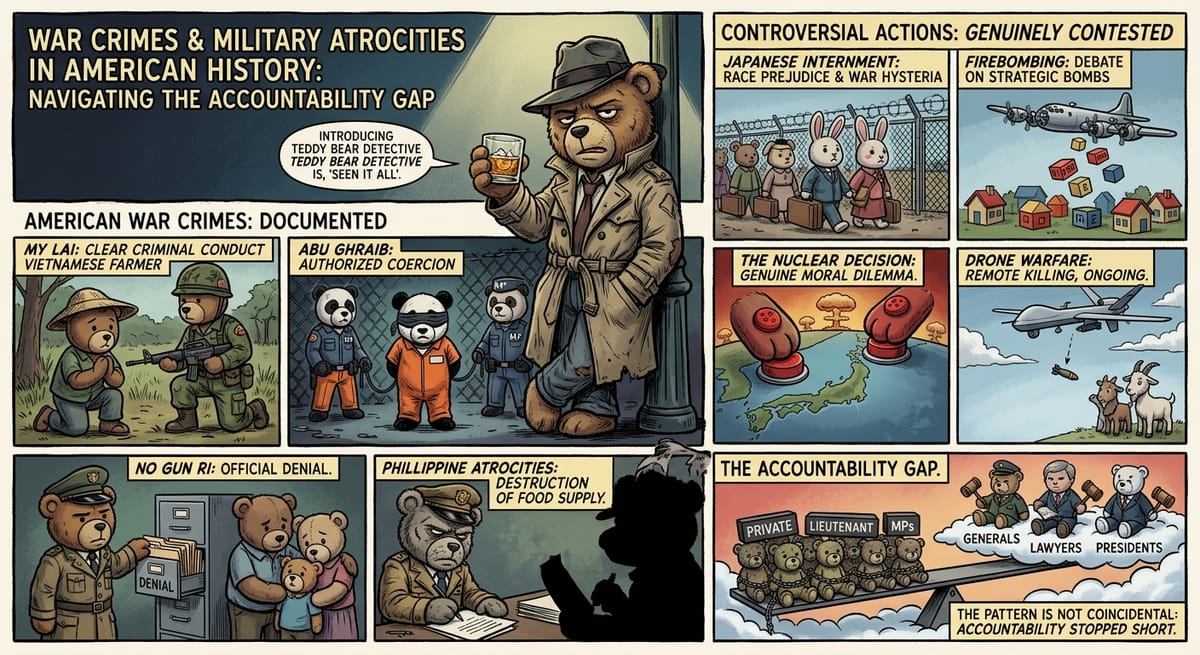
Not everything here carries the same moral weight, and the articles don’t pretend otherwise. My Lai — where soldiers of Charlie Company killed between 347 and 504 unarmed Vietnamese civilians on March 16, 1968, and where the cover-up ran from the platoon to the division — is not in the same category as the firebombing debates, where serious historians continue to disagree about whether the strategic bombing of Japanese cities shortened the war and saved lives overall. Abu Ghraib — where documented torture was authorized by a bureaucratic chain that ran from the night shift at a prison outside Baghdad to a Justice Department memo defining torture so narrowly it excluded most of what was happening — is not the same as the nuclear decision, which presents a genuine moral dilemma that has never been cleanly resolved.
Treating all of these as equivalent would be dishonest. Treating any of them as simply too hard to look at would be equally dishonest. The section is organized to reflect these distinctions.
In This Series
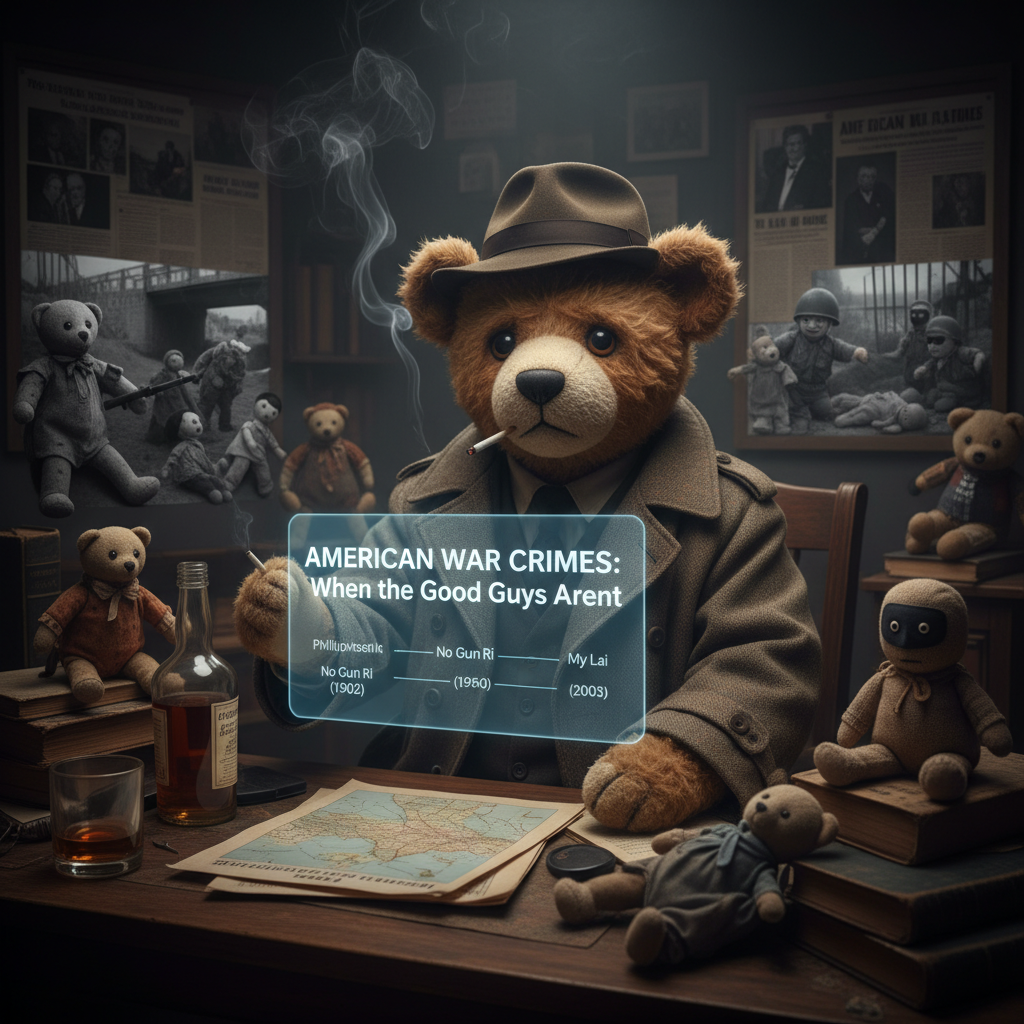
American War Crimes: Committed by Americans — The documented cases: My Lai, Abu Ghraib, No Gun Ri, and the Philippine-American War atrocities. Clear evidence of criminal conduct. Accountability that stopped at the lowest ranks.
Controversial American Military Actions — The harder cases: Japanese internment, POW camps, firebombing, the nuclear decision, and drone warfare. Documented harm. Genuine uncertainty about alternatives. Historians who disagree.
The Documented War Crimes
The Philippine-American War atrocities of 1899 to 1902 produced between 200,000 and 600,000 Filipino deaths, the majority from reconcentration policies that deliberately destroyed the civilian food supply. General Jacob Smith was court-martialed for ordering that Samar be made “a howling wilderness” and everyone capable of bearing arms — over age ten — be killed. He was admonished and retired with his pension.
No Gun Ri in July 1950 produced a half-century of official denial followed by an Army report that confirmed what the survivors had said, expressed regret rather than apology, and recommended no criminal charges.
My Lai produced one conviction: Lieutenant William Calley, sentenced to life, paroled after three and a half years under house arrest. The officers who built the system that produced the massacre — the free fire zones, the body count metrics, the dehumanization of the civilian population — were not charged.
Abu Ghraib produced eleven convictions. None above the rank of staff sergeant. The lawyers who wrote the memos authorizing coercive interrogation practices were not charged. The generals who authorized gitmo-izing the prison were not charged.
The pattern is not coincidental. It is the shape of accountability when the system protects itself. The same institutional dynamic appears in non-military contexts — COINTELPRO ran for fifteen years because the bureau investigating civil rights organizations was also the institution responsible for its own accountability.
The Genuinely Contested Cases
Executive Order 9066, signed February 19, 1942, imprisoned 120,000 Japanese Americans without charge or trial. The Commission on Wartime Relocation concluded definitively in 1983 that the internment was driven by race prejudice and war hysteria, not military necessity. The Supreme Court upheld it in 1944 and did not formally repudiate that decision until 2018.
The POW system held 425,000 Axis prisoners in compliance with the Geneva Conventions — while granting German prisoners access to facilities in the American South that were legally barred to Black Americans. The system’s relative humanity was real and its racial contradictions were also real.
The firebombing of Japan killed between 300,000 and 500,000 civilians across 67 cities. General LeMay, who designed the campaign, told Robert McNamara he expected to be prosecuted as a war criminal if the United States had lost the war. The firebombing receives a fraction of the historical attention directed at the atomic bombs that followed it.
The nuclear decision — Hiroshima and Nagasaki, August 6 and 9, 1945 — remains the most contested military decision in American history. The case for the bombs, the case against, and the evidence bearing on both are presented in full. The section does not resolve what historians have not resolved.
Drone warfare is the ongoing case: remote killing in countries where the United States is not at war, under legal frameworks that have never been fully disclosed or judicially reviewed, with civilian casualties that the government has consistently undercounted. The September 30, 2011 killing of Anwar al-Awlaki — an American citizen — without judicial process, followed two weeks later by the killing of his sixteen-year-old American-citizen son, defines the outer edge of what the program has authorized.
What This Section Is Not
This section is not an argument that American military power is uniquely evil. Every major military power in modern history has committed atrocities; several have committed them on scales that dwarf anything documented here. The Soviet Union, Imperial Japan, Nazi Germany, and colonial European powers produced mass death that makes the events in this section look like footnotes by comparison.
The relevant standard for American conduct is not whether it compares favorably to the worst actors of the twentieth century — that is a low bar — but whether it is consistent with the principles the United States has claimed to represent, the laws it has signed, and the accountability mechanisms it has built. By those standards, the record documented here is worth examining directly.
The Accountability Gap
The consistent finding across every event in this section is that accountability stopped short. The soldiers in the photographs, the platoon leader who gave the order, the MPs on the night shift — they faced consequences. The generals who built the systems, the lawyers who wrote the memos, the presidents who signed the orders — they mostly did not. This is not random. It is the predictable output of accountability systems that are designed and administered by the institution whose conduct is being reviewed.
This is not an argument that no accountability is possible. Hugh Thompson received the Soldier’s Medal in 1998 for trying to stop My Lai. Fred Korematsu’s conviction was vacated in 1983 when suppressed evidence surfaced. The Civil Liberties Act of 1988 produced formal apologies and $20,000 payments to surviving Japanese American internees. The Senate Intelligence Committee’s report on CIA torture was published, even if the full version remains classified. The record exists. The question is whether it gets read.
Containment
The history of American war crimes and controversial military actions is not a story with a clean ending, because the conditions that produced it — counterinsurgency without a front, security panics that override legal constraint, executive authority that expands in wartime and does not fully retract afterward — have not ended. The drone warfare program is ongoing. The legal memos that authorized coercive interrogation have been withdrawn but not adjudicated. The AUMF of 2001 remains in force, authorizing military operations against groups and in countries that did not exist when it passed. The pattern documented in this section is not past tense.
The reason to look at this history directly — at the names and dates and documented decisions, not the comfortable summaries — is not to condemn the country. It is to understand the system accurately enough to know what it is capable of, what conditions produce its worst outcomes, and where the accountability mechanisms fall short. That is information worth having.
─────────
Sources:
- Turse, Nick. Kill Anything That Moves: The Real American War in Vietnam. Metropolitan Books, 2013.
- Greenberg, Karen J., and Joshua L. Dratel, eds. The Torture Papers: The Road to Abu Ghraib. Cambridge University Press, 2005.
- Frank, Richard B. Downfall: The End of the Imperial Japanese Empire. Random House, 1999.
- Commission on Wartime Relocation and Internment of Civilians. Personal Justice Denied. U.S. Government Printing Office, 1983.
In This Section