POW Camps on American Soil
The U.S. held 425000 Axis prisoners in 700 camps during WWII — treating them better than Black American soldiers who guarded them. The racial contradiction was built-in.
POW Camps on American Soil
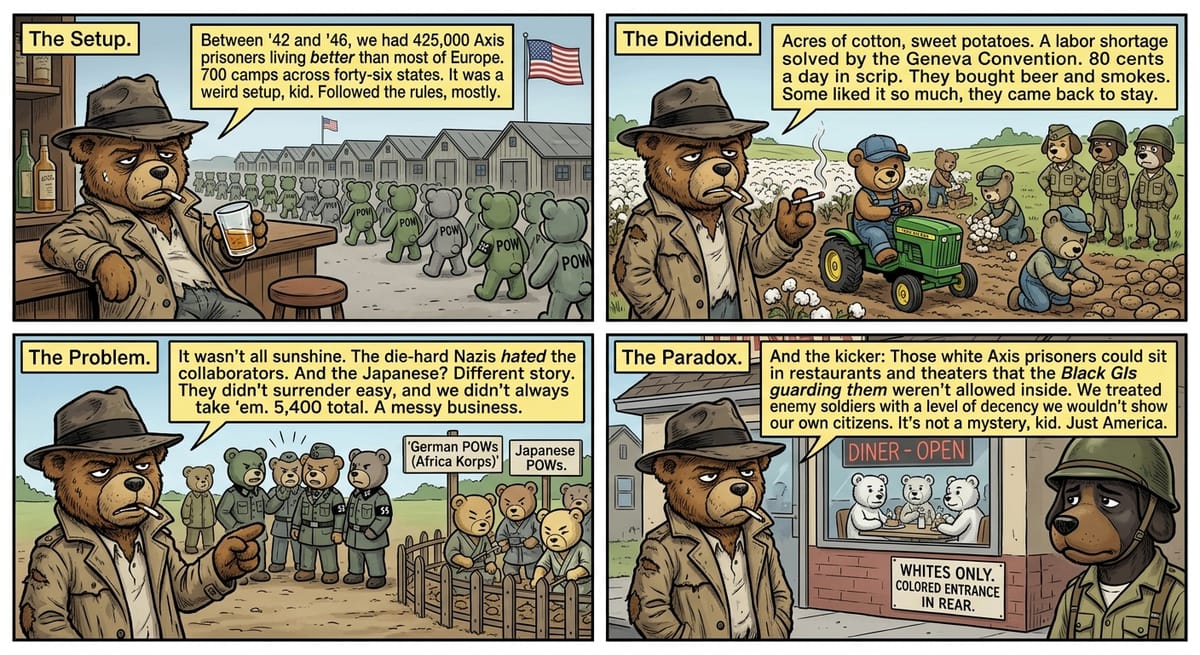
Between 1942 and 1946, the United States held approximately 425,000 Axis prisoners of war in more than 700 camps spread across forty-six states. The POW camps on American soil are one of the stranger facts of World War II: a system that was, by the standards of the era, largely humane — and that raised questions about race, labor, and American hospitality that the country handled in characteristically inconsistent ways. The majority of prisoners were German, around 380,000, with Italian and Japanese prisoners making up most of the rest. Many of them liked America well enough to try to stay.^1^
Part of Controversial American Military Actions — ← Back to series hub
How a 700-Camp System Got Built
The Geneva Convention Relative to the Treatment of Prisoners of War, signed in 1929, established the framework: prisoners were to be treated humanely, provided food and shelter equivalent to that of the detaining power’s own troops, paid for their labor at the rates established by the Convention, and not compelled to perform dangerous or war-related work. The United States, unlike Germany, Japan, or the Soviet Union, generally followed the Convention — partly out of principle, partly because reciprocity was in American interests given that Germany held 95,000 American prisoners by the war’s end.
The camps were distributed deliberately, placed in rural areas where labor shortages were acute. Camp Aliceville in Alabama held 6,000 German prisoners who harvested cotton, soybeans, and sugarcane. Camp Butner in North Carolina housed 16,000 prisoners at its peak. Fort Robinson in Nebraska held prisoners who worked in local agriculture. Prisoner pay was 80 cents per day in scrip, redeemable at camp canteens for cigarettes, beer, and sundries — better than the wages of many American workers during the Depression era, though not transferable to cash.^2^
What the German Prisoner Experience Actually Looked Like
The German prisoner population was diverse in ways that created internal tensions. Wehrmacht soldiers who had fought in North Africa — captured during the collapse of Rommel’s Afrika Korps in May 1943 — arrived with relatively little ideological investment in National Socialism. SS prisoners and committed Nazis, transferred to the United States after the D-Day campaign, were more ideologically motivated and sometimes violently hostile to fellow prisoners who cooperated with American authorities.
At Camp Hearne in Texas, Nazi prisoners assaulted and killed German prisoners they considered collaborators. The American response — segregating committed Nazis from less ideologically motivated prisoners, establishing pro-democratic re-education programs as the war wound down — was administratively complex and operationally inconsistent. The re-education effort, formalized as the Intellectual Diversion Program in 1944, attempted to expose prisoners to democratic values through lectures, newspapers, and access to anti-Nazi literature.
The German prisoners’ experience of America was often genuinely positive. They ate well by European wartime standards. They attended concerts and dances. After repatriation, a significant number of former prisoners returned to the United States legally, married American women they had met while imprisoned, and settled permanently. Several hundred former prisoners eventually became American citizens.
Why Japanese Prisoner Numbers Were So Small
Japanese prisoners were a much smaller population — approximately 5,400 at the peak — and presented a fundamentally different situation. The Japanese military’s code, Senjinkun, treated surrender as dishonorable; Japanese soldiers were expected to die before allowing capture. The relatively small number of Japanese POWs reflected both this cultural norm and the combat conditions of the Pacific theater, where capture was logistically difficult and American forces occasionally killed Japanese soldiers attempting to surrender.
The Japanese prisoners who were taken were often more cooperative with American intelligence — their willingness to provide information having already violated the most fundamental prohibition of their military culture. The Military Intelligence Service Language School used Japanese Americans and some Japanese POWs to translate captured documents and interrogate prisoners. Japanese prisoners were held in camps primarily in Arizona, Arkansas, and Louisiana. At Camp McCoy in Wisconsin, Japanese prisoners were held in the same camp system as German prisoners but under different conditions, reflecting American uncertainty about how to manage a prisoner population from a culture with different norms about captivity and cooperation.^3^
The Racial Paradox the System Couldn’t Escape
The most uncomfortable aspect of the American POW system was the racial arithmetic it produced. German prisoners in the American South were routinely given access to facilities — restaurants, movie theaters, public transportation — that were denied to Black Americans by law. At camp facilities and at local establishments where prisoners worked, German POWs could eat in white-only sections while Black American soldiers who guarded them could not.
This was not a bureaucratic oversight. It was the logical extension of the Jim Crow system into the POW context: German POWs, as white Europeans, were assimilated into the racial hierarchy of the American South above Black Americans, regardless of the fact that Germany and the United States were at war. Several African American veterans and civil rights advocates documented this dynamic explicitly. The same country that was treating enemy soldiers with Geneva Convention protections was simultaneously imprisoning 120,000 Japanese Americans without charge or trial and maintaining the legal segregation that the civil rights movement would spend the following two decades dismantling.
Containment
The POW camps on American soil demonstrate what American institutions could do when they chose to follow international law and when compliance was in their strategic interest. They also demonstrate the limits of that compliance: the system that treated German prisoners humanely was simultaneously imprisoning 120,000 Japanese Americans without charge. The same country that fed and paid Axis soldiers denied basic civil rights to the Black soldiers who guarded them. The camps are not an argument that American institutions were uniformly humane or inhumane — they are evidence that the same system could do both simultaneously, depending on who was asking and what they were worth.
─────────
Sources:
- Krammer, Arnold. Nazi Prisoners of War in America. Stein and Day, 1979.
- Lewis, George G., and John Mewha. History of Prisoner of War Utilization by the United States Army, 1776–1945. Department of the Army, 1955.
- Gansberg, Judith M. Stalag: U.S.A.: The Remarkable Story of German POWs in America. Thomas Y. Crowell, 1977.