The Nuclear Decision: Hiroshima Nagasaki and the Question That Never Ends
The atomic bombs killed up to 226000 civilians in two cities. Whether the decision was justified or a war crime is a debate historians have not resolved — and this article doesn't pretend otherwise.
The Nuclear Decision: Hiroshima, Nagasaki, and the Question That Never Ends
On August 6, 1945, at 8:15 a.m. local time, the B-29 Enola Gay dropped a uranium bomb codenamed Little Boy over Hiroshima, Japan. The atomic bomb decision remains the most contested military choice in American history — not because the facts are disputed, but because the moral questions it raises have never been resolved, and historians working from the same documents continue to reach different conclusions about whether using nuclear weapons on civilian cities was justified. The explosion killed between 70,000 and 80,000 people instantly. By the end of 1945, the death toll from injuries, burns, and radiation sickness reached between 90,000 and 166,000. Three days later, on August 9, the B-29 Bockscar dropped a plutonium bomb codenamed Fat Man over Nagasaki, killing between 40,000 and 80,000 people by the end of 1945.^1^ Japan announced its surrender on August 15.
Part of Controversial American Military Actions — ← Back to series hub
Truman’s Decision and the Authority Behind It
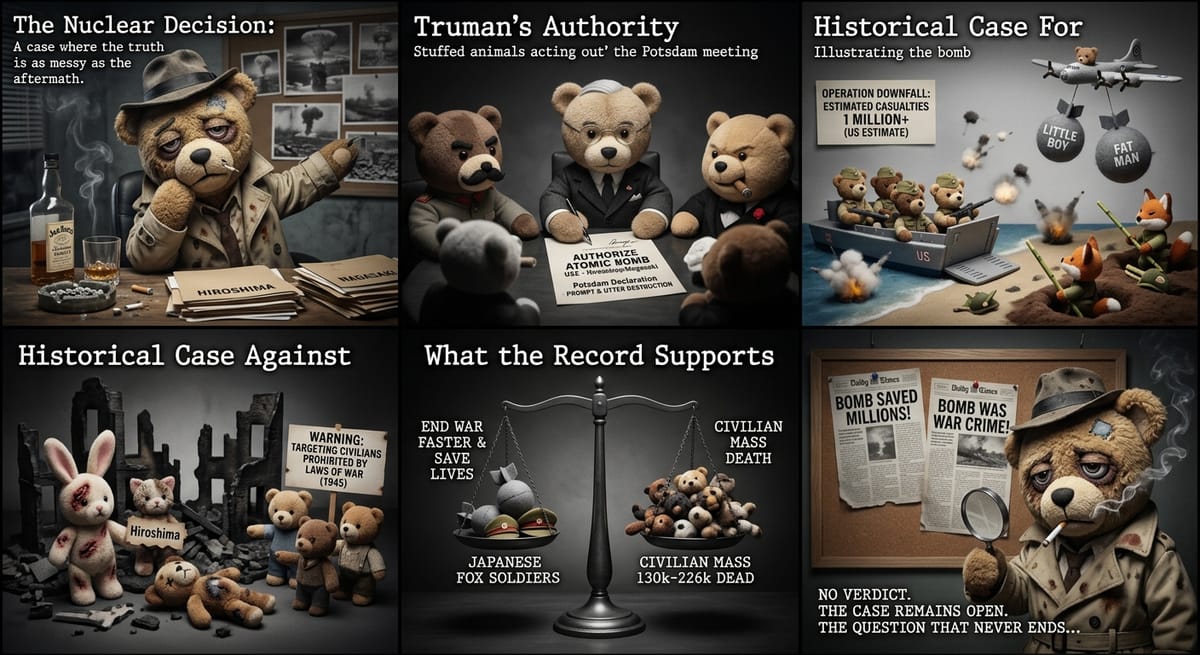
President Harry Truman authorized the use of the atomic bomb in a directive issued to the Strategic Air Forces on July 25, 1945, three days after receiving confirmation that the test at Alamogordo, New Mexico on July 16 had succeeded. The directive authorized the dropping of the bomb on four target cities — Hiroshima, Kokura, Nagasaki, and Niigata — after August 3, weather permitting. Truman was at the Potsdam Conference when the directive was issued, negotiating with Stalin and Churchill about the postwar order. The Potsdam Declaration, issued July 26, warned Japan to surrender or face “prompt and utter destruction” — without specifying that the destruction would be atomic.
Truman later wrote and said on multiple occasions that he had no doubts about the decision. “I regarded the bomb as a military weapon and never had any doubt that it should be used,” he wrote in his memoirs. His stated rationale was consistent: the bomb ended the war, avoided the invasion of Japan, and saved both American and Japanese lives. The specific figure he cited — half a million American lives saved — has been disputed by historians who argue it was inflated in retrospective accounts, with contemporary military estimates running lower, though still in the hundreds of thousands.^2^
The Historical Case for Using the Bomb
The argument that the atomic bombs ended the war and saved lives on both sides rests on several claims, each of which has significant historical support.
First: Japan was not on the verge of surrender before the bombs. The Supreme War Council in Tokyo was deadlocked in mid-1945 between military leaders who wanted to fight to the finish and civilian leaders who wanted to negotiate. Intercepted Japanese diplomatic communications — available to American planners through MAGIC decrypts — showed Japan seeking Soviet mediation for a negotiated peace, but the terms Japan was seeking (preservation of the emperor, no occupation, self-administered war crimes trials) were incompatible with the unconditional surrender the Allies demanded. The army faction controlled enough of Japanese decision-making to veto any surrender short of those terms.
Second: Operation Downfall, the planned invasion of the Japanese home islands, would have been catastrophic. Operation Olympic, the November 1945 landing on Kyushu, faced 600,000 Japanese defenders, including 10,000 kamikaze aircraft, 3,000 suicide boats, and a civilian militia armed with bamboo spears that Japanese military planners intended to deploy against American troops. American casualty estimates ranged from 250,000 to over a million; Japanese military and civilian casualties in an invasion would have exceeded anything the atomic bombs produced. The firebombing campaign was already killing hundreds of thousands of Japanese civilians; the pace of conventional destruction was not obviously more humane than the atomic alternative.
Third: the Soviet declaration of war on Japan on August 8, 1945 — between the two bombs — was also a decisive factor in Japan’s surrender decision, and the atomic bombs may have given the Japanese government a face-saving reason to accept the reality of their strategic situation rather than the primary cause of the decision to surrender.
The Historical Case Against
The argument that using atomic bombs on civilian cities was a war crime, or at minimum a moral catastrophe that should not be sanitized as military necessity, also rests on claims with historical support.
Hiroshima and Nagasaki were cities. Little Boy and Fat Man were not precision weapons aimed at military installations — they were area-destruction devices designed to destroy everything within their blast radius, and their targets were chosen in part because they had not already been firebombed, making them suitable for assessing bomb damage. The civilians who died were not incidental casualties of targeting military objectives; their deaths were the mechanism by which the bomb was intended to force Japanese surrender. Using civilian deaths as strategic leverage is, under the laws of war that existed in 1945, prohibited.
The question of whether Japan was on the verge of surrender without the bomb has been contested since the 1960s, when historian Gar Alperovitz published Atomic Diplomacy arguing that the bomb’s use was motivated as much by the desire to intimidate the Soviet Union in the emerging Cold War as by the desire to end the Pacific War. Alperovitz’s thesis has been challenged and modified by subsequent historians, but the question of Soviet deterrence as a factor in Truman’s decision remains live.
The most challenging version of the anti-bomb argument is not that Japan was about to surrender — the historical evidence does not support that cleanly — but that the United States could have demonstrated the bomb on an uninhabited target, or could have modified its unconditional surrender demand to allow for preservation of the emperor (a modification the United States ultimately accepted in the surrender terms anyway), before using the weapon on populated cities. The interim committee that advised Truman considered and rejected a demonstration in June 1945, concluding that a failed demonstration would embolden Japanese resistance. The modification of surrender terms was opposed by Secretary of State James Byrnes and others on grounds that it would appear to reward Japanese aggression.^3^
What the Historical Record Actually Supports
Historians continue to disagree on Hiroshima and Nagasaki, and the disagreements are not trivial — they concern the relative weight of evidence about Japanese surrender intentions, American casualty estimates, the influence of atomic diplomacy, and the moral framework applicable to area destruction of cities. What the historical record does support with reasonable confidence is this: the bombs ended the war faster than any available alternative, and Japanese military planners were preparing for an invasion they expected to fight to the last civilian. At the same time, the bombs killed between 130,000 and 226,000 civilians in two cities over three days — people who did not choose Japan’s war, could not control its prosecution, and had no more ability to produce Japanese surrender than the civilians of Tokyo who had already been firebombed months earlier. The argument that their deaths were an unavoidable cost of ending the war is a utilitarian calculation that requires accepting civilian mass death as a legitimate military instrument — which is precisely what the laws of war, before and after 1945, prohibit.
The nuclear decision and the drone warfare program sit at opposite ends of a scale of destructive intensity, but they share a structural feature: both required the executive branch to make unilateral decisions about killing civilians without judicial review, in contexts where the legal authorization was contested and the moral accounting was incomplete.
Containment
Hiroshima and Nagasaki do not have a verdict. The historians who have spent careers studying the documents disagree. The decision was made by human beings operating under genuine uncertainty about casualties, Japanese intentions, and Soviet ambitions, with weapons whose effects they had only seen once before — at a test site in the New Mexico desert, not on a city. Whether a different decision would have ended the war without more suffering is genuinely unknowable. What is knowable — what the record establishes — is that the decision was made deliberately, with awareness that cities would be destroyed and civilians would die in large numbers, and that the argument for making it has never been simply the argument for military necessity alone. The question that never ends is not unanswerable because the evidence is insufficient. It is unanswerable because it requires resolving moral questions about civilian life and military necessity that human beings, individually and collectively, have never agreed on — and that the invention of nuclear weapons made permanently urgent.
─────────
Sources:
- Frank, Richard B. Downfall: The End of the Imperial Japanese Empire. Random House, 1999.
- Walker, J. Samuel. Prompt and Utter Destruction: Truman and the Use of Atomic Bombs Against Japan. University of North Carolina Press, 1997.
- Alperovitz, Gar. The Decision to Use the Atomic Bomb. Knopf, 1995.