COINTELPRO: The FBI's War Against Its Own Citizens
The FBI's COINTELPRO program ran 15 years targeting civil rights leaders and dissidents — not for crimes but for ideas. Inside the surveillance program that bugged MLK and killed Fred Hampton.
COINTELPRO: The FBI’s War Against Its Own Citizens
COINTELPRO was a covert FBI domestic intelligence program that ran for 15 years — from 1956 to 1971 — targeting American citizens not for crimes they committed but for ideas they held and movements they joined. It was not a rogue operation. It was bureau policy, authorized at the highest levels, executed with bureaucratic thoroughness, and directed at over 2,000 organizations and individuals. When it came to light, it forced a reckoning with what an unaccountable federal police force could do to a democracy.
Part of Government Secrets — ← Back to series hub
COINTELPRO Targeted Political Organizing, Not Crime
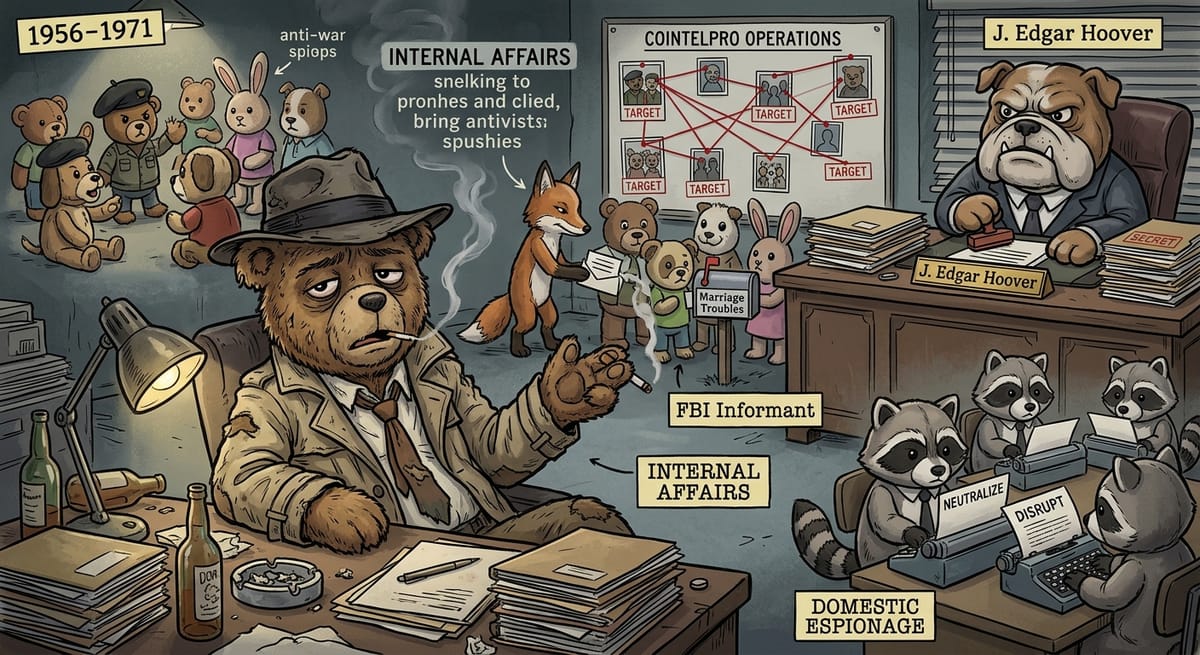
COINTELPRO began in August 1956, targeting the Communist Party USA at J. Edgar Hoover’s direction. Within a decade, it had expanded to cover the Socialist Workers Party, the Ku Klux Klan, Black nationalist groups, the American Indian Movement, and eventually almost anyone Hoover considered a threat to what he called “the American way of life.” By the late 1960s, that category included the Southern Christian Leadership Conference, the Student Nonviolent Coordinating Committee, Students for a Democratic Society, and the Black Panther Party.^1
The program operated through a playbook of dirty tricks: anonymous letters designed to break up marriages and friendships, fabricated documents planted to trigger violence between rival groups, false tips to employers that cost targets their jobs, and coordinated efforts with local police to harass, arrest, and in some cases physically harm activists. The FBI’s own files — declassified after the program became public — show agents proposing operations with language like “create factionalism,” “neutralize,” and “disrupt.” These weren’t metaphors.
The Bureau Built a Machine to Sustain Harassment
Each field office submitted proposals to Hoover’s Washington headquarters, which reviewed and approved them. Agents were graded on the number of operations they ran, creating institutional pressure to keep the harassment flowing. One 1968 memo from the Detroit field office proposed mailing a fake letter to a Black Panther leader suggesting a local rival was a government informant — a tactic designed to provoke internal violence. Headquarters approved it in ten days.^2
The program’s reach into legitimate political life was total. The FBI monitored the NAACP, the Urban League, anti-Vietnam War groups, and civil rights attorneys. Files were maintained on Supreme Court Justice William O. Douglas and on members of Congress. The goal, as one 1968 internal memo put it, was to “prevent the rise of a ‘messiah’ who could unify and electrify the militant Black nationalist movement.” The language was explicitly about preventing political organizing, not preventing crime.
Informants were recruited inside targeted groups, sometimes numbering in the dozens for a single organization. The FBI’s Los Angeles field office had 62 paid informants inside the Los Angeles chapter of the Black Panther Party by 1969. Some informants provided intelligence; others were tasked with actively sowing discord, starting arguments, and provoking confrontations.
What Did COINTELPRO Actually Do to the People It Targeted?
Martin Luther King Jr. was one of the program’s primary targets from at least 1962 onward. The FBI bugged his hotel rooms, tapped his phones, and collected recordings of his private life. In November 1964, two weeks before King was scheduled to accept the Nobel Peace Prize in Oslo, an FBI agent sent him a package containing audio recordings of his extramarital affairs along with an anonymous letter. The letter told King he had 34 days before the recordings would be made public, concluding: “There is but one way out for you. You better take it before your filthy, abnormal fraudulent self is bared to the nation.”^3 King’s family later confirmed he understood the letter as a suggestion that he commit suicide.
Fred Hampton, 21-year-old chairman of the Illinois Black Panther Party, was killed on December 4, 1969, in a pre-dawn raid by Chicago police acting on intelligence the FBI had provided — including a floor plan of his apartment drawn by an FBI informant. Hampton was shot twice in the head at close range while asleep or nearly unconscious, likely drugged by the same informant who had put a sedative in his drinks the night before. A federal grand jury found in 1977 that the raid was effectively an assassination. No officers were ever criminally charged.
The COINTELPRO operation against the American Indian Movement in the early 1970s — conducted under a successor program after the original was officially ended — contributed to a climate of violence on the Pine Ridge Reservation in South Dakota that resulted in at least 60 AIM members or supporters killed between 1973 and 1976.
Hoover’s Unchecked Power Made the Program Possible
COINTELPRO was possible because J. Edgar Hoover had run the FBI since 1924 and had accumulated enough dirt on enough politicians to make himself effectively immune to oversight. Senators and presidents who knew about or suspected the program’s excesses were reluctant to challenge a man who might have files on them. The FBI operated with virtually no external review — no inspector general, no congressional oversight mechanism with real teeth, no judicial authorization required for domestic intelligence operations.
The program only became public because of a break-in. On March 8, 1971 — the night of the Muhammad Ali–Joe Frazier fight, when they calculated the office would be unguarded — a group calling itself the Citizens’ Commission to Investigate the FBI broke into a field office in Media, Pennsylvania, and stole over 1,000 documents. They mailed copies to newspapers. The Washington Post published them over FBI objections. The word COINTELPRO appeared in public for the first time.^4
Congressional investigations followed. The Church Committee — formally the Senate Select Committee to Study Governmental Operations with Respect to Intelligence Activities, chaired by Senator Frank Church of Idaho — spent two years, from 1975 to 1976, documenting the program’s full scope. Its final report ran to 14 volumes and documented not just COINTELPRO but the CIA’s assassination plots against foreign leaders, NSA mass surveillance, and IRS audits of political opponents. The committee found that the FBI had opened 500,000 domestic intelligence files between 1960 and 1974.^5
COINTELPRO was officially terminated by Hoover on April 28, 1971, six weeks after the Media break-in, though successor programs continued under different names. Hoover died in May 1972, ending his 48-year directorship. Congress passed the Foreign Intelligence Surveillance Act in 1978, creating the first legal framework requiring judicial approval for domestic intelligence operations. FBI directors were subsequently limited to 10-year terms.
The accountability was real but partial. No FBI agent was ever criminally prosecuted for COINTELPRO operations. The Justice Department reviewed the program and declined to prosecute. Civil suits brought by survivors and families of victims — including Fred Hampton’s family, which reached a $1.85 million settlement in 1982 — provided some measure of reckoning. But the institutional redesign that followed stopped well short of dismantling the surveillance architecture that had made the program possible in the first place.
What COINTELPRO revealed is that the most dangerous threats to democratic governance don’t always announce themselves. They accumulate inside bureaucracies, authorized memo by memo, and they target the people trying to change things — not the people breaking laws. The program ran for 15 years. It took a break-in to expose it. For a broader look at how the same pattern played out in government medical research and CIA operations, see MKUltra and the Tuskegee syphilis study.
─────────
Sources:
- Cunningham, David. There’s Something Happening Here: The New Left, the Klan, and FBI Counterintelligence. University of California Press, 2004.
- Churchill, Ward and Jim Vander Wall. The COINTELPRO Papers: Documents from the FBI’s Secret Wars Against Dissent in the United States. South End Press, 1990.
- Garrow, David J. The FBI and Martin Luther King, Jr.: From “Solo” to Memphis. W. W. Norton, 1981.
- Medsger, Betty. The Burglary: The Discovery of J. Edgar Hoover’s Secret FBI. Knopf, 2014.
- United States Senate. Final Report of the Select Committee to Study Governmental Operations with Respect to Intelligence Activities. U.S. Government Printing Office, 1976.