Drone Warfare Ethics: Killing by Remote Control
The U.S. has killed American citizens by drone without trial including a 16-year-old boy. The legal memos authorizing it remain partially classified. No charges filed.
Drone Warfare Ethics: Killing by Remote Control
On September 30, 2011, a CIA-operated Predator drone killed Anwar al-Awlaki — an American citizen, born in Las Cruces, New Mexico — in Al Jawf Province, Yemen. Two weeks later, on October 14, a separate drone strike killed Abdulrahman al-Awlaki, Anwar’s sixteen-year-old son, also an American citizen, who was not a known member of any terrorist organization.^1^ Neither man was charged with a crime. Neither received a hearing. The United States government later declined to explain why the son had been killed. Drone warfare is the live case in the war crimes debate: ongoing, legally contested, and producing civilian casualties that the government has consistently undercounted.
Part of Controversial American Military Actions — ← Back to series hub
What the Drone Program Actually Is
The modern American drone warfare program grew from two separate but intertwined operations: the CIA’s covert program, operating under presidential finding authority in countries where the United States was not at war, and the military’s overt program operating in Afghanistan, Iraq, and Syria under the laws of armed conflict. Both programs use remotely piloted aircraft — primarily the MQ-1 Predator and the larger MQ-9 Reaper — to conduct surveillance and strike operations. Both can fire missiles from thousands of feet in the air, controlled by operators sitting in ground stations in Nevada, New Mexico, or Virginia, watching video feeds from cameras on the aircraft’s undercarriage.
The Obama administration dramatically expanded the drone program inherited from the Bush administration. Between 2009 and 2016, the United States conducted approximately 540 drone strikes in Pakistan, Yemen, Somalia, and Libya — countries where Congress had not authorized military force. The Bush administration had conducted approximately 50 such strikes in its eight years. The Trump administration further relaxed targeting rules in 2017, designating portions of Somalia and Yemen as “areas of active hostilities” where the stricter civilian protection standards applied under Obama’s Presidential Policy Guidance no longer applied.^2^
Three Legal Justifications With Serious Gaps
American drone strikes outside recognized war zones rest on three overlapping legal justifications, each of which has serious critics.
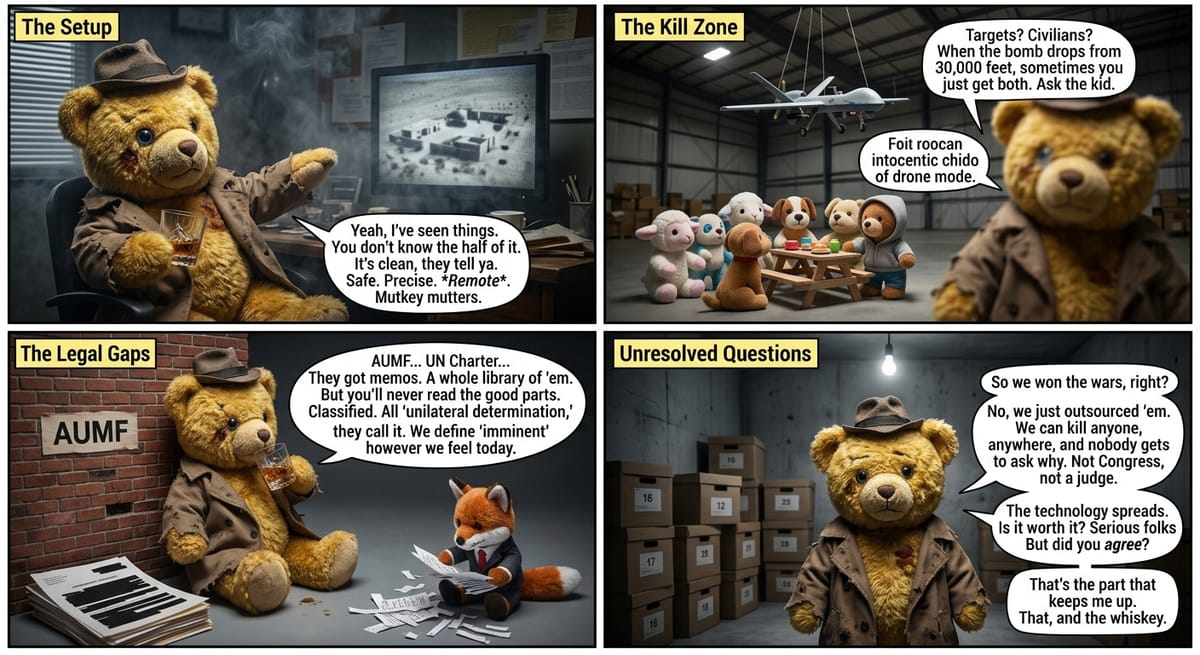
The first is the 2001 Authorization for Use of Military Force, passed by Congress three days after September 11 to authorize military action against the perpetrators of the attacks and those who harbored them. Every administration from Bush through Biden has interpreted the AUMF as authorizing strikes against al-Qaeda, the Taliban, and “associated forces” globally and indefinitely. The text of the AUMF does not explicitly authorize this; it is an executive branch interpretation of broad statutory language, extended to groups like al-Shabaab in Somalia and ISIS in Syria that did not exist on September 11, 2001.
The second is Article 51 of the UN Charter, authorizing the use of force in self-defense. The United States government has argued that drone strikes in Pakistan, Yemen, and Somalia are acts of self-defense against imminent threats, conducted with the consent of host governments (a contested claim in the case of Pakistan). The legal standard for “imminence” in this context — what level of threat, over what time horizon, justifies a lethal strike without judicial process — has never been publicly defined by the government and was described by then-Attorney General Eric Holder in a 2012 speech in terms that critics argued were so broad as to be meaningless.
The third is the domestic legal framework for killing American citizens. In 2011, the Justice Department’s Office of Legal Counsel produced a memorandum — classified until 2014 — concluding that the killing of Anwar al-Awlaki was constitutional despite his citizenship, because he posed an imminent threat, capture was infeasible, and the operation would be conducted in compliance with applicable law of war principles. The memo’s reasoning was challenged by legal scholars across the political spectrum, including those who accepted that al-Awlaki was a legitimate target, on the grounds that the executive branch had asserted the authority to determine unilaterally — without judicial review — which citizens could be killed.^3^ The same pattern of classified legal justification that enabled Abu Ghraib’s torture memos appears here, with the same absence of external review.
The Civilian Cost the Government Consistently Undercounted
The Bureau of Investigative Journalism, which has maintained the most systematic public database of drone strikes and casualties since 2010, estimated that American drone strikes in Pakistan alone between 2004 and 2020 killed between 2,558 and 3,668 people, of whom between 424 and 969 were civilians. In Yemen, strikes between 2002 and 2020 killed between 199 and 324 civilians. These numbers are minimums — they reflect documented cases and acknowledge significant uncertainty about strikes in areas with limited media access.
The government’s own accounting of civilian casualties has been consistently lower than independent estimates, a discrepancy that became a public issue when the Obama administration adopted a methodology in 2012 that counted all military-age males in a strike zone as combatants unless intelligence specifically established they were not. This methodology effectively defined “civilian” in a way that excluded most of the people independent monitors were classifying as civilians.
The strike that killed Abdulrahman al-Awlaki illustrates the problem concretely. The sixteen-year-old was eating dinner with a group of teenagers and young men at a roadside restaurant when the strike occurred. Eight other young men died with him. The government’s public explanation — that he was not the target, that the target was Ibrahim al-Banna, an Egyptian al-Qaeda propagandist — did not explain why a strike on a restaurant full of teenagers was authorized. The subsequent executive order requiring the president to personally approve every strike in Yemen and Somalia and requiring near-certainty of no civilian casualties was issued in May 2013, nineteen months after Abdulrahman al-Awlaki was killed.
What Remains Unresolved
Drone warfare represents a set of genuinely new questions that existing law and ethical frameworks were not designed to answer: Can a government kill its own citizens without judicial process? How is “imminence” defined when the enemy operates continuously rather than in discrete attacks? What accountability exists when strikes are conducted covertly, casualties are classified, and the legal memos authorizing the program remain partially redacted? Does the availability of a weapon that can kill without risking American lives lower the threshold for using lethal force in ways that increase total violence rather than reducing it?
The Obama administration engaged with these questions more publicly than its predecessor, publishing the Presidential Policy Guidance in 2013 and releasing portions of the legal memos in 2014. The Trump administration rescinded the PPG in 2017 and did not replace it with an equivalent public framework. The Biden administration reinstated civilian casualty review requirements in 2021, then withdrew American forces from Afghanistan in a way that effectively ended the program there while continuing operations in Somalia and Syria. The executive branch authority to strike and classify simultaneously — evident in drone warfare, prefigured in the nuclear decision, and structurally continuous with the legal reasoning behind Japanese internment — has never been resolved by judicial review.
Containment
The drone warfare debate is unfinished in a specific way: the technology is proliferating, the legal framework is contested, and the accountability gap between strikes conducted and casualties acknowledged has never been closed. What drone warfare has established as fact — that the United States will kill people, including its own citizens, in countries where it is not at war, based on executive branch determinations that receive no judicial review — is a significant departure from the legal and ethical framework Americans have historically associated with their government’s conduct. Whether that departure is justified by the security gains it produces is a question on which serious people disagree. Whether it has been adequately accounted for, publicly disclosed, and subjected to democratic deliberation is a question with a clearer answer.
─────────
Sources:
- Scahill, Jeremy. Dirty Wars: The World Is a Battlefield. Nation Books, 2013.
- The Bureau of Investigative Journalism. Drone Warfare. www.thebureauinvestigates.com/projects/drone-war.
- Greenwald, Glenn. No Place to Hide: Edward Snowden, the NSA, and the U.S. Surveillance State. Metropolitan Books, 2014.