No Gun Ri: The Korean War Massacre America Tried to Forget
U.S. soldiers killed up to 300 South Korean civilians at No Gun Ri in 1950. The Army denied it for 50 years then expressed regret — no charges filed.
No Gun Ri: The Korean War Massacre America Tried to Forget
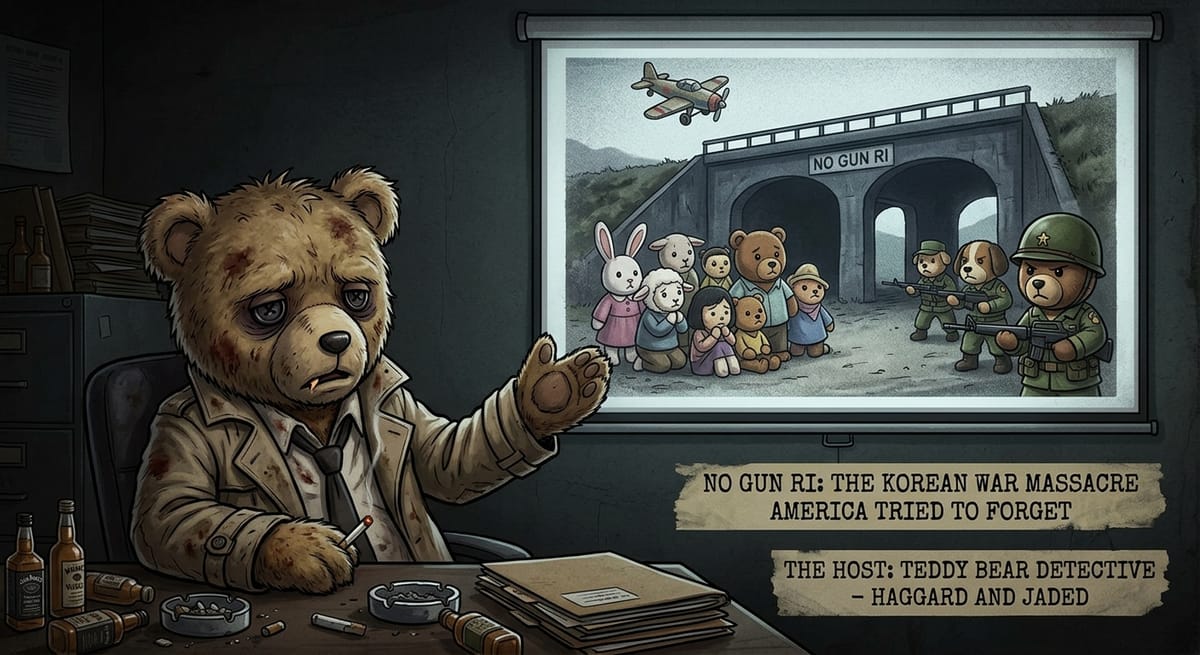
For nearly fifty years, the U.S. government denied that the No Gun Ri massacre had ever happened. Between July 26 and July 29, 1950, soldiers of the 7th Cavalry Regiment, 1st Cavalry Division opened fire on South Korean refugees sheltering under a railroad bridge at No Gun Ri, in North Chungcheong Province. The survivors put the civilian death toll at between 100 and 300. The Army put it at zero — for five decades the official position was that the massacre had not happened.^1^
Part of American War Crimes — ← Back to series hub
How the Worst Month in Modern American Military History Set the Stage
July 1950 was the worst month in American military history since the end of World War II. The Korean People’s Army had crossed the 38th Parallel on June 25 and driven the undermanned and unprepared U.S. and South Korean forces south in a collapse. The 1st Cavalry Division was among the first American units committed, and they were being pushed back toward Pusan.
In this context, American commanders faced a real and specific problem: North Korean soldiers were infiltrating South Korean civilian refugee columns. On July 24, 1950, the commander of the U.S. 8th Army, Lieutenant General Walton Walker, issued an order warning that enemy soldiers were using refugee movements as cover. The order was real. The threat was real. What happened next at No Gun Ri was not an authorized response to that threat — it was a panic that killed civilians the soldiers were supposed to protect.
On July 26, soldiers of the 7th Cavalry halted a column of several hundred South Korean civilians on a road near Im Gae Ri, checked them for weapons and enemy soldiers, found none, and then — after receiving orders from officers — directed the civilians under the railroad bridge at No Gun Ri. What happened next is documented in survivor accounts, Army veterans’ testimony, and declassified military records: U.S. aircraft strafed the refugee column on the road, and then soldiers at both ends of the twin-tunnel railroad bridge opened fire on the civilians sheltering inside. The firing continued intermittently for three days.^2^
The Survivors Who Kept Asking
Among the survivors was Chung Eun-yong, who lost two children at No Gun Ri. He spent decades collecting testimony from other survivors, writing letters to Korean and American governments, and being dismissed. His account, and the accounts of other survivors organized into the No Gun Ri Peace Foundation, became the foundation for the AP investigation that eventually broke the story.
The Associated Press investigation, led by reporters Charles Hanley, Sang-Hun Choe, and Martha Mendoza, published on September 29, 1999. The report included the testimony of South Korean survivors and, critically, the testimony of American veterans of the 7th Cavalry who confirmed that the shooting had occurred. Edward Daily, one veteran who spoke to the AP, later turned out to have fabricated or embellished his account — a complication the Army used to cast doubt on the broader investigation, though other veterans’ accounts held up under scrutiny. The AP investigation won the Pulitzer Prize for Investigative Reporting in 2000.
What the Army’s Investigation Found — and How It Fell Short
The Clinton administration ordered a Defense Department investigation in response to the AP report. The Army investigation, completed in January 2001, confirmed that U.S. soldiers had fired on civilians at No Gun Ri and that civilians had died. It found that the shooting was not ordered and not authorized, and that the death toll was “probably” in the range of “several dozen” — lower than the survivor estimates of 100 to 300.
The Army recommended no criminal charges, citing the passage of fifty years and the deaths of most of those involved. It recommended a formal expression of regret — not an apology — and a scholarship fund for Korean students. South Korean survivors and their advocates found the response inadequate, and a subsequent South Korean government investigation in 2005 concluded that the massacre had been deliberate and that the death toll was likely higher than the American estimate.^3^
The investigation also established that orders relating to refugees and potential enemy infiltrators had been issued up the chain of command, and that the 1st Cavalry Division had received guidance about controlling refugee movement in the days before No Gun Ri. The Army’s conclusion — that no order to fire on civilians at No Gun Ri specifically existed — left unresolved the question of what orders had created the conditions in which soldiers made the decision to open fire. The same unresolved question — command responsibility versus individual decision — runs through the My Lai and Abu Ghraib cases as well.
Why the Cover Required No Conspiracy
The Korean War has always occupied an uncomfortable position in American memory — fought between World War II and Vietnam, poorly understood, producing no decisive victory, not easily narrated as triumph or cautionary tale. The 1.8 million American veterans of the conflict were not a constituency demanding investigation of atrocities. The South Korean government spent decades as a close American ally dependent on U.S. security guarantees; raising No Gun Ri was not politically advantageous until democratization in the 1980s created space for survivors’ organizations to operate.
The Army’s suppression of the incident was also, by the standards of active cover-ups, relatively passive. No Gun Ri did not require a systematic conspiracy — it required nothing more than the normal bureaucratic tendency to file uncomfortable reports where they would not be found, and to not ask the questions whose answers would be inconvenient. The mass death of South Korean civilians in the first weeks of a war fought to defend South Korea was not a story that served anyone’s interest in 1950. The same bureaucratic passivity, distinct from active concealment, explains how the Philippine-American War atrocities spent decades outside the mainstream curriculum despite being documented in Senate testimony.
Containment
The No Gun Ri survivors waited forty-nine years for the U.S. government to acknowledge that the event had occurred. They received, in the end, a formal expression of regret, a scholarship fund, and a finding that the killing was not ordered — which left the question of responsibility for conditions that produced the killing formally unanswered. The gap between what the survivors asked for and what they received is not unusual in the history of American military accountability. What is unusual about No Gun Ri is that the survivors kept asking long enough to get anything at all.
─────────
Sources:
- Hanley, Charles J., Sang-Hun Choe, and Martha Mendoza. The Bridge at No Gun Ri: A Hidden Nightmare from the Korean War. Holt, 2001.
- U.S. Department of the Army. No Gun Ri Review. January 2001.
- Truth and Reconciliation Commission of Korea. No Gun Ri Incident Report. 2009.