The My Lai Massacre: When American Soldiers Slaughtered a Village
American soldiers killed 347-504 unarmed Vietnamese civilians at My Lai in 1968. One soldier was convicted. The officers who built the system walked free.
The My Lai Massacre: When American Soldiers Slaughtered a Village
On March 16, 1968, soldiers of Charlie Company, 1st Battalion, 20th Infantry Regiment, 23rd Infantry Division entered the hamlet of My Lai in Son My village, Quảng Ngãi Province, South Vietnam. By mid-morning they had killed between 347 and 504 unarmed civilians — old men, women, children, and infants. No shots were fired at them. Not a single weapon was found.^1^ The My Lai massacre remains the most thoroughly documented American war crime of the twentieth century, and it produced exactly one conviction.
Part of American War Crimes — ← Back to series hub
What Happened in Those Four Hours
Charlie Company moved into My Lai as part of Operation Muscatine, expecting to engage the 48th Local Force Battalion of the Viet Cong. They found no enemy combatants. What they found were families eating breakfast.
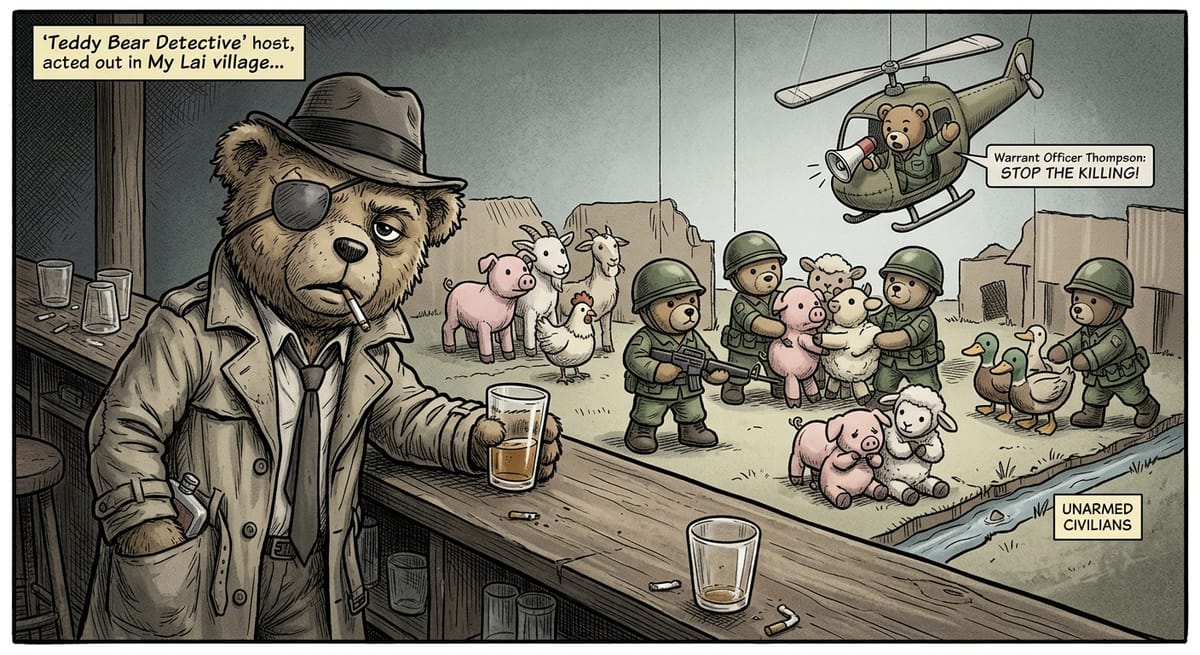
Lieutenant William Calley ordered his platoon to round up villagers. Over the next several hours, soldiers shot people at close range, threw grenades into bunkers where families were hiding, and pushed groups of men, women, and children into an irrigation ditch before opening fire. Warrant Officer Hugh Thompson, an Army helicopter pilot who observed the killing from above, landed his OH-23 scout helicopter three times to confront soldiers and extract survivors. He ordered his door gunner, Lawrence Colburn, to shoot any American soldier who harmed the civilians Thompson was evacuating.^2^ Thompson radioed in reports of the massacre to his superiors. Nothing stopped.
The official Army report filed that day described a military victory: 128 Viet Cong killed, three weapons captured. The civilians were classified as enemy combatants.
Who Was Actually Responsible?
The operational context matters: Charlie Company had recently lost men to booby traps and sniper fire. Captain Ernest Medina briefed the company the night before the operation. Exactly what Medina said at that briefing became one of the central disputes of the subsequent investigation. Some soldiers testified he authorized killing all inhabitants of My Lai; Medina insisted he gave no such order. The Army concluded the orders were ambiguous at best, criminally clear at worst — and left the judgment to individual soldiers who had been dehumanizing a civilian population for months.
Lieutenant General William Peers, who led the subsequent Army inquiry, identified at least thirty officers who either participated in the massacre, knew about it, or failed to report it. The chain of cover-up ran from the platoon level to the division command.
How a Cover-Up Held for Eighteen Months
The Army successfully suppressed My Lai for more than a year. It took a letter from veteran Ron Ridenhour, who had heard firsthand accounts from soldiers in Charlie Company, to force an investigation. Ridenhour wrote to thirty members of Congress in March 1969, describing what he had been told. The Army finally launched a criminal investigation.
Investigative journalist Seymour Hersh broke the story publicly in November 1969, after the Army had already quietly charged Calley. The photographs taken by Army photographer Ronald Haeberle, who had accompanied Charlie Company with a personal camera in addition to his military-issue camera, were published in Life magazine on December 5, 1969. The images — ditches filled with bodies, children shot at close range — made suppression impossible.^3^ This was the same Seymour Hersh who later exposed Abu Ghraib in 2004, applying the same investigative method to a later generation of the same institutional failure.
The Accountability That Didn’t Follow
Twenty-six soldiers were charged with criminal offenses related to My Lai. One was convicted. Lieutenant William Calley was found guilty of the premeditated murder of twenty-two civilians in March 1971 and sentenced to life imprisonment. President Nixon ordered him transferred from prison to house arrest at Fort Benning pending appeal within days of the verdict. After a series of appeals and reviews, Calley was paroled in November 1974, having served three and a half years under house arrest.
Captain Medina was acquitted. Every other officer was either acquitted or had charges dropped. Hugh Thompson, the pilot who tried to stop the massacre, was initially condemned by members of Congress as a traitor for turning his gun on fellow Americans. He received the Soldier’s Medal in 1998 — thirty years later.
The System That Made My Lai Predictable
My Lai was not an isolated incident produced by a few bad actors. The Army’s Peers Inquiry concluded that the massacre grew from systemic failures: a body count metric that incentivized killing, a civilian population treated as collective enemy, and a chain of command that failed at every level to enforce the laws of war.
The “mere gook rule” was a phrase documented in testimony — an informal understanding that Vietnamese civilians did not deserve the protections American law required. Free Fire Zones had been designating populated areas as legitimate targets for years before March 1968. The same structural logic — counterinsurgency without a front, enemies who look like civilians, metrics that reward body counts — would reappear decades later in the conditions that produced Abu Ghraib and in the legal architecture of the drone warfare program.^1^ The 48th VC Battalion that Charlie Company was sent to destroy was real; the threat was real. The decision to redirect that threat onto a village of farmers eating breakfast was a choice, made by men who had been told — through training, through briefings, through months of operating in a war with no front — that the choice was acceptable.
The accountability gap at My Lai also tracks directly with what happened in the Philippine-American War, where General Jacob Smith was court-martialed for ordering a “howling wilderness” and received an admonishment and a pension. The pattern across a century of American counterinsurgency is consistent: the soldier in the field bears the consequences; the system that placed him there does not.
Containment
My Lai became a fixed point in American memory partly because of what it confirmed and partly because of what it refused to resolve. It confirmed that American soldiers could commit atrocities. It refused to resolve who bore responsibility when the systems producing those soldiers — the briefings, the metrics, the rules of engagement, the command culture — were the actual machinery of the crime.
Calley’s pardon left the question of accountability formally unanswered. The men who wrote the orders, set the metrics, and covered up the evidence spent the rest of their careers in the Army or retired without charges. Thompson was called a traitor before he was called a hero. The 347 to 504 people killed in My Lai that morning have individual names in some cases — Truong Thi Le, Do Thi Chuc, Nguyen Thi Tau — but mostly they exist in the record as a number that itself remains disputed. That gap between the number and the names is where the history actually lives.
─────────
Sources:
- Peers, William R. The My Lai Inquiry. Norton, 1979.
- Bilton, Michael, and Kevin Sim. Four Hours in My Lai. Viking, 1992.
- Hersh, Seymour M. My Lai 4: A Report on the Massacre and Its Aftermath. Random House, 1970.