Philippine-American War Atrocities: The Colonial War Nobody Talks About
The Philippine-American War killed up to 600000 Filipinos through combat and deliberate reconcentration policies. The general responsible was admonished and pensioned.
Philippine-American War Atrocities: The Colonial War Nobody Talks About
The Philippine-American War began on February 4, 1899, when American soldiers fired on Filipino forces near Manila, and it ended — officially — on July 4, 1902, though guerrilla resistance continued for years after. In those three years and beyond, American forces killed between 200,000 and 600,000 Filipinos, the majority of them civilians, through combat, famine, and disease produced by a military campaign that included deliberate concentration of civilians, the burning of villages, the torture of prisoners, and the systematic destruction of the agricultural economy of Luzon.^1^ The Philippine-American War atrocities are not taught in most American schools — which is itself a fact worth examining.
Part of American War Crimes — ← Back to series hub
Why America Was There in the First Place
Spain ceded the Philippines to the United States for $20 million in the Treaty of Paris, signed December 10, 1898, ending the Spanish-American War. Emilio Aguinaldo and the Philippine Revolutionary Army had been fighting for independence from Spain alongside American forces, believing American promises of Philippine sovereignty. When they learned the terms of the treaty — that they had been sold to a new colonial power — the alliance collapsed.
The conflict that followed was not the quick pacification campaign American commanders expected. Aguinaldo’s forces, numbering around 40,000 at the start, initially fought in conventional military engagements and lost. By late 1899 they had shifted to guerrilla tactics — the same insurgent strategy that would frustrate American forces in Vietnam sixty years later and in Iraq a century later. The Philippine countryside, with its dense terrain and a civilian population that supported or was coerced into supporting the resistance, made the guerrilla force impossible to defeat conventionally.
What “Water Cure” Actually Meant
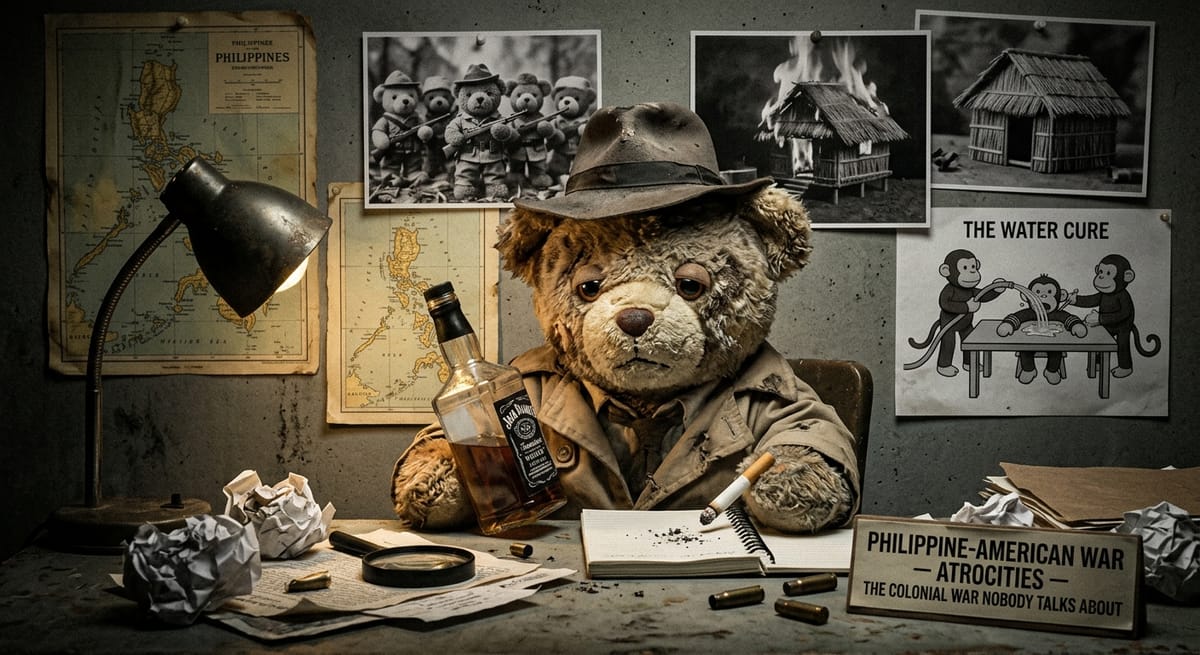
The military response to guerrilla warfare produced a documented catalog of atrocities. The “water cure” — waterboarding, in modern terminology — was applied to Filipino prisoners and was widely reported in American newspapers as early as 1900. General Frederick Funston, who captured Aguinaldo in March 1901 through a deception operation, acknowledged that the water cure was used and defended it publicly. Senator Albert Beveridge of Indiana responded to Senate debate about Philippine atrocities by arguing that the Filipinos were not capable of self-government and that American rule was a civilizing mission.^2^
General Jacob Smith, commanding operations in the province of Samar following the Balangiga Massacre of September 28, 1901 — in which Filipino forces killed 48 American soldiers in a surprise attack on Company C, 9th Infantry — ordered his subordinates to make Samar “a howling wilderness.” His orders, later quoted in his court-martial, directed that every person capable of bearing arms be killed. He specified the age threshold as ten years and above.
Smith was court-martialed in 1902. He was found guilty of “conduct to the prejudice of good order and military discipline” — not of ordering atrocities — and was admonished. He was then retired, not imprisoned, and received his pension. The sentence provoked outrage in the press, including from Mark Twain, who had become one of the most prominent anti-imperialist voices in America and who wrote extensively about Philippine atrocities in his essays and in letters to newspapers.
Reconcentration: The Policy That Killed Hundreds of Thousands
The most consequential American tactic in suppressing the Philippine insurgency was reconcentration — forcing the civilian population of contested areas into guarded camps to deny the guerrillas food, shelter, and support. General Arthur MacArthur, the military governor of the Philippines and father of Douglas MacArthur, implemented reconcentration policies across Luzon beginning in 1900.
The camps were underfed, overcrowded, and disease-ridden. Civilians who remained outside the designated zones were treated as enemy combatants. The crops and livestock outside the camps were destroyed to starve the guerrillas. The result was mass civilian death — not primarily from combat but from the deliberate destruction of the conditions necessary to survive. The death toll from disease and famine in the reconcentration zones has been estimated in the hundreds of thousands, though precise figures are disputed by historians working from fragmented records.^3^
This was not an improvisation. Reconcentration was a deliberate military strategy that American commanders had explicitly criticized when the Spanish used it in Cuba just four years earlier. Secretary of War Elihu Root approved the reconcentration policies in the Philippines while the Spanish officer who had implemented similar policies in Cuba, Valeriano Weyler, was still being denounced in the American press as “Butcher Weyler.” The same logic — isolate the civilian population to deny the insurgency its base — would appear again in Vietnam’s Strategic Hamlet program sixty years later, and in the conditions that preceded My Lai.
The Senate Investigation That Changed Nothing
Senator George Hoar of Massachusetts pushed for a Senate investigation of Philippine atrocities in 1902. The hearings that followed produced testimony from American soldiers who described the water cure, the burning of villages, and the execution of prisoners. The testimony was reported in newspapers. Congress did not halt the war, did not court-martial the generals who had ordered the policies, and did not fundamentally alter American conduct in the Philippines.
The war officially ended that July. The Moro Rebellion in the southern Philippines, fought primarily against Muslim Filipinos who had not been part of Aguinaldo’s movement, continued until 1913. The Battle of Bud Dajo in March 1906 — in which American forces under General Leonard Wood killed approximately 600 Moro men, women, and children in a crater on the island of Jolo — produced another round of press outrage and another round of official inquiries that produced no criminal accountability. The accountability gap here — congressional investigation, press coverage, and no prosecutions above the lowest ranks — anticipates exactly the pattern that would appear with Abu Ghraib a century later.^1^
Containment
The Philippine-American War is not obscure because the evidence is missing — the Senate testimony, the court-martial records, the newspaper accounts, and the casualty estimates have been available to historians for over a century. It is obscure because it does not fit the story Americans prefer about themselves at the turn of the twentieth century. The war happened at the same moment as the progressive era, the Square Deal, and the beginning of American global leadership. Placing it alongside those narratives requires acknowledging that the same government that was busting trusts and building national parks was also running concentration camps in Southeast Asia and court-martialing officers for the appearance of atrocities rather than the atrocities themselves. The Philippines became an American commonwealth in 1935 and achieved independence on July 4, 1946. The question of what American colonialism cost the Filipino people between 1899 and 1946 has never been part of official American memory.
─────────
Sources:
- Kramer, Paul A. The Blood of Government: Race, Empire, the United States, and the Philippines. University of North Carolina Press, 2006.
- Miller, Stuart Creighton. “Benevolent Assimilation”: The American Conquest of the Philippines, 1899–1903. Yale University Press, 1982.
- Linn, Brian McAllister. The Philippine War, 1899–1902. University Press of Kansas, 2000.