Japanese Internment: When America Imprisoned Its Own Citizens
Executive Order 9066 sent 120000 Japanese Americans to internment camps in 1942. Two-thirds were U.S. citizens. The Supreme Court upheld it. It took 46 years for an apology.
Japanese Internment: When America Imprisoned Its Own Citizens
Executive Order 9066, signed by President Franklin D. Roosevelt on February 19, 1942, led to the forced relocation of 120,000 Japanese Americans — two-thirds of them U.S. citizens — to internment camps across seven western states. Japanese internment is one of the most thoroughly litigated constitutional violations in American history: upheld by the Supreme Court in 1944, formally repudiated in 2018, and in between producing a formal apology and $20,000 reparations to surviving internees that arrived, for most of them, after decades of waiting.^1^ They were given days to liquidate their businesses, homes, and farms, allowed to bring only what they could carry, and held without charge or trial for up to four years.
Part of Controversial American Military Actions — ← Back to series hub
What EO 9066 Actually Did
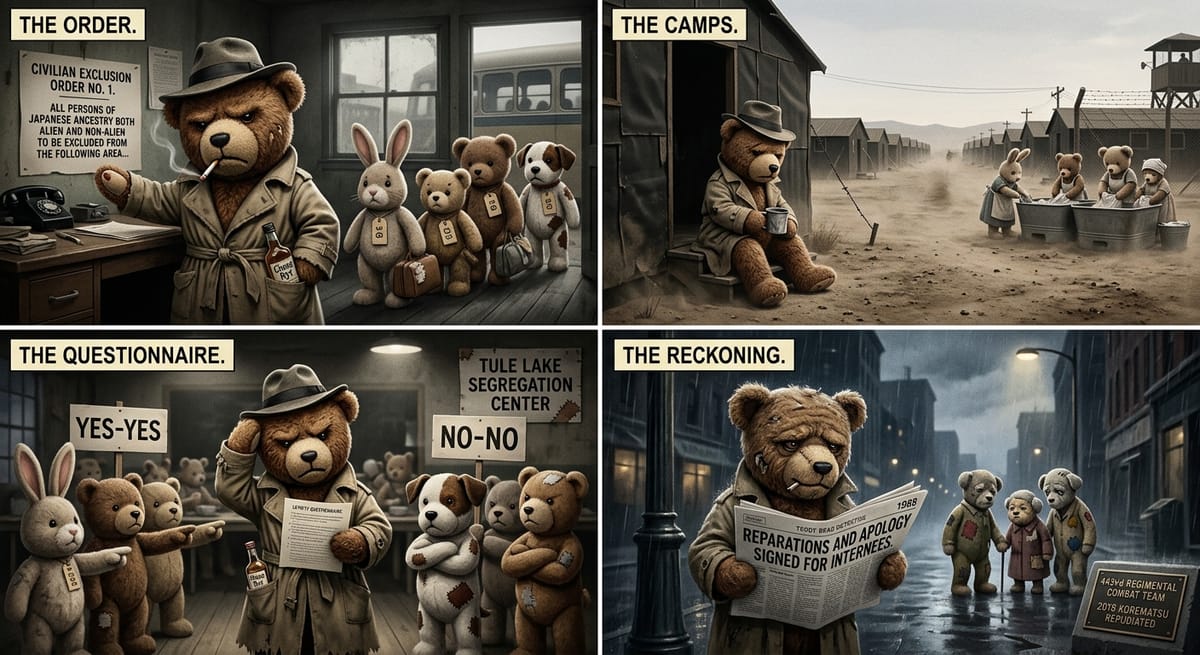
Six weeks after Pearl Harbor, Roosevelt signed EO 9066, authorizing the Secretary of War to designate military areas from which any or all persons could be excluded. The order did not mention Japanese Americans by name — it didn’t need to. General John DeWitt, commanding the Western Defense Command, designated the entire Pacific Coast as a military area and issued Civilian Exclusion Orders applying to all persons of Japanese ancestry, regardless of citizenship.
The exclusion applied to anyone with one-sixteenth or more Japanese ancestry. It did not apply to German Americans or Italian Americans in comparable numbers, despite the United States being at war with Germany and Italy. DeWitt’s own statements explained the reasoning: “A Jap’s a Jap,” he told a congressional committee in April 1943. “It makes no difference whether the citizen is theoretically a citizen — he is still a Japanese.” Approximately 127,000 Japanese Americans lived on the West Coast at the time of the order. Most of them were American citizens by birth.
What Life in the Camps Actually Looked Like
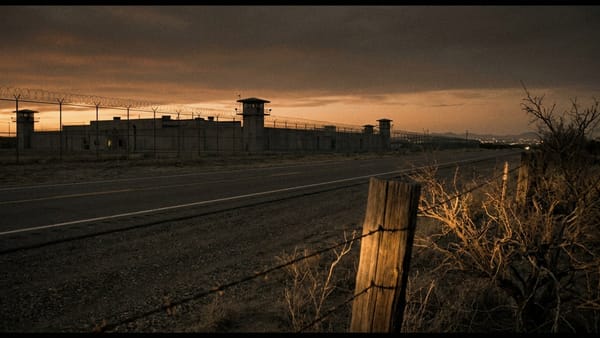
The War Relocation Authority established ten internment camps, formally called “relocation centers,” in remote, inhospitable locations: Manzanar and Tule Lake in California; Minidoka in Idaho; Heart Mountain in Wyoming; Amache in Colorado; Topaz in Utah; Poston and Gila River in Arizona; Jerome and Rohwer in Arkansas. The camps were surrounded by guard towers and barbed wire. Internees lived in hastily constructed barracks, often one family to a room, in temperatures that ranged from below freezing in winter to over 100 degrees in summer.^2^
Internees were permitted to work within the camps and in limited outside employment programs, earning between $12 and $19 per month — significantly less than the wages paid to non-Japanese workers doing the same jobs. Many internees lost their businesses, farms, and property during their imprisonment, either through forced sales at below-market prices or through neglect and vandalism during their absence. The Federal Reserve Bank estimated in 1942 that Japanese Americans lost between $400 million and $2 billion in property and income — in 1942 dollars.
Families who had lived in the United States for generations were required to answer a loyalty questionnaire — the “loyalty oath” — which included questions designed to create no-win answers for Japanese nationals who had been legally barred from citizenship by the Immigration Act of 1924. Question 27 asked whether internees were willing to serve in the U.S. armed forces; Question 28 asked whether they would forswear allegiance to the Japanese emperor, implying they had previously held such allegiance. Japanese Americans who answered “no” to both questions — called “no-noes” — were segregated to Tule Lake, branded as disloyal, and in some cases stripped of their citizenship. The same country that was simultaneously holding Axis POWs in American camps with Geneva Convention protections was stripping American citizens of their constitutional rights.^1^
Why the Supreme Court Got It Wrong — and How Long It Took to Say So
Three cases reached the Supreme Court. In Hirabayashi v. United States (1943), the Court upheld the curfew orders applying to Japanese Americans. In Korematsu v. United States (1944), the Court upheld the exclusion order itself, ruling 6-3 that the military necessity justified the action. Justice Hugo Black wrote the majority opinion. Justices Owen Roberts, Robert Jackson, and Frank Murphy dissented. Murphy’s dissent called the exclusion “one of the most sweeping and complete deprivations of constitutional rights in the history of this nation in the absence of martial law” and used the word “racism” to describe the order’s basis.^3^
Korematsu was not formally overruled until Trump v. Hawaii in 2018, when Chief Justice John Roberts, writing for the majority in a case upholding a travel ban on majority-Muslim countries, said that Korematsu “was gravely wrong the day it was decided, has been overruled in the court of history, and — to be clear — ‘has no place in law under the Constitution.’” He said this while affirming a policy that critics argued had structural similarities to the one he was rejecting.
In 1983, a federal district court in San Francisco vacated Fred Korematsu’s conviction, after historian Peter Irons discovered that the Justice Department had suppressed evidence during the original case — specifically, a report by the Federal Communications Commission and reports by the FBI and Naval Intelligence concluding that Japanese Americans did not present a significant espionage threat. The government had told the Supreme Court the opposite.
The Reparations That Came Too Late for Most
The Commission on Wartime Relocation and Internment of Civilians, established by Congress in 1980, concluded in its 1983 report Personal Justice Denied that the internment had been driven by “race prejudice, war hysteria, and a failure of political leadership” rather than military necessity. The Civil Liberties Act of 1988, signed by President Reagan, provided $20,000 in reparations to each surviving internee and a formal apology from the U.S. government. Approximately 82,000 people were still alive to receive payments. Roughly 60,000 who had been interned had already died.
The reparations amounted to far less than the documented economic losses. They also came forty-six years after the fact — which meant that the farmers who had sold their land for nothing, the businesspeople who had liquidated their inventory in days, the children who had spent their formative years behind barbed wire, and the men who had answered “yes-yes” to the loyalty questionnaire and then served in the U.S. Army’s 442nd Regimental Combat Team — one of the most decorated units in American military history — had been waiting for an acknowledgment their entire adult lives.
Containment
Japanese internment happened in public. The camps were reported on by newspapers, photographed by Dorothea Lange (whose photographs were suppressed by the Army), and debated in Congress. The Supreme Court upheld it. Most Americans supported it, or at least did not oppose it. The failure was not one of information — it was a failure of political will in a moment of collective panic, enabled by the long history of anti-Asian discrimination in California and the western states that had made Japanese Americans legally and socially marginal long before December 7, 1941. The formal apology that came in 1988 acknowledged what happened. It did not reckon with why it was possible.
─────────
Sources:
- Commission on Wartime Relocation and Internment of Civilians. Personal Justice Denied. U.S. Government Printing Office, 1983.
- Daniels, Roger. Prisoners Without Trial: Japanese Americans in World War II. Hill and Wang, 1993.
- Irons, Peter. Justice at War: The Story of the Japanese American Internment Cases. Oxford University Press, 1983.