Firebombing Debates: When America Burned Cities on Purpose
Operation Meetinghouse killed more people in one night than the Hiroshima bomb. General LeMay said he expected to be tried as a war criminal if the U.S. had lost.
Firebombing Debates: When America Burned Cities on Purpose
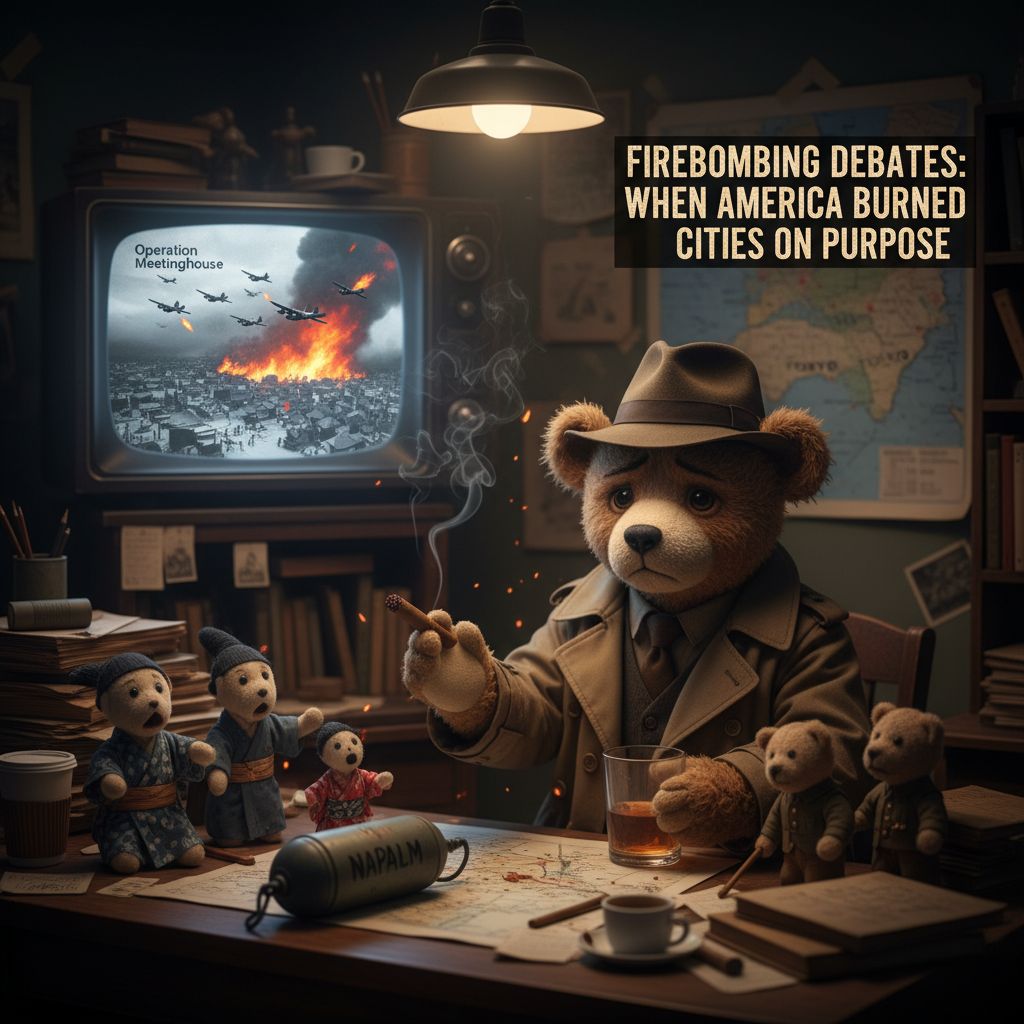
On the night of March 9–10, 1945, 279 B-29 Superfortresses of the XXI Bomber Command flew low over Tokyo and dropped 1,665 tons of incendiary bombs — primarily M-69 cluster munitions packed with napalm — on the most densely populated city on Earth. In six hours, approximately 16 square miles of Tokyo burned. Between 80,000 and 100,000 people died, the majority of them civilians. Operation Meetinghouse killed more people in a single night than the atomic bomb dropped on Hiroshima two months later.^1^ It is rarely discussed, a fact that itself reflects something about how American memory constructs the Pacific War.
Part of Controversial American Military Actions — ← Back to series hub
How the Firebombing Campaign Was Designed to Burn Cities
Operation Meetinghouse was not an improvisation — it was the deliberate implementation of a strategy developed over years. General Curtis LeMay, who took command of the XXI Bomber Command in January 1945, had concluded that high-altitude precision bombing of Japanese industrial targets was not working. The combination of jet stream winds at altitude, persistent cloud cover over Japan, and the dispersal of Japanese war industry into residential neighborhoods made precision targeting ineffective. LeMay’s solution was to abandon precision for area bombing.
The M-69 incendiary had been specifically engineered for Japanese cities. Standard Oil’s development division worked with the Chemical Warfare Service to design a weapon optimized for the construction materials of Japanese urban housing — wood, paper, and thatch — and tested it against a full-scale replica of a Japanese neighborhood built at Dugway Proving Ground in Utah. The tests confirmed that the weapon was extraordinarily effective at setting Japanese cities on fire.
LeMay’s March 9–10 raid stripped the B-29s of their defensive guns to increase bomb load, lowered the bombing altitude from 30,000 feet to between 5,000 and 9,000 feet — below most anti-aircraft guns’ effective range — and sent them in at night. The result was the deadliest air attack in history. Over the following five months, LeMay’s command systematically burned 67 Japanese cities, killing between 300,000 and 500,000 civilians and leaving 8 million people homeless.
The Strategic Case for the Bombing
The strategic rationale for the firebombing campaign was explicit and was made by LeMay and by the Army Air Forces’ leadership without apology. Japan’s war economy was genuinely dispersed into residential areas — not as a shield, but because Japanese industrial production relied on thousands of small workshops and cottage manufacturers integrated into urban neighborhoods. Destroying those neighborhoods was destroying war production.
The Joint Chiefs of Staff had estimated that a land invasion — Operation Downfall, planned in two phases beginning with Operation Olympic in November 1945 — would result in between 250,000 and 1 million American casualties, with Japanese military and civilian casualties in the millions. The firebombing campaign, and the atomic bombs that followed, were explicitly justified as alternatives to that invasion. General Douglas MacArthur’s planning staff estimated that Olympic alone would produce 105,000 American dead in the first 90 days.^2^
The strategic logic holds that the firebombing of Japan, terrible as it was, shortened the war and reduced total casualties on all sides. This argument is made seriously by serious historians and is not simply a post-hoc rationalization. Japan’s war-making capacity was genuinely collapsing by the summer of 1945, and the population was enduring genuine hardship.
The Case Against: Area Bombing Was Targeting Civilians
The firebombing of Japan was area bombing of civilian populations. The laws of war, even as they existed in 1945, did not authorize the deliberate targeting of civilians, and the American military’s own doctrine — the United States Strategic Bombing Survey’s pre-war emphasis on precision bombing — was based on the principle that civilian populations were not legitimate military targets. The shift to area bombing was a strategic decision made not because the laws of war permitted it but because the operational situation made precision bombing ineffective.
The German city of Dresden was firebombed by British and American forces on the night of February 13–14, 1945, killing between 22,500 and 25,000 civilians. Dresden became a symbol of the moral costs of area bombing in the European theater, and the debate about whether it was militarily necessary has continued among historians ever since. The Tokyo raid killed four times as many people as Dresden in a single night, and it barely features in American memory of the war.
LeMay himself acknowledged the moral weight of what he had done. He told journalist Robert McNamara, who served under him during the firebombing campaign, that if the United States had lost the war, he expected to be prosecuted as a war criminal. McNamara discussed this in the 2003 documentary The Fog of War: “LeMay said, ‘If we’d lost the war, we’d all have been prosecuted as war criminals.’ And I think he’s right. He, and I’d say I, were behaving as war criminals.”^3^
The Double Standard Between Germany and Japan
The debate about American firebombing intersects with the more widely discussed debate about the British bombing campaign against German cities, conducted by Bomber Command under Air Chief Marshal Arthur Harris. Harris deliberately targeted German civilian populations beginning in 1942, explicitly as a strategy to break civilian morale. The bombing of Cologne on May 30–31, 1942, Hamburg in July 1943, and Dresden in February 1945 killed tens of thousands of German civilians.
The distinction most commonly drawn between the British area bombing campaign and American bombing is that American doctrine nominally maintained precision bombing as its goal, even when operations drifted toward area effects. The practical distinction by the end of the war, particularly in the Pacific, had collapsed. LeMay’s campaign was area bombing in everything but name, and it was conducted with full knowledge and authorization from Washington. The same moral questions at stake in the nuclear decision — deliberate civilian mass death as military instrument — were already being answered in practice months before Hiroshima.
Containment
The firebombing of Japan sits in American memory as a non-event — far less discussed than the atomic bombs that followed, which ended the war and which have been debated intensively ever since. The moral logic of the atomic bombs — debated, contested, layered with retrospective analysis — applies with at least equal force to a bombing campaign that killed more people over a longer period by a less dramatic method. The silence around firebombing is itself an artifact of how American memory constructs the Pacific War: the atomic bomb is the punctuation mark that ended it, and the months of burning that preceded it do not fit the narrative either of American heroism or of American atrocity as cleanly as a single day and a single weapon. What firebombing reveals, if you look at it directly, is that the moral questions about the atomic bomb were already present — and already being answered in practice — before August 1945.
─────────
Sources:
- Werrell, Kenneth P. Blankets of Fire: U.S. Bombers over Japan during World War II. Smithsonian Institution Press, 1996.
- Crane, Conrad C. Bombs, Cities, and Civilians: American Airpower Strategy in World War II. University Press of Kansas, 1993.
- Morris, Errol, dir. The Fog of War: Eleven Lessons from the Life of Robert S. McNamara. Sony Pictures Classics, 2003.