Abu Ghraib: The Photos That Showed What America Was Doing
The Abu Ghraib photos in 2004 documented systematic torture authorized from the top. Eleven soldiers were convicted. No officer above staff sergeant was charged.
Abu Ghraib: The Photos That Showed What America Was Doing
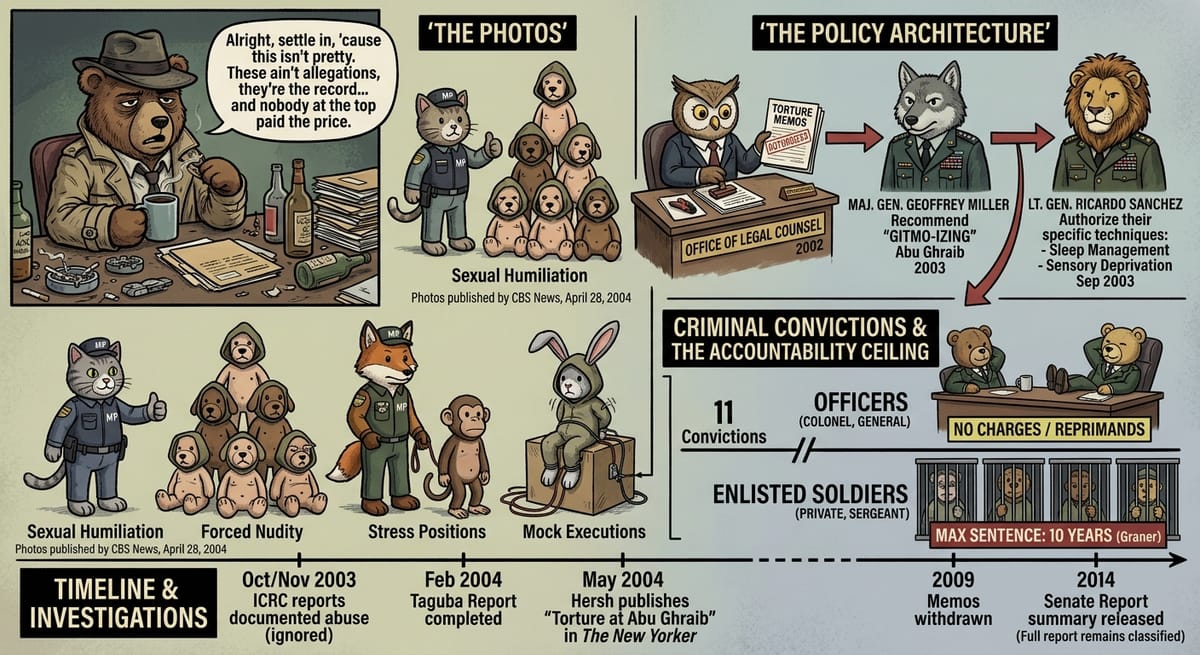
The Abu Ghraib photos were not an allegation — they were a record. First published by CBS News on April 28, 2004, they showed Specialist Lynndie England holding a leash attached to a naked Iraqi prisoner and Specialist Charles Graner giving a thumbs-up while standing over a pyramid of naked men. Within days, 60 additional photographs had leaked to The New Yorker, where journalist Seymour Hersh published them alongside a classified Army report by Major General Antonio Taguba describing “sadistic, blatant, and wanton criminal abuses.”^1^ The Abu Ghraib scandal is the clearest documented case of American military torture producing eleven criminal convictions — and zero convictions above the rank of staff sergeant.
Part of American War Crimes — ← Back to series hub
What the Photos Showed and What They Couldn’t
Abu Ghraib was a prison on the western edge of Baghdad that the U.S. military had taken over from Saddam Hussein’s regime in 2003. By the fall of that year, it held thousands of detainees, many of them swept up in mass arrests following the collapse of Iraqi security forces. The prison was overcrowded, understaffed, and regularly mortared by insurgents. It was also a site of systematic abuse.
The images that became public showed sexual humiliation, forced nudity, stress positions, mock executions, and prisoners on leashes. What the photographs could not show — what took years of litigation, congressional testimony, and FOIA requests to establish — was the bureaucratic architecture behind them. The abuse at Abu Ghraib did not start with a few soldiers deciding to improvise on a night shift. It started with policy.
In August 2003, Major General Geoffrey Miller visited Abu Ghraib from Guantanamo Bay, where he ran detention operations, and recommended “gitmo-izing” the prison — using military intelligence to drive the detention process and adopting more aggressive interrogation approaches. In September 2003, Lieutenant General Ricardo Sanchez authorized interrogation techniques at Abu Ghraib that included stress positions, sleep management, and sensory deprivation. The International Committee of the Red Cross visited the prison in October and November 2003 and documented abuse; their reports went to the coalition command and produced no action.
What the Taguba Report Actually Said
Major General Antonio Taguba completed his classified investigation in February 2004, two months before the photographs became public. The Taguba Report documented, in specific and damning detail, that soldiers of the 372nd Military Police Company had committed “numerous incidents of sadistic, blatant, and wanton criminal abuses” at Abu Ghraib between October and December 2003. Taguba named names: Staff Sergeant Ivan Frederick, Specialist Charles Graner, Specialist Sabrina Harman, Specialist Lynndie England, Specialist Jeremy Sivits, and others.^2^
The report also implicated Brigadier General Janis Karpinski, who commanded the 800th Military Police Brigade and was responsible for Abu Ghraib, and found that military intelligence personnel had actively encouraged MPs to “set the conditions” for interrogations. Taguba later told journalist Seymour Hersh — the same reporter who broke the My Lai story in 1969 — that he believed the abuses went beyond what his investigation was permitted to examine, and that he had been asked to limit his inquiry to the military police rather than extending it to military intelligence or to civilian contractors from CACI International and Titan Corporation who were present during interrogations.
The Criminal Proceedings That Stopped at Staff Sergeant
Eleven soldiers were convicted of offenses related to Abu Ghraib. The sentences ranged from reprimand and demotion to ten years in prison. Charles Graner, identified as the ringleader by other defendants, received the harshest sentence: ten years, reduced to six and a half on appeal, with a dishonorable discharge. Lynndie England received three years. Ivan Frederick received eight years. All served far less than their maximum sentences.
Not a single officer above the rank of Brigadier General was charged with a criminal offense. Janis Karpinski was reprimanded and demoted to colonel. Geoffrey Miller, who had recommended gitmo-izing the prison, received a letter of reprimand that was later withdrawn. Ricardo Sanchez, who had authorized the interrogation techniques, retired without prosecution. The civilian architects of the interrogation policy — including the lawyers who wrote the legal memos authorizing coercive techniques — faced no criminal consequences.^3^ This accountability ceiling — consequences for the people in the photographs, none for the people who wrote the policies — matches the pattern from My Lai and the Philippine-American War with enough consistency to constitute a structural feature rather than a coincidence.
The Policy Architecture That Made Abu Ghraib Possible
The Abu Ghraib photographs arrived in the middle of an active policy debate about what the United States was permitted to do to prisoners in the War on Terror. In August 2002, the Office of Legal Counsel at the Justice Department had produced what became known as the “Torture Memos,” authored primarily by John Yoo and Jay Bybee, arguing that enhanced interrogation techniques did not constitute torture as defined by federal law and the Convention Against Torture. The memos defined torture so narrowly — requiring pain equivalent to organ failure or death — that they effectively authorized much of what was later documented at Abu Ghraib and at CIA black sites.
The Bush administration had also determined in January 2002 that the Geneva Conventions did not apply to Taliban fighters or al-Qaeda detainees, a determination that critics argued created a legal vacuum that authorized abuse throughout the detention system. Abu Ghraib was not a CIA facility, and most of its prisoners were not terrorism suspects — they were ordinary Iraqis detained during military operations. But the atmosphere created by the policy debate, and the specific instruction to adopt Guantanamo-style approaches, shaped what happened in that prison. The same executive branch legal reasoning that enabled Abu Ghraib also shaped the parallel drone warfare program, where similar questions about legal authorization, civilian casualties, and democratic accountability remained unresolved.
What Changed and What Didn’t
The Abu Ghraib photographs produced a congressional investigation, a cascade of military investigations, and eleven criminal convictions. They produced no convictions above the rank of staff sergeant. The Torture Memos were eventually withdrawn by the Office of Legal Counsel in 2009, under the Obama administration, which also closed the CIA’s black site program and banned the use of waterboarding. None of the individuals who authorized those programs were prosecuted.
In 2014, the Senate Intelligence Committee released a 525-page summary of its 6,700-page report on CIA interrogation and detention practices, documenting that the CIA had misled Congress and the White House about the effectiveness of enhanced interrogation, and that the techniques used were more brutal than had been acknowledged. The full 6,700-page report remained classified.
The Abu Ghraib photographs entered the permanent record of American history as a specific kind of document: evidence that was simultaneously undeniable and insufficient to produce accountability at the level where the decisions were made.
Containment
What Abu Ghraib established was not that American soldiers could behave brutally — that was not new. What it established was that a bureaucratic system could authorize brutality, document it in classified reports, receive Red Cross complaints about it, and continue operating until photographs made suppression impossible. The soldiers convicted were real people who made real choices. They were also people who had been placed in a prison with overcrowded conditions, minimal oversight, explicit encouragement from military intelligence to “soften up” detainees, and a policy environment that had spent two years arguing that the normal rules didn’t apply. The gap between the punishment received by the people in the photographs and the people who wrote the policies that shaped their choices is where the legal and moral accounting remains unfinished.
─────────
Sources:
- Hersh, Seymour M. “Torture at Abu Ghraib.” The New Yorker, May 10, 2004.
- Taguba, Antonio M. Article 15-6 Investigation of the 800th Military Police Brigade. U.S. Army, 2004.
- Danner, Mark. Torture and Truth: America, Abu Ghraib, and the War on Terror. New York Review Books, 2004.