Mass Violence in American History
School shootings, historical bombings, public massacres: 14 articles tracking 100 years of American mass violence — the warning signs that were seen, the systems that failed, and what followed.

Mass Violence in American History
Mass violence in America is not a modern phenomenon, an imported pathology, or a product of any single decade’s cultural failures. It is a recurring feature of American life with traceable patterns, documented warning signs, and a consistent gap between what institutions know and what they do with it. The events cataloged in this section span more than a century — from the Wall Street bombing of 1920 to the Las Vegas shooting of 2017 — and they share more structural features than they share ideological ones.
In This Section
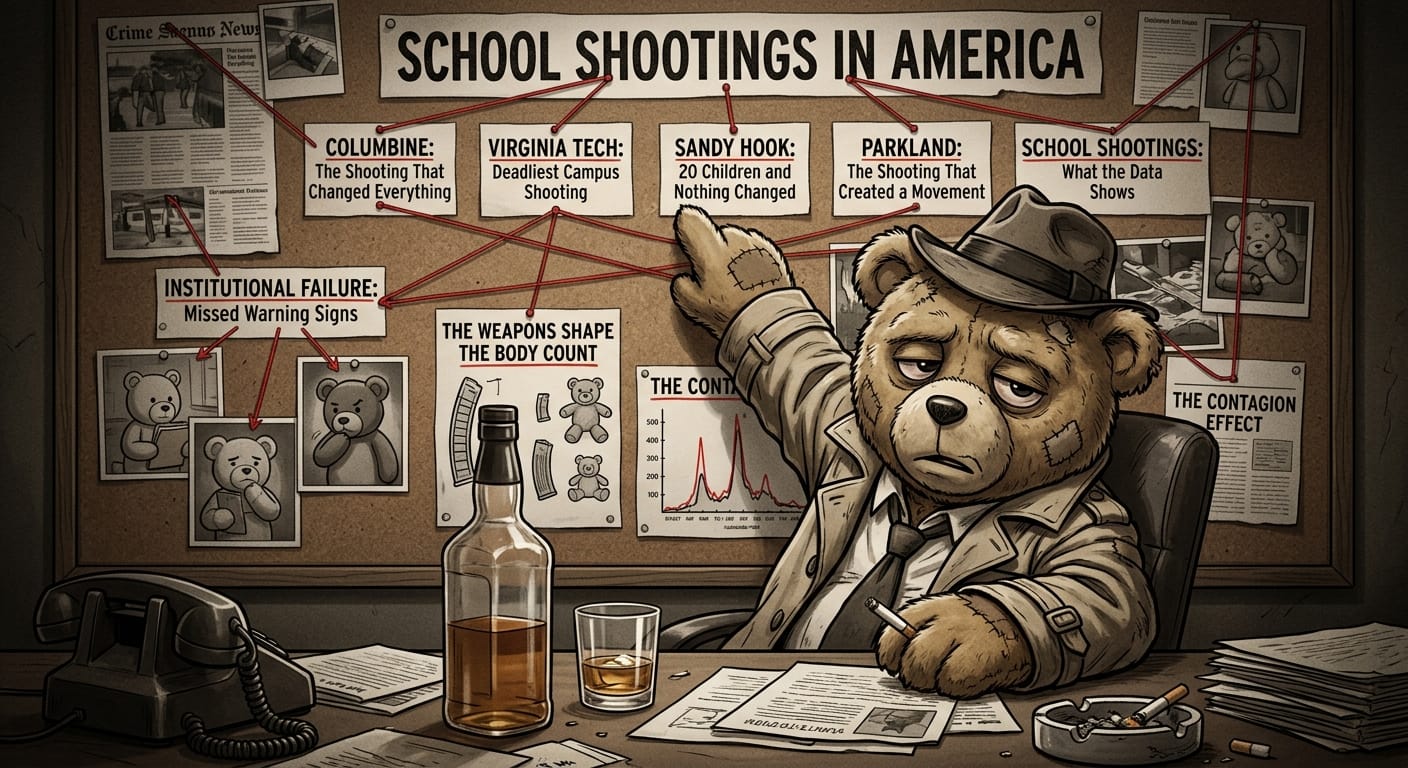
- School Shootings — Columbine, Virginia Tech, Sandy Hook, Parkland, and the data on what the pattern actually shows
- Historical Mass Violence — The Bath School Disaster of 1927 and the Wall Street bombing of 1920
- Workplace and Public Shootings — Charles Whitman, San Ysidro, Going Postal, Las Vegas, and Pulse
The Pattern That Runs Across Every Event
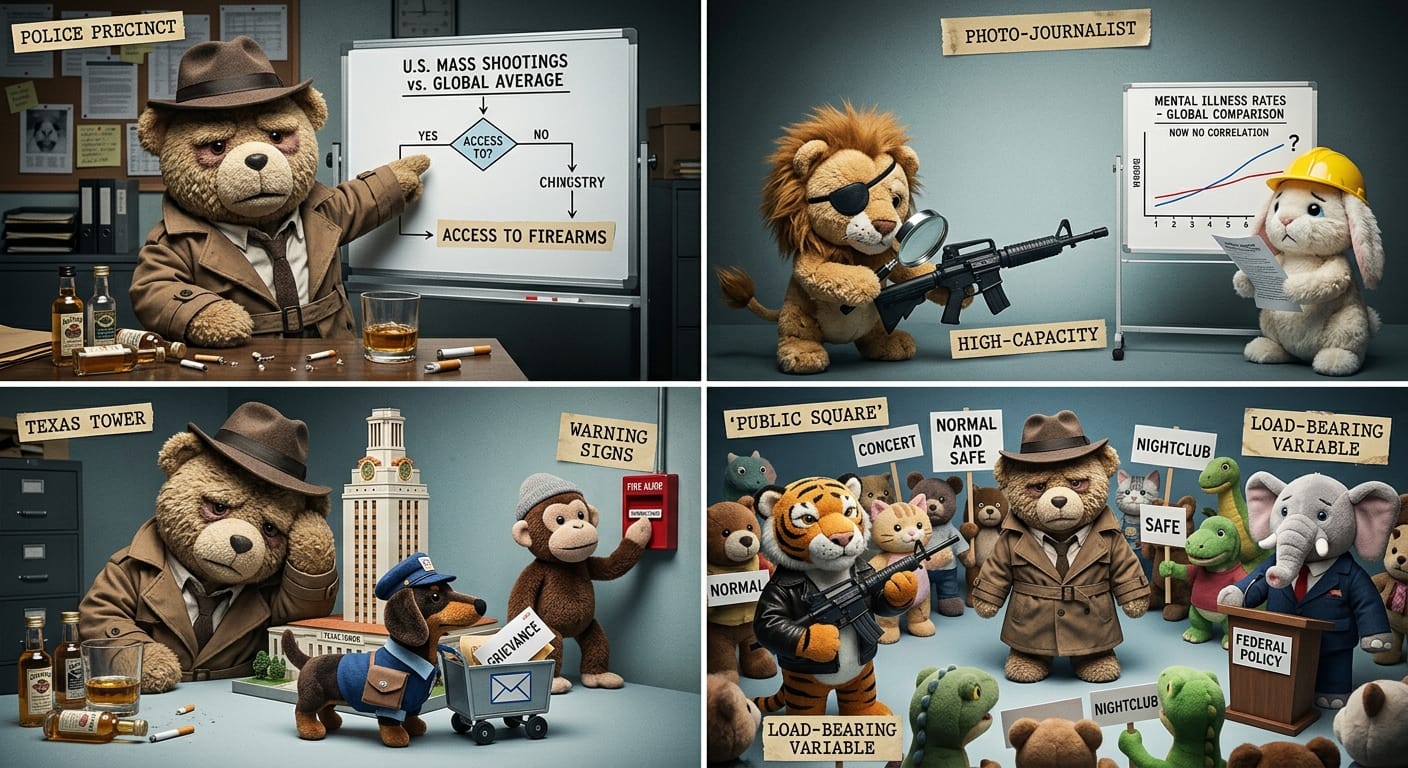
Start with what is consistent. In nearly every major mass violence event in the modern record — school shootings, public shootings, workplace attacks — warning signs existed and were seen by people who either didn’t know what to do with them or weren’t empowered to act. Eric Harris’s violent writings were flagged to law enforcement in 1998. Seung-Hui Cho was evaluated by a psychiatrist in 2005 and his records weren’t properly entered into the background check system. Nikolas Cruz was reported to the FBI by name, with explicit language about his intentions, 40 days before he killed 17 people at Parkland. Omar Mateen had been investigated twice by the FBI before the Pulse shooting.
This is not a record of invisible threats. It is a record of visible threats that moved through institutional processes without producing effective intervention. The pattern repeats in the historical cases: Andrew Kehoe’s deteriorating financial situation and hostile relationship with the Bath Township school board were known to his community for years before May 18, 1927. The postal workers who killed coworkers in the 1980s and early 1990s had documented, escalating grievances that the grievance system failed to resolve.
The Role of Weapons Access
The United States has the highest civilian gun ownership rate in the world: approximately 120 firearms per 100 civilians, compared to 53 per 100 in Yemen, the second-highest country, and 15 or fewer per 100 in most peer democracies. The United States also has the highest rate of mass shootings among developed nations. Criminologist Adam Lankford’s cross-national analysis of 171 countries found that civilian firearm ownership rate was the variable most strongly correlated with mass shooter rate, even after controlling for differences in population, inequality, and mental health prevalence.^1^
The specific lethality difference that high-capacity semiautomatic weapons create in mass violence events is documented in the data: the Bushmaster XM15-E2S that fired 154 rounds at Sandy Hook in less than five minutes, the bump-stock-equipped rifles that fired approximately 1,100 rounds at Route 91 Harvest in Las Vegas in nine minutes, the AR-15-style rifle at Parkland that killed 17 people in six minutes. Comparable events in countries with restricted access to these weapons produce dramatically lower body counts, not because intent or motivation differs but because the tools available are less lethal. This doesn’t resolve the policy debate in a political sense. It does settle the empirical question.
What Changed After Each Major Event — and What Didn’t
The legislative response to American mass violence has followed a consistent pattern: state-level action after major events, federal inaction or limited action, and no measurable reduction in the frequency of subsequent events. After Columbine, school security spending increased dramatically while no federal gun legislation passed. After Virginia Tech, the NICS Improvement Amendments Act improved mental health reporting to background check databases. After Sandy Hook, Connecticut, New York, and Maryland passed assault weapons bans; Congress voted down background check expansion by filibuster. After Parkland, 19 states passed red flag laws; Florida raised the purchase age to 21, then later passed permitless carry. After Las Vegas, bump stocks were banned by executive action, then the ban was struck down by the Supreme Court in 2024.^2^
The Bipartisan Safer Communities Act in June 2022 — following the Uvalde, Texas shooting that killed 21 people including 19 children — represented the first federal gun legislation in nearly 30 years. It closed the “boyfriend loophole,” enhanced background checks for buyers under 21, and provided funding for mental health and school safety programs. It did not address assault weapons, magazine capacity, or universal background checks. The historical events — the 1920 Wall Street bombing and the 1927 Bath School Disaster — produced no lasting policy changes because the institutional infrastructure for that kind of response didn’t exist in the 1920s. The modern events happened with that infrastructure in place and still produced incremental, incomplete responses.
Why Ideology Is the Wrong Frame for Prevention
One of the consistent errors in public discourse about mass violence is to assign it a primary ideological driver — Islamic extremism, white nationalism, left-wing radicalism — based on the most salient recent events. The record across a century shows that mass violence in America has been perpetrated by anarchists (the 1920 Wall Street bombing), by disaffected individuals with individual grievances (the vast majority of workplace and school shootings), by white supremacists (the 2019 El Paso Walmart shooting that killed 23 people), by Islamist extremists (the 2016 Pulse shooting), by people with no discernible ideology at all (Las Vegas 2017), and by a man who killed children with legally purchased explosives because he lost a tax dispute with a rural school board in 1927.
The search for a single ideological explanation produces prevention strategies calibrated to the most recent event and blind to the next one. The research literature consistently finds that the warning signs that predict attacks are behavioral and situational — crisis points, prior communications of intent, weapons access, the presence of a specific target or grievance — rather than ideological. A prevention system calibrated around ideology will miss events outside its expected category. A system calibrated around behavioral warning signs will catch more regardless of the underlying ideology.^3^
Who Gets Remembered — and Why It Matters
The cultural memory of mass violence is selective in ways that track closely with who the victims were. Columbine is remembered; the San Ysidro McDonald’s massacre, where 21 people were killed including nine children in 1984, is not. Virginia Tech is remembered; the Bath School Disaster, where 36 children were killed in 1927, is barely known. The Pulse shooting is discussed primarily in political rather than historical terms; 43 of the 49 dead were Latino.
This selectivity is not neutral. The events that anchor the national narrative shape the policy debate, the research agenda, and the cultural understanding of the problem. A history of mass violence that centers Columbine and leaves out Bath, that centers Las Vegas and leaves out San Ysidro, produces an incomplete and distorted picture of who gets killed and who gets mourned. The articles in this section are an effort toward completeness. They name the people who died, document what was known before each attack and what the systems failed to do with it, and track what legislation followed and what it didn’t change. These events happened. The conditions that produced them are largely still present.
─────────
Sources:
- Lankford, Adam. “Public Mass Shooters and Firearms: A Cross-National Study of 171 Countries.” Violence and Victims, 2016.
- United States Secret Service, National Threat Assessment Center. Targeted School Violence. 2019.
- Follman, Mark, Gavin Aronsen, and Deanna Pan. “US Mass Shootings, 1982–2023.” Mother Jones, 2023.
- Bernstein, Arnie. Bath Massacre: America’s First School Bombing. University of Michigan Press, 2009.
- Gage, Beverly. The Day Wall Street Exploded. Oxford University Press, 2009.
In This Section