Columbine: The Shooting That Changed Everything
On April 20, 1999, Eric Harris and Dylan Klebold killed 13 people at Columbine High School in 49 minutes — and opened a copycat pipeline that has never closed.
Columbine: The Shooting That Changed Everything
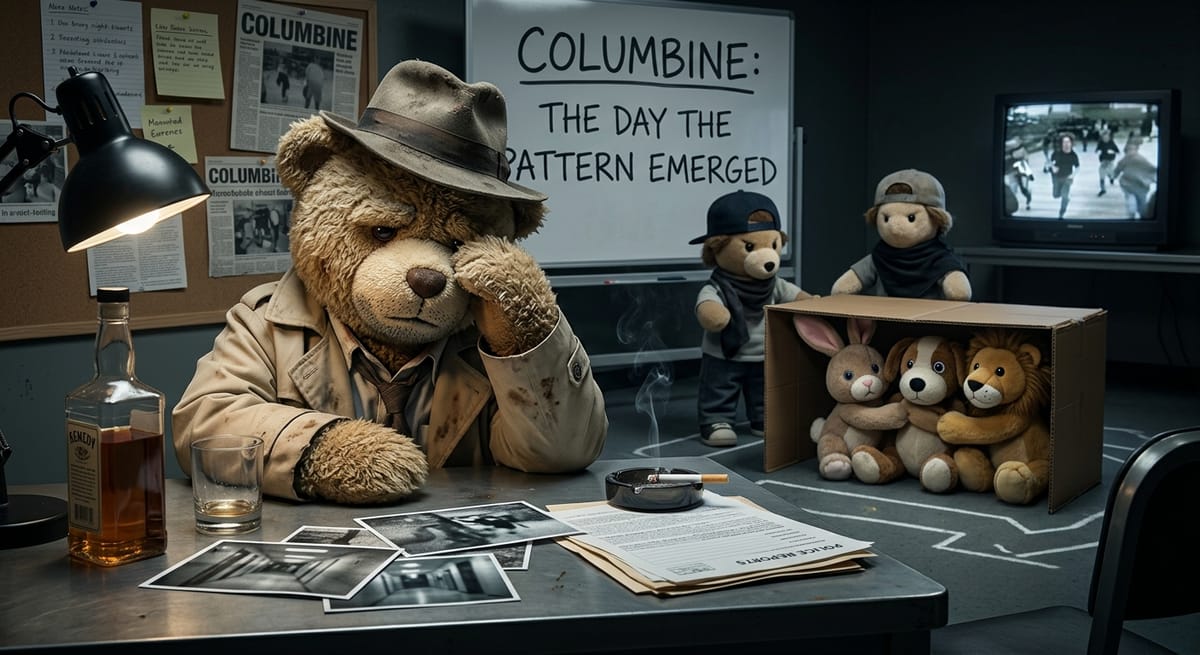
On April 20, 1999, Eric Harris and Dylan Klebold walked into Columbine High School in Littleton, Colorado, and killed 13 people — 12 students and one teacher — before taking their own lives. It took 49 minutes. The two teenagers had planned for more than a year, and what they envisioned wasn’t a school shooting. It was a bombing that would kill hundreds. The propane bombs they planted in the cafeteria failed to detonate, and the shooting was the fallback.
The Columbine shooting didn’t invent the phenomenon — there were 11 other school shooting incidents in 1997 and 1998 alone, including Jonesboro, Arkansas on March 24, 1998, where four students and one teacher were killed by two boys aged 11 and 13. What Columbine changed was scale, planning, and coverage. It was the first school massacre to unfold in real time on live television, and the image of terrified students running from the building became the defining visual of a new American horror.
Part of School Shootings — ← Back to series hub
What the Library Tells You About Those 7 Minutes
At 11:19 a.m., Harris and Klebold entered the school’s west entrance and began firing. Ten of the thirteen murders happened inside the library, where 52 students had taken shelter under tables. Harris and Klebold moved through the room methodically, taunting students and selecting targets. Isaiah Shoels, 18, was shot at close range. Cassie Bernall, 17, was killed after Harris pointed a gun at her and asked if she prayed. Kyle Velasquez, 16, never made it under a table. In 7 minutes, they killed 10 people and wounded 12 more in that room alone before leaving.
Teacher Dave Sanders, 47, was shot in a hallway while steering students to safety. He bled out over four hours on the floor of a science classroom while SWAT teams held a perimeter outside. A group of students kept him alive as long as they could and held a sign in the window — “1 bleeding to death” — while waiting for medical help that didn’t arrive in time. Sanders was the only adult killed.
The Mythology That Took Root
In the hours and days after Columbine, a set of narratives formed that turned out to be wrong. The “trench coat mafia” angle — the idea that Harris and Klebold were part of a gothic outcast clique — was repeated across every major outlet and was mostly fictional. The claim that Cassie Bernall said “yes” when asked if she believed in God became a bestselling book (She Said Yes, published in 1999 by her mother Misty Bernall) before investigators determined she likely never said it. The myth of targeted jock persecution became the dominant explanation despite little evidence of systematic bullying.
The real picture, assembled over years by the Jefferson County Sheriff’s Office and journalists like Dave Cullen, whose 2009 book Columbine remains the definitive account, is more disturbing. Harris showed clear signs of psychopathy and had written detailed plans for mass murder well before targeting the school. Klebold was deeply depressed and suicidal. Their journals showed two different motivations converging toward the same catastrophic end — Harris wanted to kill as many people as possible, while Klebold mostly wanted to die.
What Changed After April 20 — and What Didn’t
The political and institutional response to Columbine was immediate and lasting. Within months, hundreds of school districts had adopted zero-tolerance discipline policies for anything that could be construed as a threat. Schools began installing security cameras, requiring ID badges, and locking exterior doors during the school day. Metal detectors became standard in many urban districts. The Secret Service and Department of Education launched the Safe School Initiative, eventually identifying 37 incidents of targeted school violence between 1974 and 2000 and publishing findings in 2002 that became the foundation of threat assessment programs still in use today.^1^
Congress debated gun legislation for months but passed nothing substantive at the federal level. Colorado tightened its gun show background check laws in 2000 after a ballot initiative passed with 70 percent of the vote — closing the loophole Harris and Klebold exploited when a friend purchased weapons for them at a gun show.
Did Columbine Create the Template for What Came After?
The answer is yes — and the research is specific about it. Between 1999 and 2019, at least 75 planned or completed school attacks were directly influenced by Columbine, according to a 2019 study by researchers at Northeastern University and the National Threat Assessment Center. The shooters at Virginia Tech, Red Lake, and Sandy Hook all referenced Columbine. The term “contagion effect” — borrowed from suicide research — entered the vocabulary of mass violence researchers to describe how media coverage of one attack inspires subsequent ones.^1^
The FBI’s 2018 report on the active shooter threat specifically noted that Columbine had become a cultural touchstone for people planning mass violence, and that online communities celebrating Harris and Klebold — the phenomenon researchers now call “Columbiners” — represent an ongoing radicalization pipeline. More than two decades later, Columbine still generates copycat threats every April.^2^
The 13 Who Died
The 13 people killed were: Cassie Bernall, 17; Steven Curnow, 14; Corey DePooter, 17; Kelly Fleming, 16; Matthew Kechter, 16; Daniel Mauser, 15; Daniel Rohrbough, 15; William “Dave” Sanders, 47; Rachel Scott, 17; Isaiah Shoels, 18; John Tomlin, 16; Lauren Townsend, 18; Kyle Velasquez, 16.
Rachel Scott was the first person killed, shot outside the cafeteria. Her father Darrell Scott testified before Congress 11 days later. Isaiah Shoels was one of only a small number of Black students at Columbine and the only Black student killed; his parents initially considered a hate crime lawsuit before settling with the families of Harris and Klebold. Twenty-four students and teachers were also wounded.
The Long Aftermath
Jefferson County paid out more than $2.5 million in settlements to victims’ families by 2001. The school building was partially demolished and rebuilt, reopening in 2001 with the library site converted to an atrium with windows looking out to the memorial garden. A permanent memorial park opened in 2007, a quarter mile from the school.
The survivors scattered. Some left Colorado. Some became advocates for gun control or mental health reform. Patrick Ireland — the boy seen dangling from a library window during live coverage — graduated from Colorado State University in 2003, became a financial analyst, and gave one interview about the shooting in 2009 before largely returning to his life.
Harris and Klebold’s parents have all spoken publicly in the years since. Sue Klebold published A Mother’s Reckoning in 2016, detailing her failure to see her son’s suicidal depression. She donates all royalties to mental health research. The library tables where students hid were placed in storage for years. In 2019, on the 20th anniversary, some survivors said they had never been back to the building.
To understand what patterns connect Columbine to the mass shootings that followed — and what the data actually shows about school violence — see School Shootings: What the Data Actually Shows.
─────────
Sources:
- Cullen, Dave. Columbine. Twelve, 2009.
- Larkin, Ralph W. Comprehending Columbine. Temple University Press, 2007.
- Muschert, Glenn W. “Research in School Shootings.” Sociology Compass, 2007.
- United States Secret Service and Department of Education. The Final Report and Findings of the Safe School Initiative. 2002.
- Follman, Mark, Gavin Aronsen, and Deanna Pan. “US Mass Shootings, 1982–2019.” Mother Jones, 2019.