Sandy Hook: 20 Children and Nothing Changed
Adam Lanza killed 20 first-graders and 6 adults at Sandy Hook Elementary in December 2012. The Senate's background check bill failed four months later on a procedural vote.
Sandy Hook: 20 Children and Nothing Changed
Twenty children and six adults were killed at Sandy Hook Elementary School in Newtown, Connecticut, on December 14, 2012. The children were between six and seven years old — first-graders. The shooter, Adam Lanza, 20, drove to the school that morning, shot his way through the front glass door, and spent less than five minutes inside before a responding police unit entered and he shot himself. In that time he fired 154 rounds from a Bushmaster XM15-E2S semiautomatic rifle. Most of the children were shot multiple times.
The Sandy Hook shooting changed the American debate about gun violence in a way that nothing before or since has quite replicated — and then revealed that it had changed almost nothing at all.
Part of School Shootings — ← Back to series hub
What Lanza’s Life Looked Like Before He Came to the School
Adam Lanza had not left his mother’s house in Newtown in months before the shooting. He slept during the day, communicated with his mother Nancy largely by email even though they lived in the same home, and spent most of his waking hours in a blacked-out bedroom playing video games and researching mass shootings. Investigators found a spreadsheet, seven feet long, cataloging past mass shootings with statistics about weapons, ammunition, and kill counts. He was thin and severely underweight, with a constellation of diagnoses — Asperger’s, sensory processing disorder, OCD — that had been addressed and then allowed to lapse as he isolated further in early adulthood.
On the morning of December 14, 2012, Lanza shot and killed his mother, Nancy Lanza, 52, at their home on Yogananda Street while she slept. He then drove her car approximately five miles to Sandy Hook Elementary. Nancy Lanza was a licensed gun owner who kept multiple legally-purchased firearms in the home, including the Bushmaster rifle Adam used at the school.^1^
Five Minutes: What Happened Inside the School
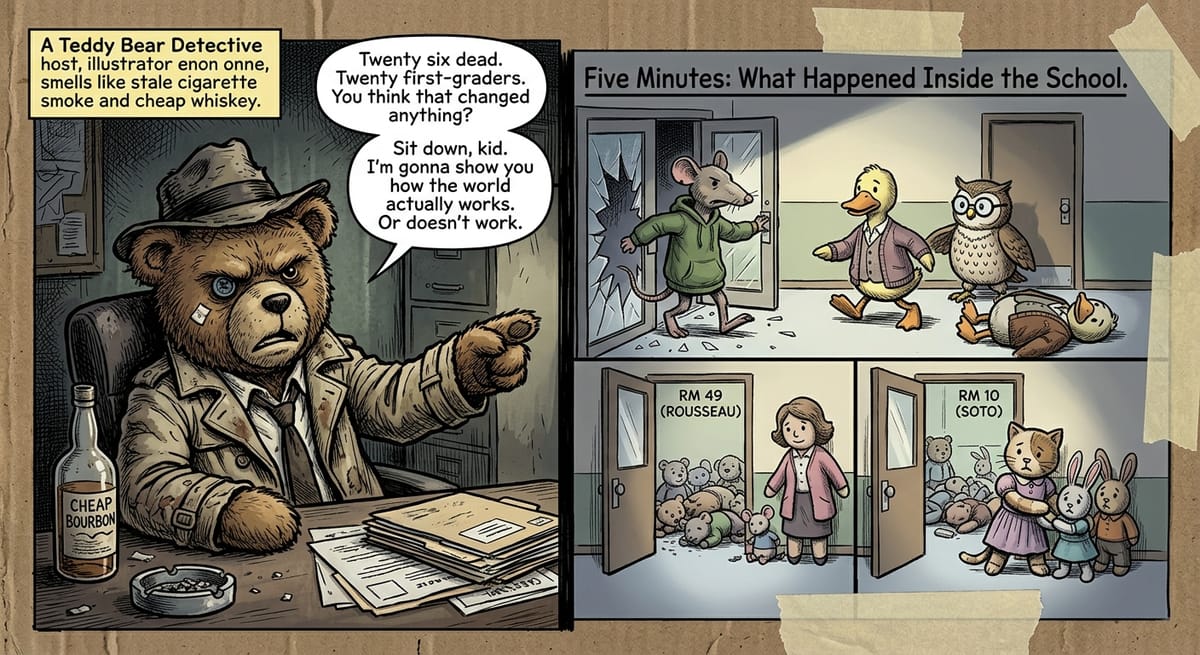
Lanza arrived at Sandy Hook Elementary at approximately 9:35 a.m. The school had a newly installed security system requiring visitors to be buzzed in via intercom and video. Lanza shot through the locked glass entrance. Principal Dawn Hochsprung and school psychologist Mary Sherlach ran toward the sound of gunfire; both were killed in the hallway. Lanza then moved to two first-grade classrooms.
In Lauren Rousseau’s classroom, he killed Rousseau — a substitute teacher who had recently been hired to a permanent position — and 14 of the 15 students present. The one survivor hid under other students’ bodies and lived by lying still. In Victoria Soto’s classroom, Soto, 27, positioned herself in front of her students in an attempt to shield them. She was shot and killed. Six of her students were killed; four survived by running when Lanza paused to reload.^2^
The six adults killed were: Hochsprung, 47; Sherlach, 56; Rousseau, 30; Soto, 27; Anne Marie Murphy, 52, a special education aide; and Rachel D’Avino, 29, a behavioral therapist. The twenty children were all first-graders: Charlotte Bacon, Daniel Barden, Olivia Engel, Josephine Gay, Dylan Hockley, Madeleine Hsu, Catherine Hubbard, Chase Kowalski, Jesse Lewis, Ana Marquez-Greene, James Mattioli, Grace McDonnell, Emilie Parker, Jack Pinto, Noah Pozner, Caroline Previdi, Jessica Rekos, Avielle Richman, Benjamin Wheeler, and Allison Wyatt. All were six or seven years old.
Why the Senate Vote Failing Matters More Than the Shooting
President Obama addressed the nation at 3:15 p.m. on December 14, visibly emotional, saying: “They had their entire lives ahead of them — birthdays, graduations, weddings, kids of their own.” In January 2013, Obama signed 23 executive actions on gun violence and proposed legislation to Congress including an assault weapons ban, universal background checks, and limits on high-capacity magazines.
The Senate voted on the background check bill — the Manchin-Toomey amendment — on April 17, 2013. It received 54 votes, but Senate rules required 60 to overcome a filibuster. The bill failed. The assault weapons ban legislation never made it to a floor vote.^3^ Connecticut, New York, Maryland, and several other states passed their own restrictions, but at the federal level, Sandy Hook produced nothing. The pattern held until 2022, when the Bipartisan Safer Communities Act — passed after Uvalde — became the first federal gun legislation in nearly 30 years. It addressed background check gaps without touching the specific firearm types most associated with mass casualties.
What Alex Jones Did to the Families of the Dead
Alex Jones, running the website Infowars, began claiming in 2012 that Sandy Hook was a “hoax” and that the grieving parents were “crisis actors.” The claim circulated in online communities for years, and the families of Sandy Hook victims became targets of harassment, threats, and stalking. Lenny Pozner, whose six-year-old son Noah was killed, spent years fighting fake death certificate claims, organized harassment campaigns, and death threats, eventually relocating multiple times and founding the HONR Network to combat online abuse of mass shooting victims’ families.
Jones was sued by eight Sandy Hook families. In 2022, two Texas juries awarded $49.3 million in compensatory and punitive damages in one case, and a Connecticut jury awarded $965 million in another. In November 2022, a Texas bankruptcy judge added $473 million in damages. Jones’s company, Free Speech Systems, filed for bankruptcy. The litigation set a legal precedent for holding media figures financially liable for harassment campaigns built on false claims about mass shootings.^4^
What the Investigation Found
The Connecticut State Police released a final report on the Sandy Hook investigation in November 2013, running to nearly 1,000 pages. It documented that Lanza had no prior criminal history, no social media presence, and no known contact with other extremists. His motivation was never definitively established. A separate report by the Connecticut Office of the Child Advocate in 2014 concluded that failures in his mental health treatment and his profound social isolation contributed to his deterioration, but that no specific intervention would definitively have changed the outcome.
Investigators found that Lanza had been fascinated with mass shootings for years and had extensively studied Columbine. His spreadsheet was found on a computer hard drive he had destroyed, then partially recovered. The document ranked mass shooters by body count.
Twenty first-graders who walked into school that December morning never walked out. Their classmates have grown up in a country that has watched more than 3,500 people killed in mass shootings since that day, while the legislation designed to respond to their deaths failed on a procedural vote in the Senate four months later. For the broader context on what the data shows about school violence, see School Shootings: What the Data Actually Shows.
─────────
Sources:
- Connecticut State Police. Sandy Hook Elementary School Shooting Reports. November 2013.
- Sedensky, Stephen. Report of the State’s Attorney for the Judicial District of Danbury on the Shootings at Sandy Hook Elementary School. November 2013.
- Peters, Jeremy W. “Senate Blocks Drive for Gun Control.” The New York Times, April 17, 2013.
- Rosenthal, Brian M. “Alex Jones Is Ordered to Pay Nearly $1 Billion in Sandy Hook Damages.” The New York Times, October 12, 2022.
- Connecticut Office of the Child Advocate. Shooting at Sandy Hook Elementary School: Report of the Office of the Child Advocate. November 2014.