School Shootings in America
From Columbine to Parkland: the five events and the data that define American school shootings. Each shooting exposed institutional failures that were legible before the attack.
School Shootings in America
There is a before and after to American school shootings. The line is April 20, 1999, but the violence predates it. What Columbine changed was not the fact of school shootings but the national consciousness of them — the real-time television coverage, the named perpetrators, the copycat pipeline that opened and has never closed. The question is not whether school shootings are new. They aren’t. The question is what patterns connect them, what failed to stop them, and what that failure means.
In This Series
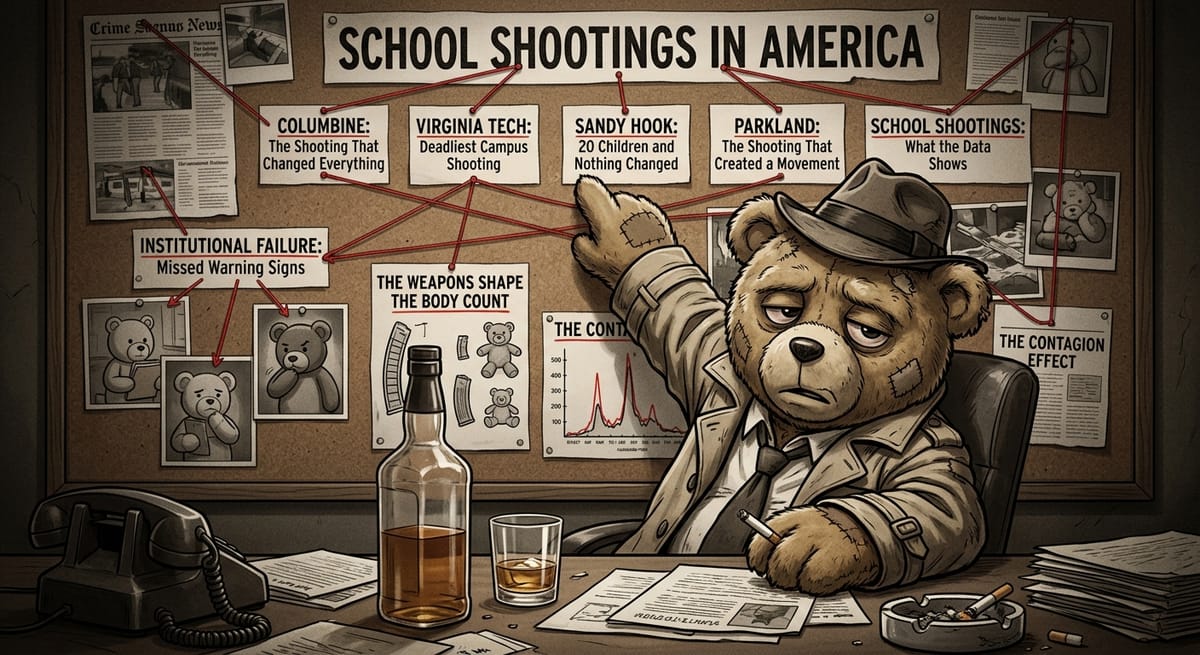
- Columbine: The Shooting That Changed Everything
- Virginia Tech: The Deadliest Campus Shooting in American History
- Sandy Hook: 20 Children and Nothing Changed
- Parkland: The Shooting That Created a Movement
- School Shootings: What the Data Actually Shows
Institutional Failure Is the Through-Line, Not Individual Pathology
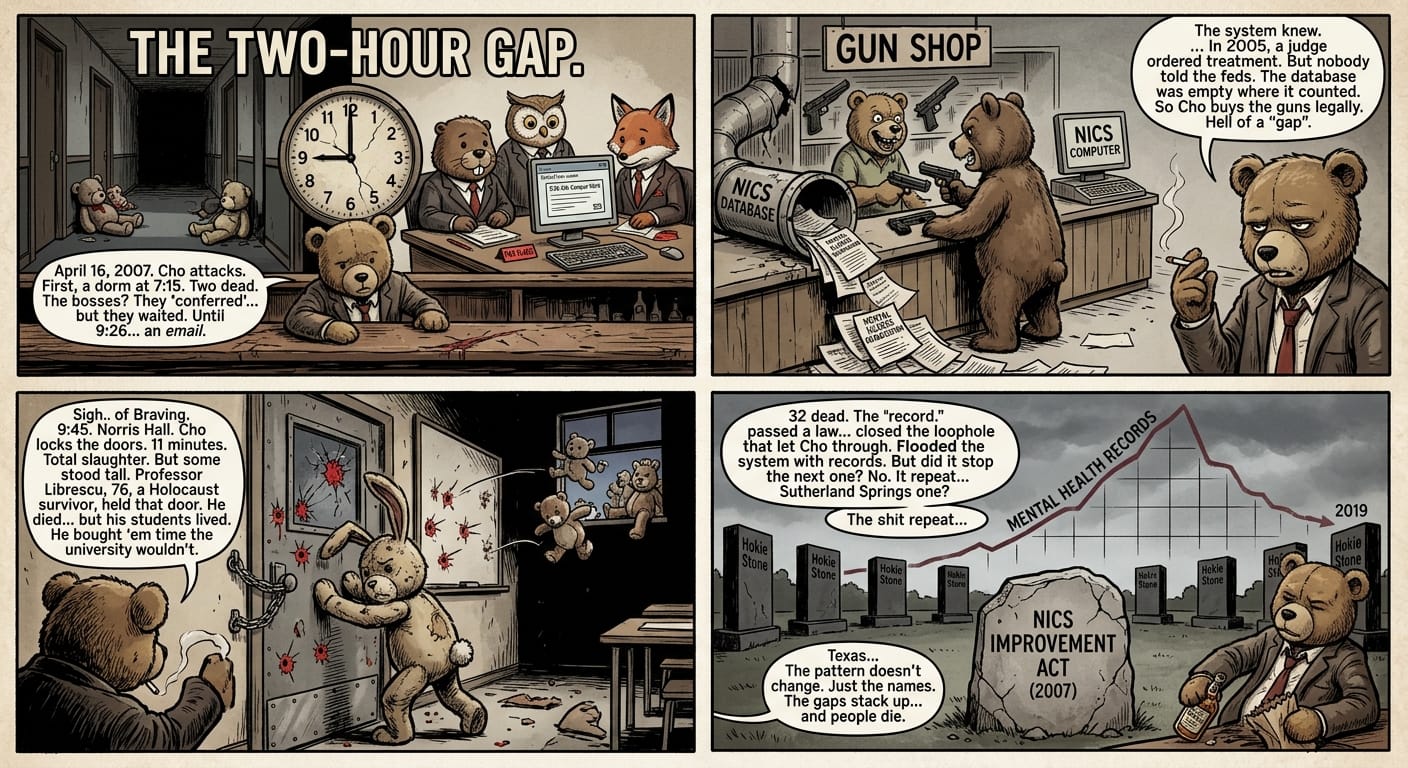
Every major school shooting in the modern era — Columbine, Virginia Tech, Sandy Hook, Parkland — involves at least one institution that had information that could have led to intervention and didn’t act decisively on it. Eric Harris had written openly violent content that was flagged by a parent and reviewed by law enforcement; no action was taken. Seung-Hui Cho had been reported by two classmates, seen by a campus psychiatrist, and flagged by a professor; the concerns didn’t connect into prevention. Nikolas Cruz was the subject of 45 calls to Broward County police and a specific FBI tip that explicitly named him and warned of his intent; neither produced intervention.
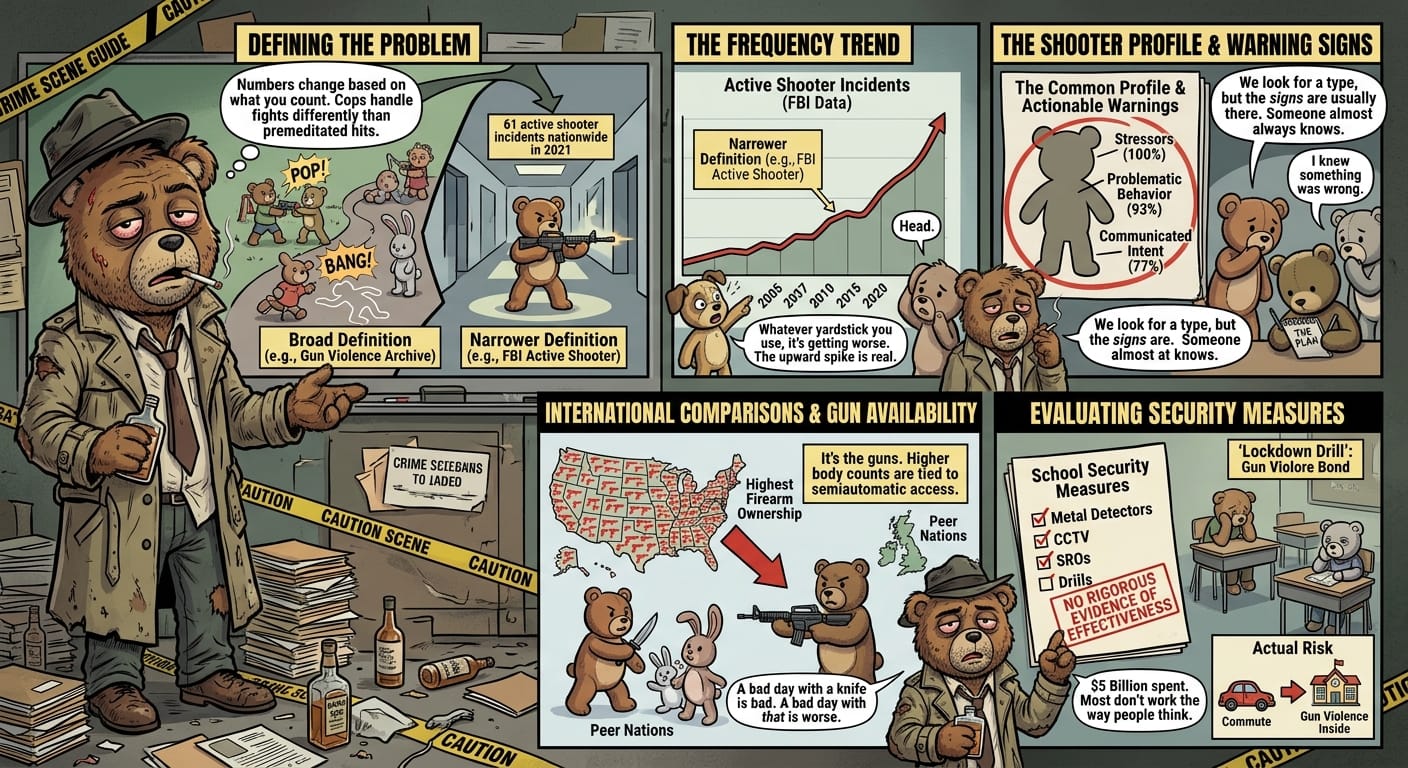
This is not a pattern of invisibility. It is a pattern of institutional failure to convert visible warning signs into effective action. The Secret Service’s 2019 study of 41 school attacks found that 93 percent of attackers showed concerning behavior noticed by others before the attack, and that in 93 percent of cases at least one other person knew in advance and either said nothing or raised concerns that weren’t escalated. The information was there. The systems failed.
The Weapons Shape the Body Count
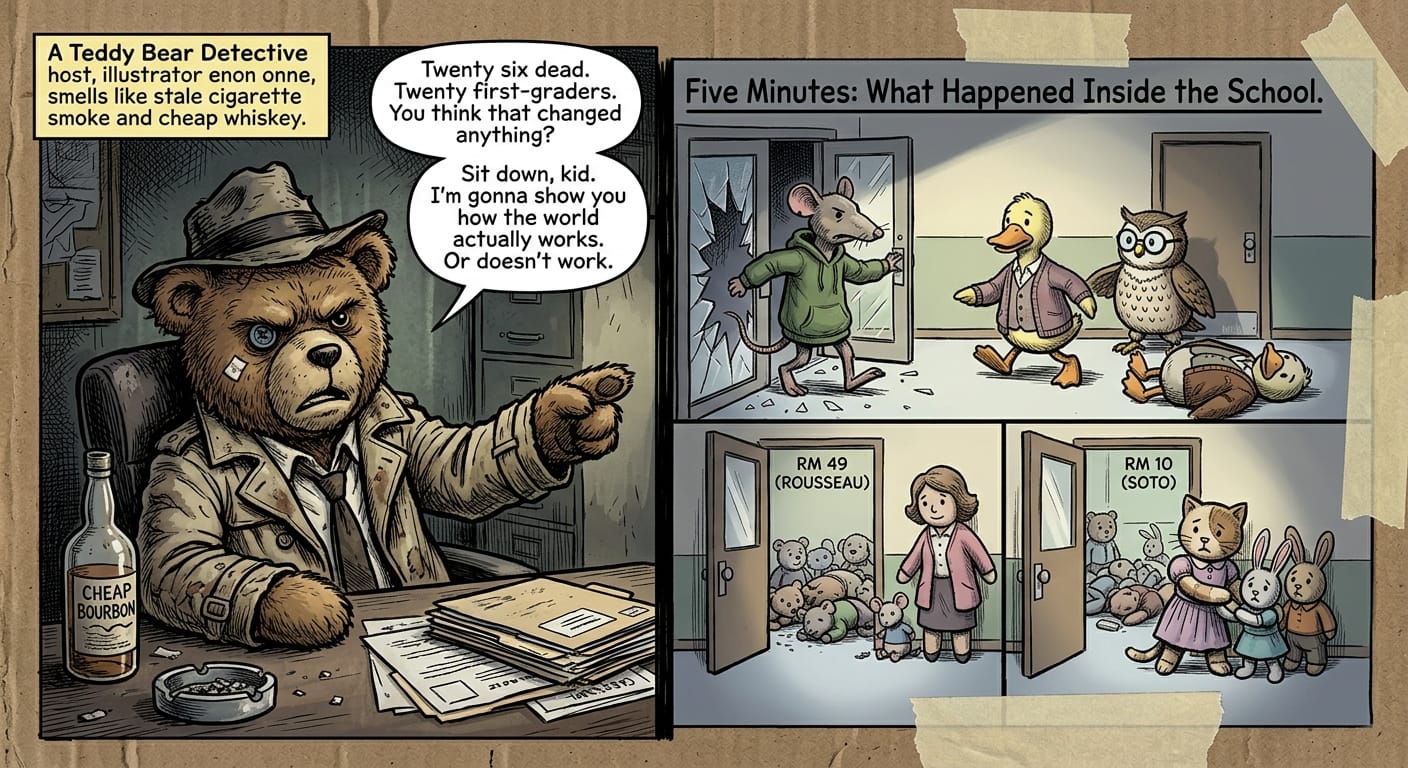
Columbine: 13 dead. Virginia Tech: 32 dead. Sandy Hook: 20 children and 6 adults dead. Parkland: 17 dead. The death tolls are not random — they correlate closely with the type of weapons used and the time to effective law enforcement response. The Bushmaster XM15-E2S at Sandy Hook, the Glock 19 and Walther P22 at Virginia Tech, the AR-15-style Smith & Wesson M&P15 at Parkland — each weapon’s magazine capacity and rate of fire shaped how many people could be shot in the minutes before intervention. This is not a contested finding in the research literature. It is the central variable that distinguishes American school mass casualty events from those in peer nations.^1^
The policy debate about this variable has been conducted largely without reference to the data, and the political results reflect that. Congress passed no major federal firearms legislation after Columbine, Virginia Tech, or Sandy Hook. Florida raised the purchase age to 21 and passed a red flag law after Parkland, then passed permitless carry in 2023. The federal Bipartisan Safer Communities Act of 2022, passed after Uvalde, was the first federal gun legislation in nearly 30 years and addressed background check gaps without addressing the specific firearm types most associated with mass casualties.
What Changed After Each Attack
Columbine changed school architecture and security procedures. Virginia Tech changed mental health reporting to background check databases. Sandy Hook produced state-level assault weapons bans in Connecticut, New York, and Maryland but nothing federally. Parkland produced red flag laws in nearly 20 states and a lasting student advocacy organization.
What no individual attack produced was a change in the frequency of subsequent attacks. The data from the FBI, the Gun Violence Archive, and the K-12 School Shooting Database all show a consistent upward trend in school shooting incidents from 2000 forward, with acceleration after approximately 2012. The pattern of incremental, state-level legislative response to individual events, without federal action on the variables most associated with lethality, has not reversed that trend.
The Contagion Effect Is Real and Documented
Research by Northeastern University, the National Threat Assessment Center, and scholars at Arizona State University has documented the contagion or “copycat” effect in school shootings: media coverage of one high-profile attack increases the probability of subsequent attacks, particularly in the days and weeks following initial coverage. The effect is dose-dependent — more coverage of the perpetrator, particularly name and photograph, correlates with higher subsequent risk. The FBI’s active shooter program has incorporated this finding into its media guidance, recommending that news organizations limit coverage of perpetrators’ identities and stated motivations.
The recommendation has been partially adopted and largely ignored. The perpetrators of Columbine, Virginia Tech, Sandy Hook, and Parkland are all widely known by name. Their weapons, methods, and — in several cases — their manifestos and writings are public record. This is not an argument for suppressing historical information. It is an observation that the media environment that has documented these attacks has also functioned as a component of the process that produced subsequent ones.
What Comes After
The five articles in this series cover the most consequential events and the most actionable research. They document specific failures, specific legislative responses, and the specific people who died. The pattern they describe is not hopeless. School shootings are not inevitable, and the conditions that produce them are not immutable. Warning signs exist. Interventions work. The gap between what is known and what is implemented is a political problem, not a factual one.
The children whose names appear in these articles were real. Keeping them as names — Rachel Scott, 17; Daniel Mauser, 15; Isaiah Shoels, 18; Charlotte Bacon, 6; Alyssa Alhadeff, 14; Peter Wang, 15 — is the minimum obligation the record carries.
─────────
Sources:
- United States Secret Service, National Threat Assessment Center. Targeted School Violence. 2019.
- Federal Bureau of Investigation. Active Shooter Incidents in the United States in 2022. 2023.
- Cullen, Dave. Columbine. Twelve, 2009.
- Riedman, David, and Desmond O’Neill. K-12 School Shooting Database. CHDS, 2020.
The Series