Virginia Tech: The Deadliest Campus Shooting in American History
On April 16, 2007, Seung-Hui Cho killed 32 people at Virginia Tech in two attacks two hours apart — exposing a fatal gap between mental health records and background check databases.
Virginia Tech: The Deadliest Campus Shooting in American History
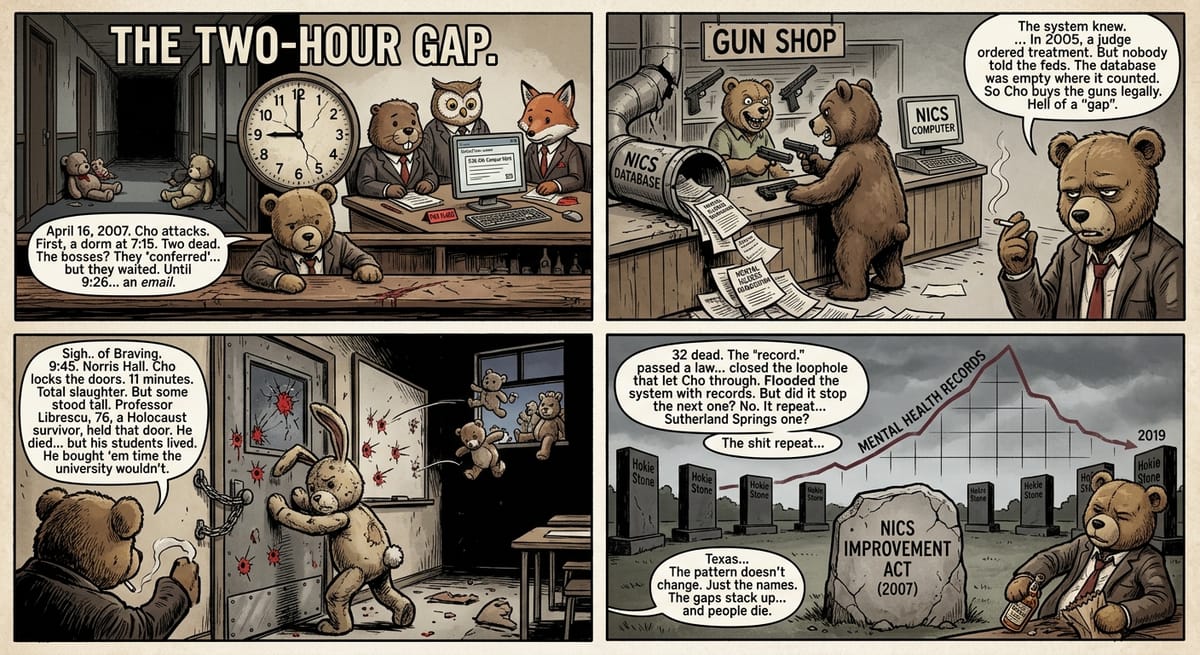
Seung-Hui Cho killed 32 people and wounded 17 more at Virginia Polytechnic Institute and State University on April 16, 2007 — making it the deadliest campus shooting in US history, a record it still holds. He did it in two separate locations, two hours apart. For most of that gap, the university’s administration believed the first shooting was an isolated domestic incident. By the time they sent out a campus-wide email warning at 9:26 a.m., Cho had already locked the doors of Norris Hall with chains he’d brought from home and was moving through the engineering building’s second floor, classroom by classroom.
The attack prompted the most significant federal gun legislation in more than a decade, exposed catastrophic failures in mental health reporting between institutions, and raised questions about university emergency notification that universities have been arguing about ever since.
Part of School Shootings — ← Back to series hub
The Two-Hour Gap That Damned the University
At 7:15 a.m., Cho shot and killed Emily Jane Hilscher, 19, a freshman, and Ryan Christopher Clark, 22, a resident advisor, in West Ambler Johnston Hall dormitory. Campus police initially theorized Hilscher’s boyfriend — a student who owned firearms — might be responsible and focused early investigation on him. The university president and police chief conferred and decided not to lock down campus or send a general warning.
Cho returned to his dormitory room, changed clothes, mailed a package of video recordings and writings to NBC News, and walked to Norris Hall with a backpack containing two handguns and nearly 400 rounds of ammunition. He entered at approximately 9:40 a.m. At 9:41 a.m., the university sent its first campus-wide email about the earlier shooting. At 9:45 a.m., Cho began firing in Norris Hall.^1^
He moved through four classrooms in 11 minutes, killing 30 people. Professor Liviu Librescu, 76, a Holocaust survivor and aeronautics engineer, barricaded his classroom door with his body while students escaped through a second-story window; he was shot through the door and killed, but all but one of his students survived. Professor G.V. Loganathan, 53, was killed in his classroom, and none of his students survived. Cho shot himself at 9:51 a.m. as police breached the building.
Who Seung-Hui Cho Was — and What the System Knew
Cho was 23 years old, a senior English major, and had been on the university’s radar for concerning behavior since at least 2005. Two female students had reported him for stalking. His creative writing professor, Lucinda Roy, had stopped teaching him in a class setting after his writings disturbed other students, and had personally tutored him while repeatedly flagging her concerns to campus authorities. A Virginia special justice had found him mentally ill and an imminent danger to himself in December 2005, ordering outpatient treatment — but the order was never properly entered into the National Instant Criminal Background Check System (NICS), the federal database used for gun purchase background checks.
Cho legally purchased both handguns used in the attack from licensed dealers, passing background checks that should have caught his adjudicated mental health history but didn’t because of the reporting gap.^2^ The package Cho mailed to NBC News arrived the next morning. It contained 28 video clips, 43 photographs, and an 1,800-word document full of rage toward wealthy classmates and references to Columbine perpetrators Eric Harris and Dylan Klebold, whom Cho called “martyrs.” NBC aired portions of the materials on April 18, 2007 — a decision that drew sharp criticism from victims’ families and mental health researchers who argued it constituted exactly the kind of coverage that incentivizes future attackers.
The Gun Law That Actually Passed
The most direct legislative result of Virginia Tech was the NICS Improvement Amendments Act of 2007, signed by President George W. Bush on January 5, 2008. The law provided federal grants to states to improve their reporting of mental health records to NICS and set minimum reporting requirements. In the decade following passage, state submissions of mental health disqualifying records to NICS increased from roughly 400,000 to more than 5 million, according to the Government Accountability Office.^3^ Virginia’s state legislature simultaneously passed a law requiring that anyone ordered to mandatory outpatient treatment for mental illness be reported to NICS — the specific loophole that had applied to Cho’s 2005 order.
Whether the law has prevented subsequent shootings is difficult to measure. What it clearly did was close the administrative gap that allowed Cho to arm himself legally despite a court finding of mental illness.
The 32
The victims ranged in age from 18-year-old freshmen to 76-year-old Librescu, and came from nine countries. Seventeen of the 32 were international students or faculty. The university held a convocation on April 17, 2007, attended by President Bush and Governor Tim Kaine, at which the name of each victim was read. Thirty-two Hokie stones — the limestone blocks used in campus buildings — were placed in a semicircle on the university’s Drillfield as a temporary memorial. A permanent memorial was dedicated on August 19, 2007, with a thirty-third stone placed for Cho that was later removed and then quietly returned to the memorial’s edge after discussion among survivors and administrators.
The university faced lawsuits from victims’ families arguing that the two-hour gap between the first and second shootings represented negligence. In 2012, a Virginia jury found the state liable and awarded $4 million in damages to two families, though the amount was later reduced to $100,000 each under Virginia’s cap on judgments against state agencies.
What Didn’t Change
Mass shooting frequency didn’t drop. The 2007 NICS law improved reporting but couldn’t compel states to submit records they chose not to prioritize. As of 2019, twenty-eight states were still submitting fewer than 20 records per 1,000 residents to the mental health category of the NICS database. The pattern of a person with documented, institutionally-known warning signs legally purchasing firearms and then committing mass murder would repeat at Sutherland Springs, Texas in 2017 — the shooter there had a military court-martial disqualification that the Air Force had failed to report to NICS — and at multiple locations in the years after Virginia Tech.
Virginia Tech is not the outlier. The 49-minute window between first and second attacks is a compression of a recurring pattern: institutions see warning signs, do not act decisively, and the system that should catch the gap fails. To understand how this pattern extends across the history of school shootings, see School Shootings: What the Data Actually Shows. The 32 people killed on April 16, 2007, are what happens at the end of all those gaps stacking up.
─────────
Sources:
- Virginia Tech Review Panel. Mass Shootings at Virginia Tech: Report of the Review Panel. August 2007.
- Klaidman, Daniel. “The Mind of a Killer.” Newsweek, April 2007.
- Hauser, Christine. “Virginia Tech Settlement Leaves Questions Unanswered.” The New York Times, 2012.
- Government Accountability Office. Gun Control: Sharing Promising Practices and Assessing Incentives Could Better Position Justice to Assist States in Providing Records to the National Instant Criminal Background Check System. 2012.