The Wall Street Bombing of 1920: Terrorism Before the Word Existed
At noon on September 16, 1920, a horse-drawn wagon exploded at 23 Wall Street and killed 38 people. No one was arrested. The case has never been solved.
The Wall Street Bombing of 1920: Terrorism Before the Word Existed
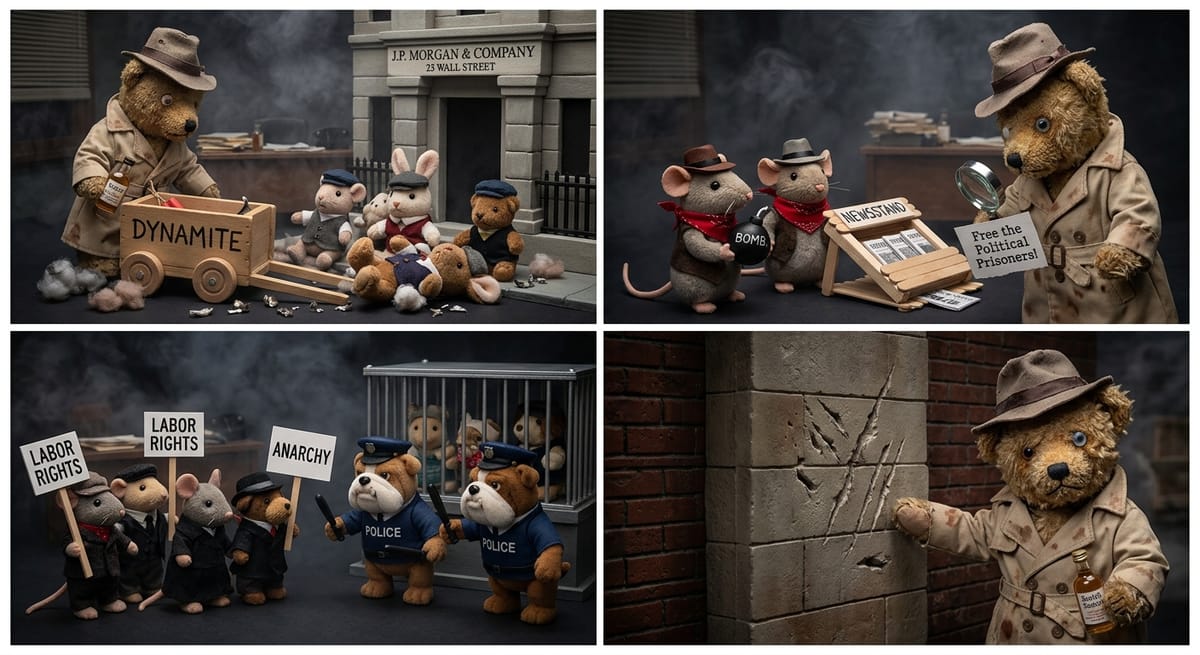
At 12:01 p.m. on September 16, 1920, a horse-drawn wagon parked across the street from the J.P. Morgan & Company bank at 23 Wall Street exploded. The wagon had been packed with 100 pounds of dynamite and 500 pounds of cast iron window sash weights — improvised shrapnel. Thirty-eight people were killed, most of them within seconds, and more than 400 were wounded. The blast shattered windows for blocks, blew people off their feet, and sent fragments of iron through office windows on the upper floors of surrounding skyscrapers. It was the deadliest attack on American civilians on American soil in the country’s history at that point and the worst terrorist attack in New York City until September 11, 2001.
No one was ever arrested. No group definitively claimed responsibility. The case was never solved.
Part of Historical Mass Violence — ← Back to series hub
What a Bomb at the Lunch Hour on Wall Street Actually Does
September 16, 1920, was a clear Thursday. The New York Stock Exchange was open and trading had been active. Wall Street at noon was one of the most densely populated places on earth at that hour — clerks, bankers, messengers, delivery workers, secretaries leaving early for lunch. The wagon had been parked at the corner of Wall and Broad Streets for perhaps an hour before the explosion, attracting no particular notice. A horse-drawn delivery wagon on Wall Street in 1920 was as unremarkable as a delivery truck today.
The bomb went off at the lunch hour, apparently by design. The iron sash weights turned into projectiles traveling at high velocity in all directions. Joseph Keenan, a 40-year-old broker’s assistant at Broad and Wall, was killed instantly. A newsstand operator at the corner was blown apart. Windows on the upper floors of 23 Wall Street shattered inward, wounding people on floors 2 through 4. A fire broke out inside Morgan’s trading room. Windows at the New York Stock Exchange across the street were destroyed.^1^
The NYSE shut down trading for the day within minutes. It reopened the next morning. Morgan’s senior partners, away in Europe, cabled condolences and reassurances. J.P. Morgan Jr. returned from Europe within days and oversaw the cleanup personally. The pockmarks left in the limestone facade of 23 Wall Street were deliberately never repaired — they remain visible today, more than a century later, as the only public acknowledgment of what happened there.
Who Did It — and Why the Case Was Never Solved
The leading suspects, then and now, were followers of Luigi Galleani, an Italian anarchist who had been deported from the United States in June 1919 under the Sedition Act. The Galleanists were a network of radical anarchists who believed in “propaganda by the deed” — political violence as a tool of class revolution. They had already carried out a series of bombings in 1919, including coordinated bomb attacks in eight cities on June 2, 1919, that killed the bomber himself, Carlo Valdinoci, when his device detonated prematurely. Documents found near Valdinoci’s body referenced Galleanist publications.
The September 1920 Wall Street bombing bore the hallmarks of a Galleanist operation: cast iron shrapnel maximized casualties, the target was a symbol of American capitalism, and flyers found in a nearby mailbox shortly before the explosion read: “Free the Political Prisoners or it will be sure death for all of you!” signed by “American Anarchist Fighters.” The language matched Galleanist literature.^2^
The investigation, led by the Justice Department’s Bureau of Investigation under William Flynn, failed to produce charges against anyone. The primary suspect — Mario Buda, a Galleanist associate of Nicola Sacco and Bartolomeo Vanzetti — departed for Italy days after the bombing and never returned. He was never charged and died in Italy in 1963.
Historian Paul Avrich, whose 1991 book Sacco and Vanzetti: The Anarchist Background remains the most detailed examination of the Galleanist network, concludes that Buda likely planted the bomb as retaliation for the indictment of Sacco and Vanzetti, arrested in May 1920 for an unrelated robbery-murder in South Braintree, Massachusetts. Buda had the means, motive, and connections — and left the country within days of the explosion.^3^
The Political Moment Made the Violence Possible
The bombing occurred at the peak of what historians call the First Red Scare, a period of intense political repression following the Russian Revolution of 1917. The Palmer Raids — organized sweeps conducted by Attorney General Palmer’s Justice Department — had arrested approximately 10,000 people between November 1919 and January 1920, many of them immigrant radicals, often without warrants. More than 500 people were deported. The government had substantially dismantled the far left of American political life by the summer of 1920.
The bombing of Wall Street was an act of political violence directed at the financial center of the capitalist system the perpetrators believed had oppressed workers and justified government repression. Its victims were not bankers and financiers — they were the clerks and messengers and lunch-hour workers at the bottom of that system’s hierarchy. Thirty-three of the 38 dead were working-class people.^4^
The bombing did not produce the insurrection the perpetrators may have intended. Instead, it accelerated already-strong nativist and anti-immigrant sentiment, contributed to the passage of the Emergency Quota Act of 1921 that dramatically restricted immigration from Southern and Eastern Europe, and hardened public opinion against labor radicals. The political effect was precisely the opposite of what the bombers sought.
What Was Never Resolved — and What It Established
The case was never officially closed. The Bureau of Investigation pursued suspects for years, with Bureau director William Burns going to Europe in 1921 seeking Galleanist connections. It produced nothing prosecutable.
The 38 dead were mostly forgotten within years. Wall Street was rebuilt, the stone was left scarred, and trading resumed the next morning as if to demonstrate that capital would not be interrupted. The scale of the attack — 38 dead, 400 wounded — was not surpassed in a domestic attack until the Oklahoma City bombing of April 19, 1995, 75 years later, which killed 168 people.
The 1920 bombing also established a precedent: that a single person or small cell could plan and execute a mass casualty attack on American soil, disappear without identification, and never be held accountable. That precedent has been tested many times since. The Bath School Disaster in 1927, carried out by a single man who was similarly impossible to stop because no one understood what he was planning, shares the same structural DNA. The Wall Street bombing case remains open.
─────────
Sources:
- Gage, Beverly. The Day Wall Street Exploded: A Story of America in Its First Age of Terror. Oxford University Press, 2009.
- Avrich, Paul. Sacco and Vanzetti: The Anarchist Background. Princeton University Press, 1991.
- Murray, Robert K. Red Scare: A Study in National Hysteria, 1919–1920. University of Minnesota Press, 1955.
- McCormick, Charles H. Seeing Reds: Federal Surveillance of Radicals in the Pittsburgh Mill District, 1917–1921. University of Pittsburgh Press, 1997.