The Pulse Nightclub Shooting: Terror at Last Call
Omar Mateen killed 49 people at Pulse nightclub in Orlando on June 12, 2016 — during Latin Night at a gay club. The FBI had investigated him twice before the attack.
The Pulse Nightclub Shooting: Terror at Last Call
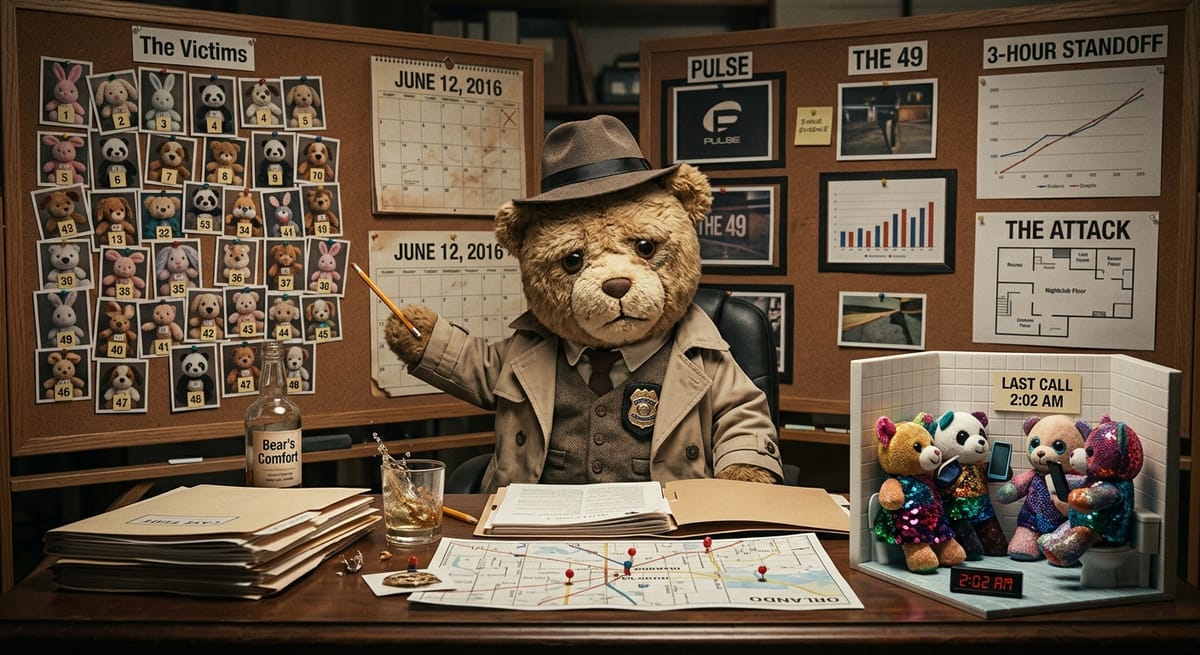
At 2:02 a.m. on June 12, 2016, Omar Mateen, a 29-year-old security guard from Fort Pierce, Florida, entered Pulse nightclub in Orlando and began shooting. He killed 49 people and wounded 53 more before being killed by an Orlando Police Department SWAT team at 5:15 a.m., approximately three hours after the attack began. The attack was carried out at a gay nightclub during Latin Night, a weekly event drawing a predominantly LGBTQ+ and Latino clientele. The Pulse shooting was, at the time, the deadliest mass shooting in American history — surpassing the San Ysidro McDonald’s massacre that had held the record for 32 years. It held the record for 16 months, until the Las Vegas shooting in October 2017.
Part of Workplace and Public Shootings — ← Back to series hub
Inside Pulse: What the First Hours Looked Like
Pulse was a small venue, capacity approximately 300 people, on South Orange Avenue in Orlando. It had been operating since 2004 and was well known as a gay-friendly club. Latin Night drew a large crowd of LGBTQ+ Latinos and allies. At 2:02 a.m. the club was near capacity when Mateen entered through the main entrance with a Sig Sauer MCX semiautomatic rifle and a Glock 17 semiautomatic pistol — both purchased legally from a firearms dealer in Port St. Lucie, Florida, five to six days before the attack, after Mateen had passed background checks.
He opened fire on the crowded dance floor, then moved through the club. The initial burst of fire lasted several minutes; some survivors fled through exits, others hid in bathrooms, closets, and back rooms. Orlando police responded within two minutes of the first 911 calls and engaged Mateen near the entrance, forcing him deeper into the club where hostages were sheltering. At approximately 2:30 a.m., police classified the situation as a hostage scenario, shifting from active shooter response to negotiation mode — a decision that would later be heavily scrutinized given the death toll still accumulating inside.^1^
Mateen called 911 three times during the siege and made statements pledging allegiance to ISIS and referencing the Tsarnaev brothers, perpetrators of the Boston Marathon bombing. He called a local television station and identified himself. FBI negotiators spoke with him by phone. The three-hour standoff ended at 5:02 a.m. when SWAT operators used an armored vehicle to breach a bathroom wall. Mateen was shot and killed as he emerged; three officers were struck, one bullet stopped by a Kevlar helmet, another by a ballistic vest.
The 49
The victims ranged in age from 18 to 50. Forty-three were Latino. Twenty-three were Puerto Rican, reflecting the demographics of Latin Night at Pulse. Among those killed: Luis Omar Ocasio-Capo, 20; Juan Ramon Guerrero, 22; Christopher Andrew Leinonen, 32, whose mother Christine Leinonen appeared before cameras hours after the shooting while her son’s fate was still unknown and pleaded for information; Amanda Alvear, 25, who had been Snapchatting video from inside the club moments before the shooting and whose last video recorded the sound of gunfire.
Eddie Jamoldroy Justice, 30, texted his mother Mina Justice from inside the bathroom where he was hiding: “mommy I love you.” His final text, sent as the SWAT breach began: “He’s coming.” He was among those killed in the breach.^2^ The youngest killed was Cory James Connell, 18. The oldest was Javier Jorge-Reyes, 50. Angel Colon survived being shot five times and his leg being broken when a police vehicle rolled over him during the evacuation; he gave an interview from his hospital bed the next day describing how Mateen had walked past him while he played dead, stepped on his hand, looked at him, and moved on.
What the FBI Investigation Found — and Didn’t
The FBI’s investigation of Mateen’s motivations was extensive and ultimately unresolved in important ways. Mateen had been investigated by the FBI twice before the attack — in 2013, when coworkers reported he had made inflammatory statements about terrorist organizations, and in 2014, when he appeared to have associated with Moner Abu-Salha, an American who became a suicide bomber for al-Nusra Front in Syria. Both investigations were closed without action.
Mateen had described himself during the attack as an Islamic soldier and pledged allegiance to ISIS. FBI Director James Comey described the attack as “homegrown extremism inspired by” rather than directed by ISIS, noting that Mateen had also, in calls during the siege, claimed affiliation with Hezbollah and al-Qaeda — organizations that are opposed to each other. The ideological coherence of his stated motivations was limited.^3^
Complicating the picture further were accounts from people who said Mateen had frequented Pulse before the attack and from a man who said Mateen had messaged him on a gay dating app. His former wife and several acquaintances described what appeared to be a conflicted relationship with his own sexuality. The FBI stated it could not confirm or deny these accounts. His second wife, Noor Salman, was charged with aiding and abetting and obstruction of justice; she was acquitted by a jury in March 2018 after a trial in which the government’s case was found insufficient on the evidence.
The Community Response and the Political Silence
The response to the Pulse shooting among Florida’s LGBTQ+ community, and particularly among the Puerto Rican community in Orlando, was intense and visible. Blood banks announced donation drives; lines stretched for hours. A memorial of 49 crosses went up outside the club within days and remained a gathering point, covered in flowers, flags, and photographs of the dead, for months.
Florida’s political response was muted on gun legislation. Congress held a sit-in organized by House Democrats in June 2016 demanding a vote on gun legislation; the sit-in lasted 26 hours before the Republican majority ended the session. No federal gun legislation passed.^4^ The FBI’s 2017 investigative summary recommended improved information sharing between federal and local law enforcement and noted that the two prior Mateen investigations had been properly closed under existing guidelines but might have benefited from additional follow-up — the same institutional gap pattern visible at Virginia Tech, Parkland, and elsewhere in this record.
The OnePulse Memorial
Pulse nightclub closed after the attack and became a makeshift memorial site. The onePULSE Foundation was established to create a permanent memorial and museum. By 2023, the foundation had raised approximately $40 million, acquired surrounding property, and completed a design process for a memorial that would include the preserved club structure and a museum of LGBTQ+ history in Florida. Construction was ongoing.
The Pulse shooting is held and processed differently by different communities. In some contexts it is discussed primarily as a terrorist attack, emphasizing Mateen’s ISIS allegiance declaration. In others it is understood primarily as a hate crime targeting LGBTQ+ people and Latino communities. In most honest accounts of what happened, it was both simultaneously — and that simultaneity is part of what made the political conversation around it so immediately fractured.
Forty-nine people were dancing on a Saturday night. It was Latin Night. Last call was ninety minutes away. Some of them had texted people they loved earlier that evening and said they’d be home later. The word “later” was still true when Mateen walked in the door.
─────────
Sources:
- Federal Bureau of Investigation. Investigative Summary: Shootings at the Pulse Nightclub. March 2018.
- Alvarez, Lizette, and Richard Pérez-Peña. “Orlando Gunman Attacks Gay Nightclub, Leaving 50 Dead.” The New York Times, June 12, 2016.
- Mazzetti, Mark, and Eric Schmitt. “F.B.I. Treating Orlando Attack as Terrorism Case.” The New York Times, June 13, 2016.
- City of Orlando and Orange County. Pulse Nightclub Shooting After Action Review. 2018.