Public Mass Shootings: America's Unique Epidemic
From Charles Whitman in 1966 to Pulse in 2016: five events across 50 years that document America's epidemic of public mass violence and why the data points to one consistent variable.

Public Mass Shootings: America’s Unique Epidemic
The United States accounts for roughly 5 percent of the world’s population and 31 percent of its mass shooters, according to a 2016 study by criminologist Adam Lankford covering 171 countries between 1966 and 2012. The gap between population share and mass shooting share is not explained by higher rates of mental illness, more violent media consumption, or greater social isolation — peer nations with comparable rates of all three have dramatically lower rates of mass public violence. The variable that most consistently differentiates the United States is civilian access to high-capacity, high-lethality firearms. That finding doesn’t resolve the debate. But it is where the data points.
In This Series
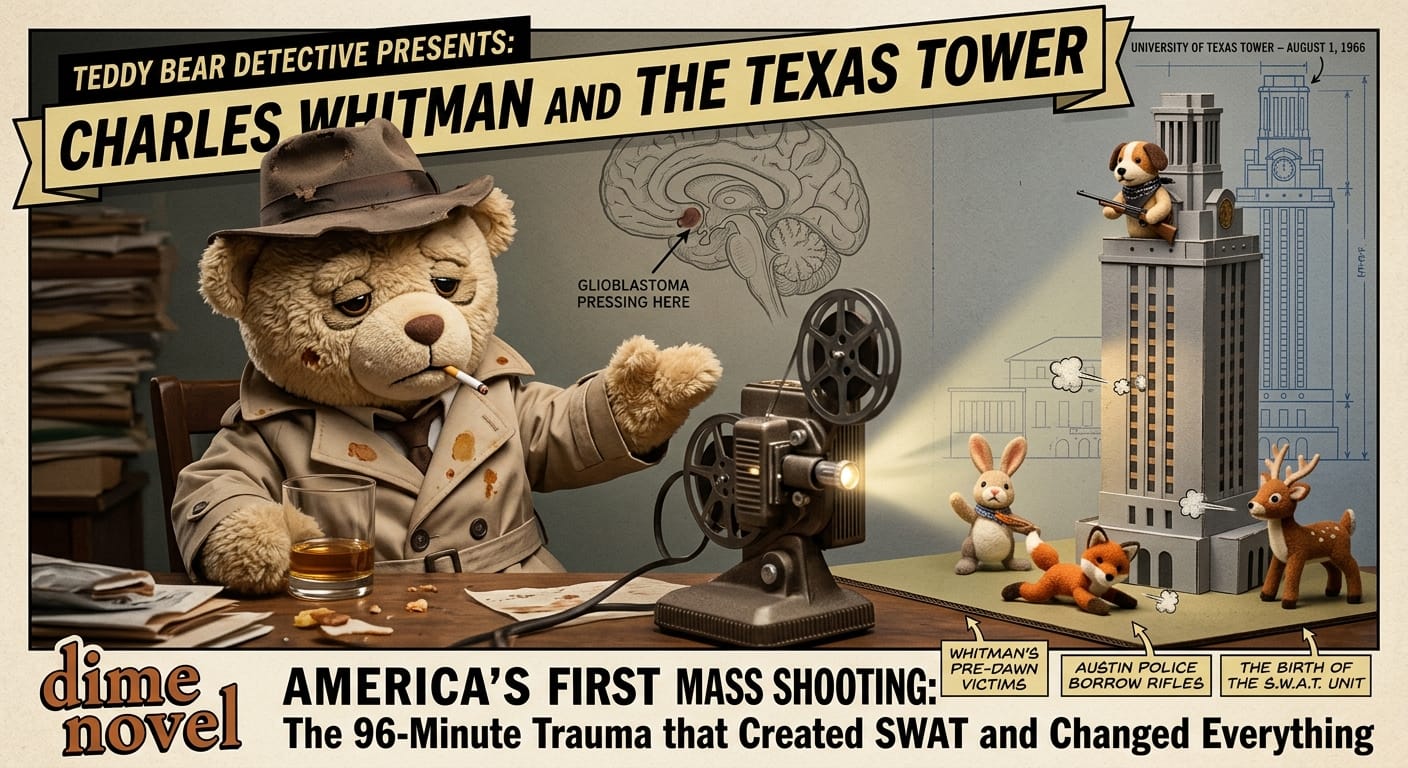
- Charles Whitman and the Texas Tower: America’s First Mass Shooting
- The San Ysidro McDonald’s Massacre
- Going Postal: When the Workplace Became a War Zone
- The Las Vegas Shooting: 58 Dead From a Hotel Window
- The Pulse Nightclub Shooting: Terror at Last Call
The Span of the Pattern
Charles Whitman in Austin in 1966. James Oliver Huberty in San Ysidro in 1984. Postal workers in Edmond, Royal Oak, and Ridgewood through the 1980s and 1990s. Stephen Paddock in Las Vegas in 2017. Omar Mateen in Orlando in 2016. The specific events in this series span more than 50 years and cross the boundaries of workplace violence, public space attacks, terrorism, and mass murder without discernible motive. The pattern they share is not ideological. It is structural.
Each attack happened in a place people treated as ordinary and safe — a university campus, a fast food restaurant, a post office, a concert, a nightclub. Each produced a body count that reflected the type of weapon used, the density of people present, and the time to effective response. Each exposed a gap between what warning signs existed and what intervention occurred. None produced a federal policy response commensurate with the scale of what happened.
Motive Is Not the Constant — Warning Signs Are
One of the patterns this series documents is the variability of stated motive — and the danger of organizing prevention policy around any single motivational type. Whitman left notes and a brain tumor. Huberty told his wife he was “going hunting for humans.” The postal shooters had documented, traceable grievances with their employer and the grievance process that failed them. Paddock left nothing useful. Mateen called 911 and declared allegiance to an organization while simultaneously referencing rival organizations that contradicted each other.
The effort to identify a mass shooter profile has been ongoing since at least the late 1970s and has produced two consistent findings: most mass shooters share certain behavioral warning signs observable before attacks, and those warning signs are shared by an enormous population of people who never commit violence, making them nearly useless for predicting specific individuals.^1^ What threat assessment research does find actionable — consistently, across the FBI, the Secret Service NTAC, and academic literature — is the importance of situational warning signs: specific statements of intent, specific targets mentioned, specific weapons acquired in advance. These indicators, when reported and acted on, can be interrupted. In case after case in this series, they weren’t.
The Public Space Dimension
The San Ysidro McDonald’s, the Route 91 Harvest festival grounds, Pulse nightclub — public gathering places, all of them. One of the consistent arguments against gun restriction is that determined attackers will find a way regardless of the tools available. The data from international comparisons doesn’t support this: countries with comparable levels of social stress and interpersonal conflict but with more restricted access to high-capacity firearms have lower rates of mass casualty public violence.
This is not a political observation — it is a factual one. Thirty-eight people were killed at San Ysidro in 77 minutes using a 9mm Uzi capable of firing 600 rounds per minute. Fifty-eight people were killed at Route 91 in 10 minutes using rifles fitted with bump stocks approximating automatic fire. Forty-nine people were killed at Pulse in a confined venue over 3 hours using a semiautomatic rifle and pistol. The weapons are load-bearing variables in each body count.
The Workplace Violence Thread
The postal shootings of the 1980s and early 1990s introduce a specific subset of public mass violence: attacks on workplace institutions as a response to institutional failure. The Califano Report of 1994 documented that the USPS had created conditions of sustained harassment, ineffective grievance processes, and unaccountable supervisory power that concentrated explosive grievances among workers with no functional outlet. The attacks were, in this analysis, not random — they were the endpoint of institutional processes that had multiple failure points.^2^
That pattern has appeared outside the post office: the 1999 Xerox Corporation shooting in Honolulu, the 2010 Hartford Distributors shooting in Connecticut, the 2019 Virginia Beach municipal building shooting where 12 people were killed by a city employee who had submitted a resignation letter the morning of the attack. Workplace violence as a category shares with school violence the characteristic that warning signs, when documented, are legible in retrospect and frequently were legible in real time to people who didn’t know what to do with what they saw.
Five Events, One Line
Charles Whitman in 1966 established the template and exposed the gap in law enforcement tactical capability. San Ysidro in 1984 refined the argument for active shooter doctrine. The postal shootings through the late 1980s and early 1990s documented what institutional failure looks like as a root cause. Las Vegas in 2017 demonstrated that a mass casualty attack can happen without legible motive, without prior warning, and without any existing system catching it in time. Pulse in 2016 demonstrated that public mass violence can simultaneously be terrorism, hate crime, and personal crisis — and that the political conversation will fracture along each of those definitions simultaneously.
The through-line is not ideology or motive or demographics. It is the availability of weapons capable of killing many people quickly, and the consistent gap between what institutions know and what they do with it.
─────────
Sources:
- Lankford, Adam. “Public Mass Shooters and Firearms: A Cross-National Study of 171 Countries.” Violence and Victims, 2016.
- United States Postal Service Commission on a Safe and Drug-Free Workplace. Breaking the Cycle of Violence. 1994.
- Las Vegas Metropolitan Police Department. 1 October: After Action Review. 2018.
- Federal Bureau of Investigation. Active Shooter Incidents in the United States in 2022. 2023.
The Series