The Las Vegas Shooting: 58 Dead From a Hotel Window
On October 1, 2017, Stephen Paddock killed 58 people at the Route 91 Harvest festival from his Mandalay Bay hotel suite. The FBI investigated for years and found no clear motive.
The Las Vegas Shooting: 58 Dead From a Hotel Window
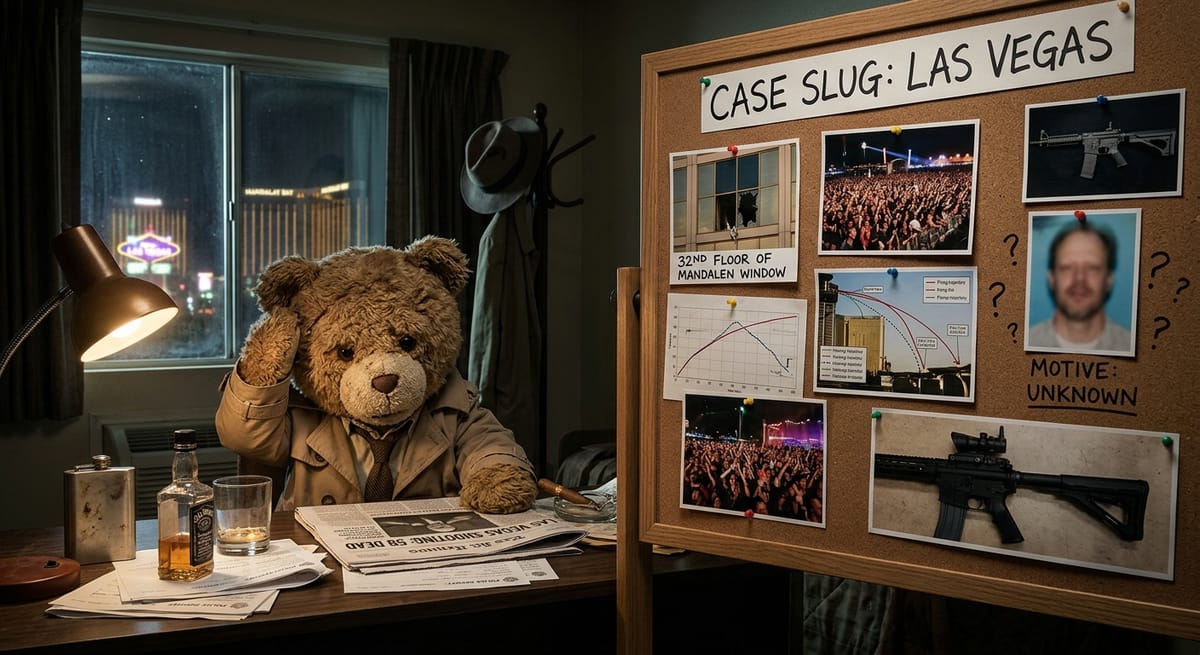
At 10:05 p.m. on October 1, 2017, Stephen Paddock, a 64-year-old retired accountant and real estate investor, opened fire from his 32nd-floor suite at the Mandalay Bay Resort and Casino in Las Vegas, Nevada, into the crowd attending the Route 91 Harvest country music festival on the Las Vegas Strip below. He fired for approximately 10 minutes, killing 58 people and wounding 413 more from gunshot wounds; 456 additional people were injured in the panic and evacuation that followed. He had 23 firearms in his hotel suite, 12 of them fitted with bump stocks that allowed them to fire at a rate approximating automatic weapons. When Las Vegas police breached his suite at 11:20 p.m., Paddock was dead of a self-inflicted gunshot wound.
The Las Vegas shooting was the deadliest mass shooting in American history, and it remains so. It is also the mass shooting whose motivations were never explained — a fact that sits at the center of everything that followed.
Part of Workplace and Public Shootings — ← Back to series hub
The Festival Below
Route 91 Harvest was in its third year, drawing approximately 22,000 people to a 15-acre outdoor venue across the street from Mandalay Bay. Jason Aldean was performing when the shooting began. It took the crowd several seconds to process what they were hearing — country music events in Nevada commonly feature firearms, and the initial bursts sounded to many like fireworks. When the realization set in, 22,000 people attempted to move through a venue with limited exits while Paddock continued firing from 490 yards away and 200 feet above. The distance meant his fire was inaccurate by sniper standards, but at the density of 22,000 people in 15 acres, accuracy was not required.
The 58 killed ranged in age from 20 to 67 and came from across the United States. They included off-duty police officers, firefighters, a nurse, a teacher, a newlywed. Bailey Schweitzer, 20, had driven from Bakersfield, California, for the festival. Jordan McIldoon, 23, from Maple Ridge, British Columbia, was the only Canadian killed. His phone rang repeatedly after his death, his girlfriend calling to find him; a stranger answered and stayed with him until police arrived.^1^
Who Stephen Paddock Was — and What the Investigation Couldn’t Find
Paddock had no criminal record, no known extremist associations, no social media presence of note, and no apparent motive. He was the son of Benjamin Paddock, a bank robber who appeared on the FBI’s Most Wanted list in 1969 and was described in FBI documents as “psychopathic” — but the relevance of that lineage to his son’s actions is speculative. Paddock had worked as a letter carrier, then as an IRS agent, then in government contracting, before becoming a professional gambler and real estate investor. He was successful at both. He had gambled at high stakes for years, reportedly losing significant amounts in the years before the shooting.
He had no history of mental illness diagnosis. His girlfriend, Marilou Danley, who was traveling in the Philippines when the shooting occurred, told investigators she had no warning. His brother Eric Paddock, reached by reporters in Orlando, said he was “completely dumbfounded.”
The Las Vegas Metropolitan Police Department and the FBI conducted one of the most extensive investigations in American law enforcement history — reviewing Paddock’s financial records, travel history, electronic communications, and relationships, and interviewing more than 400 people. The final report, released in August 2018, concluded that no single or clear motive had been identified. Investigators found no evidence of religious extremism, no manifesto, no known grievance.^2^
The FBI behavioral analysis unit concluded that Paddock appeared to have targeted a large group of people and had been in a state of “terminal decline” — depressed, aging, losing significant amounts gambling — but could not assign a definitive motivation. The inability to explain why is one of the most unsettling features of the Las Vegas shooting: it breaks the pattern almost every other mass shooting follows, including Columbine, Virginia Tech, Parkland, and the Pulse nightclub shooting.
The Bump Stock That Fired 1,100 Rounds in Nine Minutes
Paddock had 23 long guns in his suite, all legally purchased, plus additional weapons at his home in Mesquite, Nevada. He had acquired 33 firearms in the 12 months preceding the attack, a purchasing pattern that no background check system flagged because there was no federal requirement to flag multiple long gun purchases to law enforcement, as there was for handguns.
Twelve of his rifles were equipped with bump stocks, devices that use a rifle’s recoil energy to allow the shooter to fire at a rate approximating full-automatic fire. Bump stocks had been legal since 2010, when the ATF ruled they did not convert semiautomatic weapons into machine guns under federal law. The firing rate they enabled — Paddock fired approximately 1,100 rounds in his first nine minutes — was central to the casualty count.
President Trump ordered the ATF to reconsider the bump stock classification in December 2017. The ATF reclassified bump stocks as machine gun conversions in December 2018, banning the devices and requiring existing owners to destroy or surrender them. The ban was challenged in court and ultimately struck down by the Supreme Court in Garland v. Cargill in June 2024, with the majority holding that bump stocks do not mechanically constitute machine guns under the statutory definition. The dissent, written by Justice Sonia Sotomayor, noted that the decision restored the legality of a device used in the single deadliest mass shooting in American history.^3^
The Settlement and the Aftermath
MGM Resorts International was named in hundreds of lawsuits by victims and survivors. In 2019, MGM reached a settlement of $735 million — the largest mass shooting settlement in American history — to be shared among approximately 4,500 plaintiffs. Lawyers for the victims noted that MGM had invoked a rarely-used 2002 federal law, the SAFETY Act, to limit its liability by arguing that its security technology was a federally certified anti-terrorism system. The use of the law was widely criticized as an attempt to use post-9/11 anti-terrorism legislation to shield a corporation from accountability for a domestic mass shooting.
Las Vegas city and county officials invested $11 million in a permanent memorial on the festival site, opened in October 2023 — six years after the shooting. The design includes 58 glass pillars, one for each person killed. Nevada strengthened its red flag law and enacted restrictions on high-capacity magazines after the shooting. Federal legislation addressing the specific vulnerabilities exposed — the lack of multi-gun purchase reporting requirements for long guns, the absence of a bump stock ban — largely stalled.^4^
The Question Without an Answer
The most honest thing that can be said about the Las Vegas shooting is that the “why” remains unknown. Paddock planned the attack with methodical precision — he booked his suite days in advance under a false pretext, scouted other potential locations before selecting Mandalay Bay, and arranged his room to maximize firing angles. He clearly intended to kill as many people as possible and left no explanation for why.
Mass violence researchers who have spent careers studying attacker motivation describe the absence of a legible motive as genuinely unusual. Most mass shooters are transparent about grievance, ideology, or stated purpose even when those stated purposes are incoherent. Paddock’s silence — deliberate, apparently complete — has no clean parallel in the literature. The 58 people killed at Route 91 Harvest on October 1, 2017, were killed for reasons no investigation has yet established. That is the truth of it. It is not a satisfying landing, but it is accurate.
─────────
Sources:
- Las Vegas Metropolitan Police Department. 1 October: After Action Review. August 2018.
- Federal Bureau of Investigation. Las Vegas Shooting, Behavioral Analysis Unit Report. 2019.
- Liptak, Adam. “Supreme Court Strikes Down Trump-Era Bump Stock Ban.” The New York Times, June 14, 2024.
- Kesslen, Ben. “MGM Reaches $735 Million Settlement With Las Vegas Shooting Victims.” NBC News, October 3, 2019.
- Roth, Alissa J. “Route 91 Harvest: A Year After Las Vegas.” NPR, October 2018.