The San Ysidro McDonald's Massacre
James Huberty killed 21 people — including 9 children — at a San Diego McDonald's on July 18, 1984. He called a mental health crisis line that morning. They never called back.
The San Ysidro McDonald’s Massacre
James Oliver Huberty walked into a McDonald’s restaurant in the San Ysidro neighborhood of San Diego, California, on July 18, 1984, at 3:57 p.m. and began shooting. He killed 21 people and wounded 19 others before a San Diego Police Department SWAT sniper killed him from a rooftop 77 minutes after the attack began. Huberty, 41, used three firearms: a 9mm Uzi semiautomatic carbine, a 12-gauge Winchester pump-action shotgun, and a 9mm Browning semiautomatic pistol — all carried from his apartment across the street.
The San Ysidro massacre was, at the time, the deadliest single-day mass shooting by one person in American history. It held that record for two years, until the Post Office shooting in Edmond, Oklahoma, in 1986. The event directly shaped the development of active shooter tactical doctrine, exposed fatal failures in mental health intervention, and became one of the foundational cases in the modern study of mass violence.
Part of Workplace and Public Shootings — ← Back to series hub
Who Died in That McDonald’s
The dead ranged in age from 8 months to 74 years. Nine of the 21 killed were children: Matao Gaspar, 8 months; Joshua Coleman, 6; Mellissa Ureste, 8; Arisdelsi Vuelvas Argüelles, 11; David Flores, 11; Ivonne Vuelvas, 11; Alicia Vargas, 12; Margarita Padilla, 13; Omar Droz Velasquez, 8. Many were Mexican or Mexican-American, reflecting the demographics of San Ysidro, a border community where the McDonald’s on that summer afternoon was filled with working families, many from across the border.^1^
Several of the dead had tried to run. Larry Maxfield, 44, was shot in the parking lot. A family who had arrived just before Huberty — Jackie Wright, her son David, 8, and daughter Alicia Vargas — were shot within the first minutes. Both children were killed. Jackie Wright survived. Eighteen-year-old National Guard member Josh Coleman, in civilian clothes and unarmed, was one of the first killed. His death would later be cited in debates about whether armed civilians could have altered the outcome.
Why Huberty Called a Mental Health Crisis Line That Morning
Huberty had moved to San Ysidro with his wife Etna and their two daughters just seven months before the attack, after losing his job as a welder and security guard in Massillon, Ohio. He had a documented history of psychological problems, including paranoia and depression. He called the San Diego mental health crisis center the morning of the attack, left his name and phone number, identified himself as a “mass murderer,” and was never called back. A clerical error had been made with his name.^2^
Huberty had told his wife before leaving their apartment: “I’m going hunting. Hunting for humans.” She assumed he was kidding — he had always been volatile and she had lived with it for years. He carried the Uzi under his jacket and crossed the street.
The mental health clinic’s failure to return his call was investigated after the shooting. The clinic’s director acknowledged the error. Whether a callback would have led to intervention is not answerable with certainty, given the narrow window between his call and the shooting and the constraints on emergency psychiatric holds. What is certain is that Huberty had made his intent explicit and the system didn’t catch it.
77 Minutes: What the Police Response Got Wrong
The first San Diego police units arrived approximately three minutes after the shooting began. Their weapons — standard service revolvers — were ineffective at the range and through the windows of the restaurant. A SWAT unit was assembled and a sniper team was positioned. For 77 minutes, people inside the McDonald’s who were wounded but alive lay on the floor while Huberty continued to move through the space. Some survivors played dead. One employee, Kenny Doolittle, hid in a freezer for the duration and emerged unharmed.
SWAT sniper Chuck Foster killed Huberty with a single shot from approximately 100 yards at 5:17 p.m., after Huberty exposed himself in the doorway. At that point, Huberty had fired an estimated 245 rounds.
The SDPD’s response was later critiqued for the 77-minute timeline. The critique — that law enforcement waited while people bled out inside — became one of the driving arguments for the “active shooter” doctrine that eventually replaced “contain and negotiate” as standard protocol. The Charles Whitman shooting in 1966 had begun this conversation; Columbine in 1999 completed the transition. The failure at Uvalde in 2022, where officers waited 77 minutes — the same duration as San Ysidro — demonstrated how incompletely that lesson had been absorbed.
What Was Left and What Was Forgotten
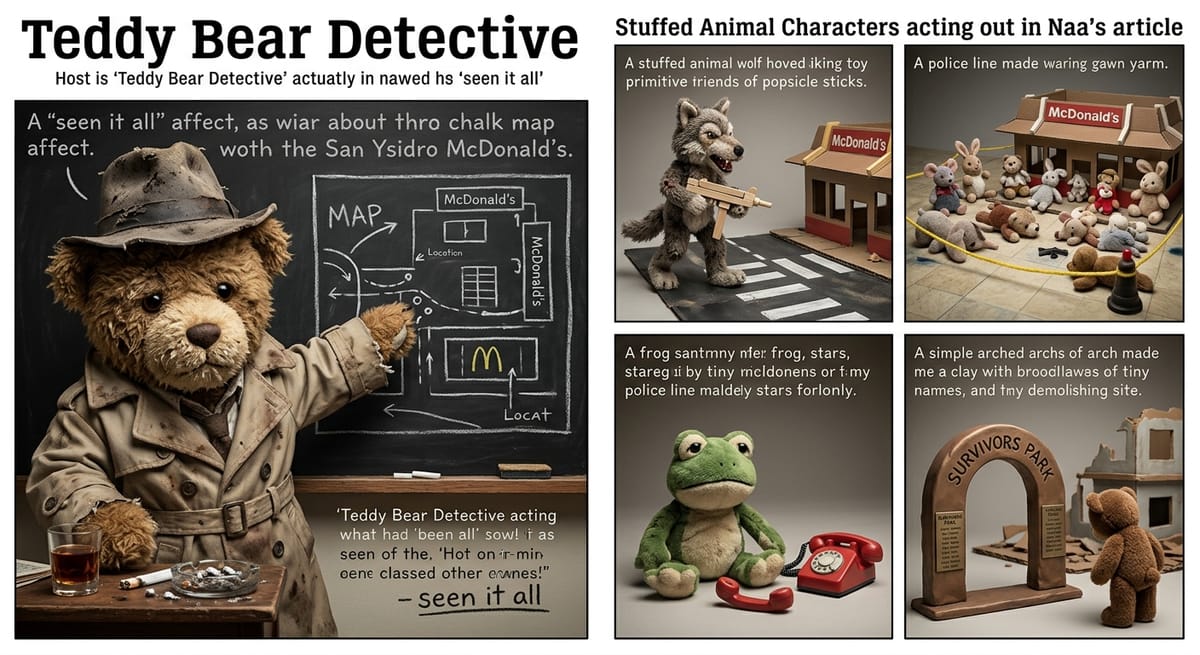
McDonald’s demolished the San Ysidro location and donated the land to the City of San Diego. A memorial was built on the site and dedicated on July 18, 1988, four years after the shooting. The monument, designed by Mexican sculptor Armando Amaya, includes a bronze plaque with the 21 names of the dead. The site is called Survivors Park.
California passed one of the first state assault weapons bans in 1989 — the Roberti-Roos Assault Weapons Control Act — in part as a response to the San Ysidro massacre and the Stockton school shooting of January 17, 1989, in which Patrick Purdy killed five children and wounded 30 more at Cleveland Elementary School using an AK-47 variant he had purchased legally.
The families of the San Ysidro dead settled lawsuits against McDonald’s Corporation, arguing the restaurant’s design and window placement limited exit options for customers attempting to flee. McDonald’s subsequently changed some design standards for restaurant layouts. The total settlement amount was never publicly disclosed. Etna Huberty, James’s widow, filed her own lawsuit against McDonald’s, claiming that her husband’s violence was caused by elevated zinc levels from eating too many Chicken McNuggets. The lawsuit was dismissed.^3^
The 21 people killed in San Ysidro in 77 minutes on a July afternoon were predominantly Latino, predominantly young, and largely forgotten in the national narrative that more often anchors mass shooting history to Columbine, 15 years later. The difference in cultural memory is not entirely about scale. It is also about who the victims were and who was watching.
─────────
Sources:
- Katz, Jesse. “San Ysidro Shooting Remembered by Survivors.” Los Angeles Times, July 18, 2004.
- Dietz, Park E. “Mass, Serial and Sensational Homicides.” Bulletin of the New York Academy of Medicine, 1986.
- Headden, Susan. “McDonald’s Massacre: 10 Years Later.” U.S. News & World Report, July 18, 1994.
- Follman, Mark, Gavin Aronsen, and Deanna Pan. “US Mass Shootings, 1982–2019.” Mother Jones, 2019.