Ideological Terror: Domestic Terrorism in America
From the KKK to the Unabomber to the Army of God — six cases that reveal the three conditions that turn political grievance into domestic terrorism on American soil.
Ideological Terror: Domestic Terrorism in America
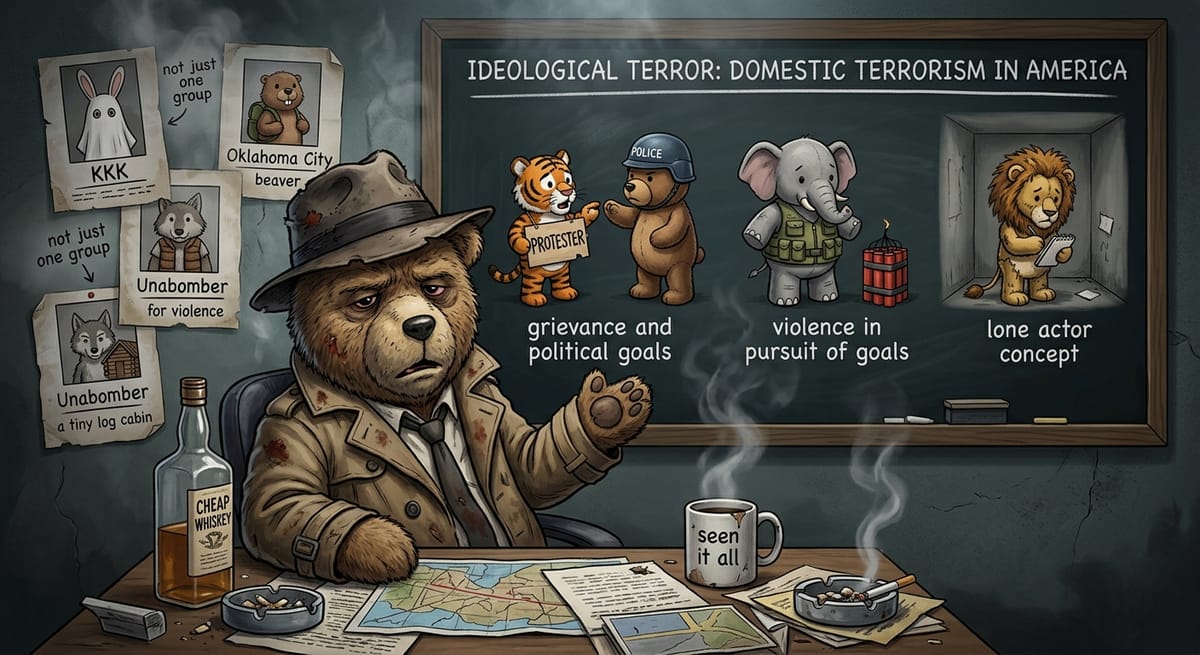
Domestic terrorism in the United States does not follow a single ideology. It comes from the left and the right, from religious conviction and secular grievance, from lone actors and organized networks. What connects the cases covered here is something more specific than ideology: the decision to commit violence against civilians or civilian infrastructure in pursuit of a political or social goal, on American soil, by Americans.
That decision has been made by a Harvard-educated mathematician living alone in a Montana cabin, by a decorated Army veteran who had won the Bronze Star, by middle-class white college students from the Midwest who had watched their country prosecute a war they believed was criminal, and by religious extremists who were convinced that murder was a form of defense. The range is not a coincidence. Domestic terrorism in the United States has never been the province of a single group or ideology.
In This Series
- The KKK Across Three Eras: America’s Longest-Running Terrorist Organization — 150 years of revival and collapse, and what that cycle reveals about impunity as a structural condition.
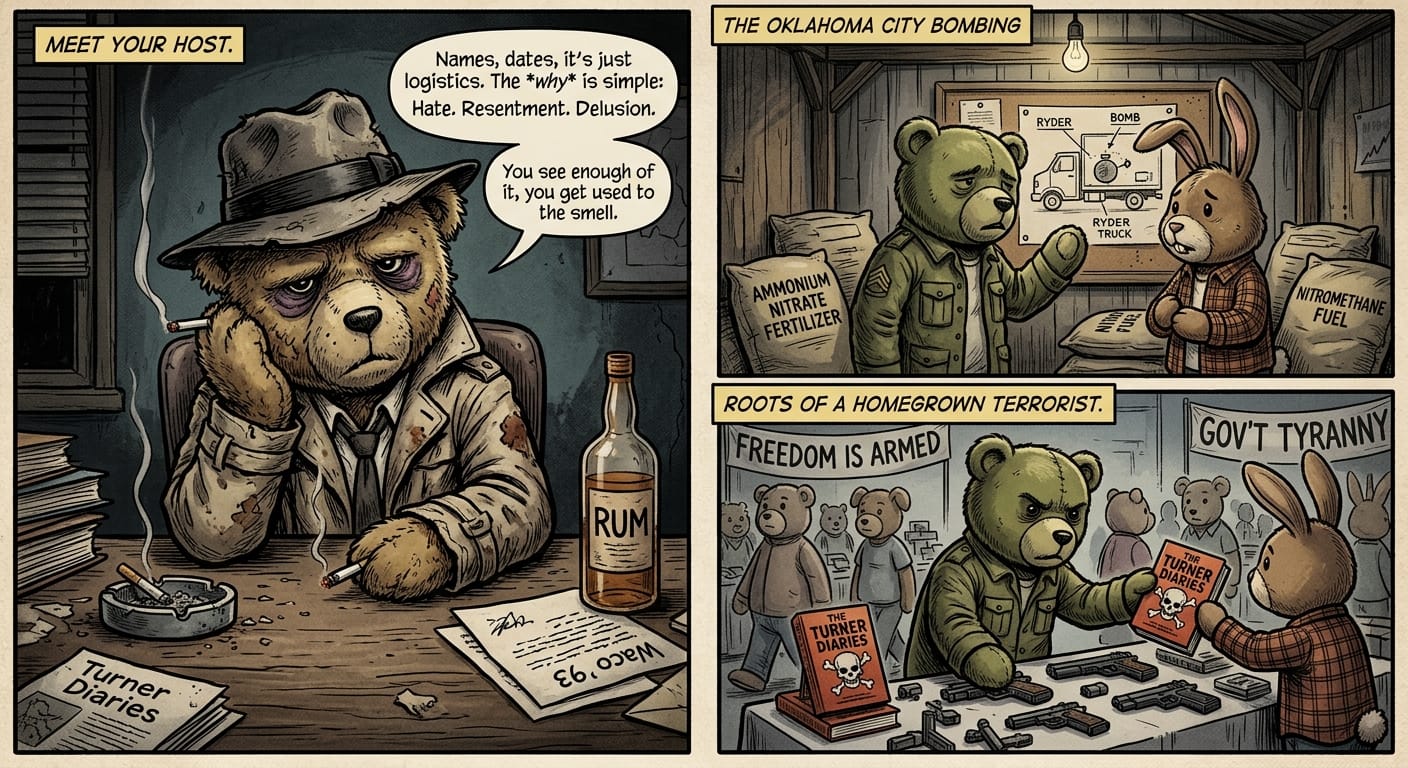
- The Oklahoma City Bombing: Homegrown Terror in the Heartland — 168 dead, including 19 children, and how one man’s radicalization through militia literature produced the deadliest act of domestic terrorism before 9/11.
- The Unabomber: Ted Kaczynski’s 17-Year Campaign — The case that closed because the bomber wanted to be read, and what 17 years of failure says about reactive law enforcement against isolated actors.
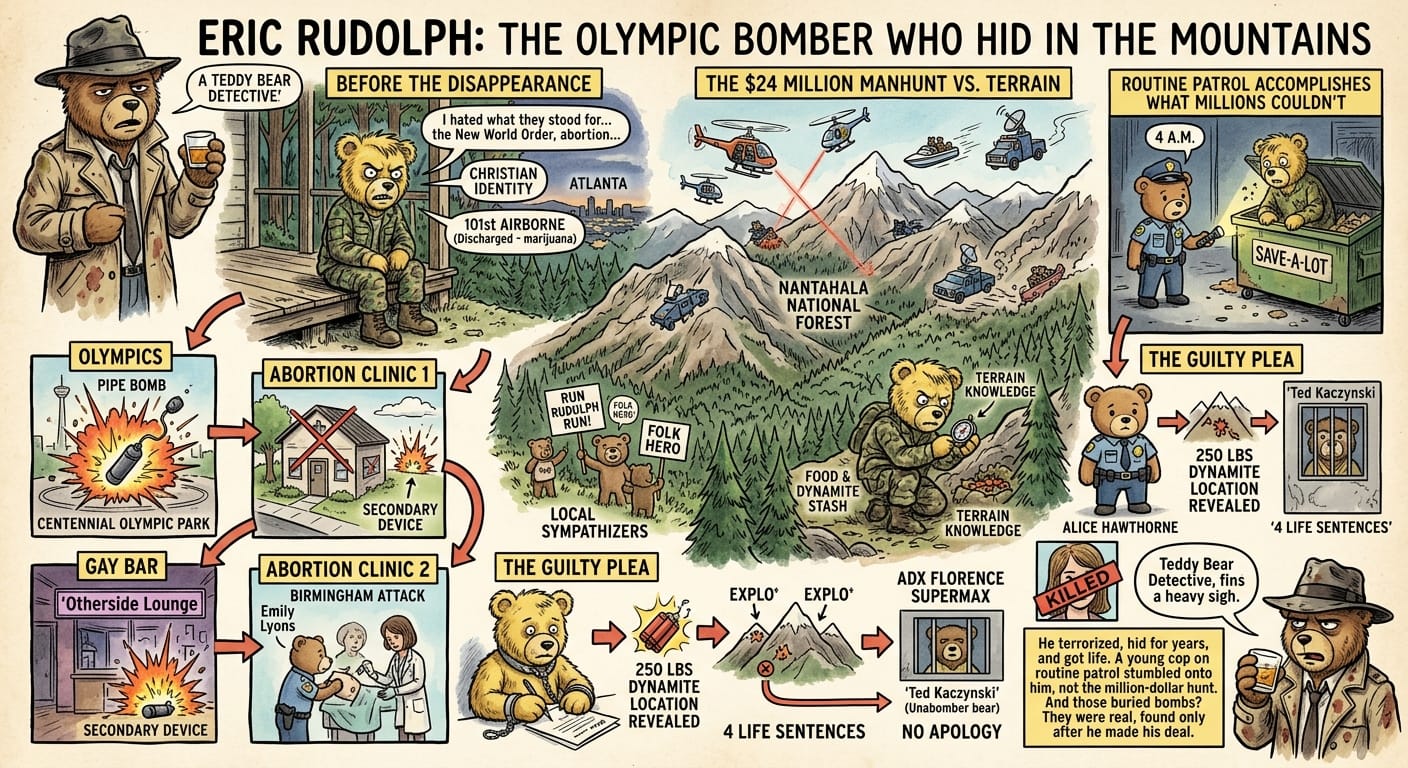
- Eric Rudolph: The Olympic Bomber Who Hid in the Mountains — Four bombings, a $24 million manhunt, five years in a national forest, and arrest by a 21-year-old officer on a routine patrol.
- The Weather Underground: When the Left Bombed America — Approximately 25 bombings, zero civilian fatalities from those bombings, and a decade in hiding that ended without resolution for most members.
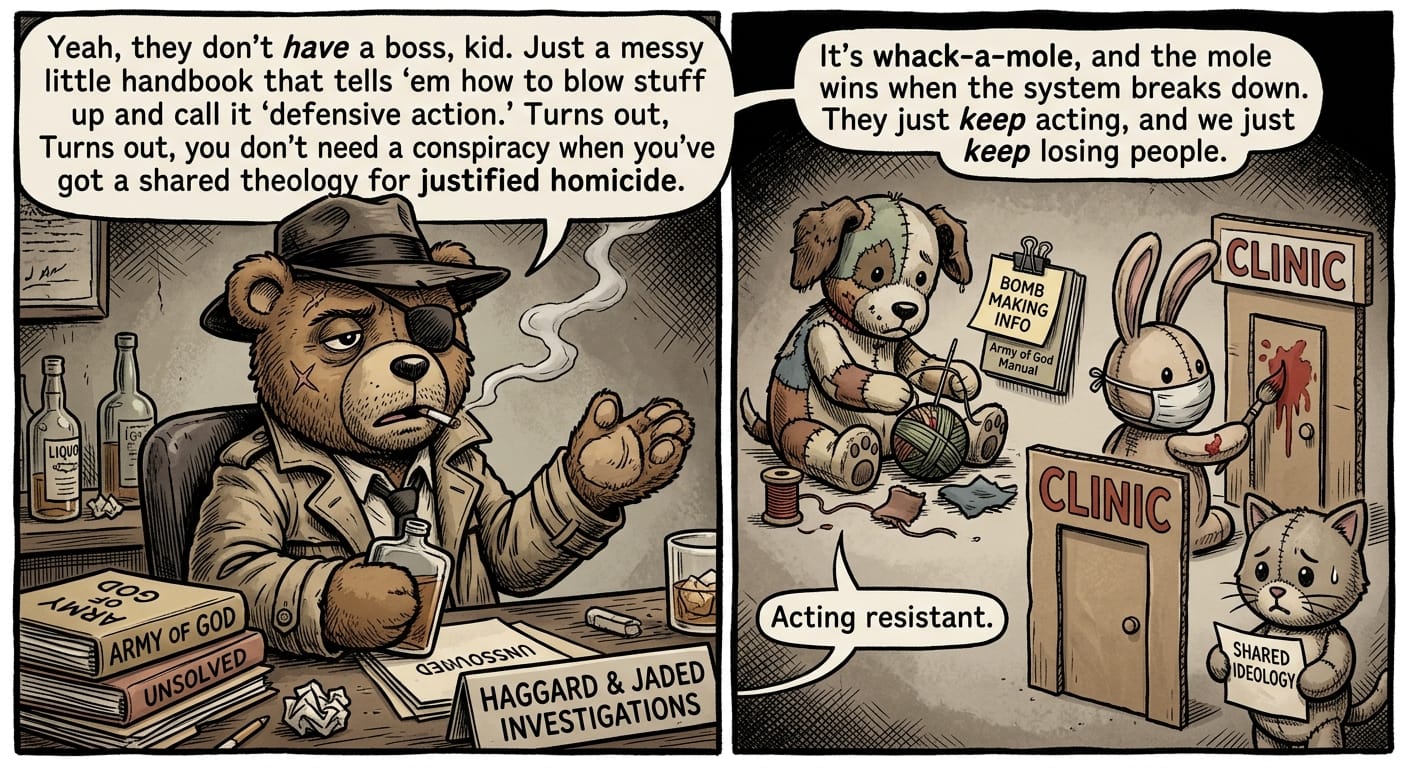
- The Army of God: Anti-Abortion Extremists Who Turned to Bombs — Four decades of anti-abortion violence, the theology of justified homicide, and a leaderless resistance model that has made the campaign nearly impossible to prosecute as a conspiracy.
Three Patterns That Appear Across Every Case
The six cases in this series span more than 150 years and three distinct ideological traditions. They share a smaller set of structural features.
Grievance plus ideology plus permission. Every actor here had a real or perceived grievance — government overreach, legal abortion, industrial society, racial integration, left-wing politics, the Vietnam War. What transformed grievance into violence was an ideological framework that identified a specific enemy and granted permission to act against that enemy. For Timothy McVeigh, that framework was the militia movement’s reading of The Turner Diaries. For Eric Rudolph and the Army of God, it was a theology that equated abortion with murder and murder with justified defense. For Ted Kaczynski, it was a coherent, self-constructed critique of industrial society. For the Weather Underground, it was Third World anti-colonialism applied to American conditions. Grievance alone does not produce terrorism. Grievance plus a framework that authorizes violence does.
Impunity as a precondition. The Ku Klux Klan operated through three distinct historical eras because it benefited from structural impunity in each of them: legal impunity during Reconstruction, political protection during the 1920s, and slow or absent prosecution during the civil rights era. The Army of God’s campaign of anti-abortion violence has extended for more than four decades because the underlying ideology is not illegal, the leaderless resistance model is nearly impossible to prosecute as a conspiracy, and the political environment has periodically protected rather than condemned the ideology. When impunity exists, movements continue.
The lone actor is rarely actually alone. Ted Kaczynski lived alone, built his bombs alone, and was caught only because his brother recognized his writing. Eric Rudolph survived five years as a fugitive in North Carolina. Both are classified as lone actors. But Kaczynski’s manifesto had intellectual predecessors and political cousins. Rudolph moved in a specific ideological milieu — Christian Identity communities in western North Carolina — before acting. McVeigh bought weapons at gun shows, read movement literature, and moved through militia networks. The “lone wolf” framing, while legally accurate, often obscures the ecosystem that produced and sustained the actor.
What These Cases Reveal About Periods of Rapid Social Change
American domestic terrorism since the Civil War has functioned as a recurring response to periods of rapid social change. The first Klan emerged from the collapse of the Confederacy and the expansion of Black political rights. The second Klan emerged from postwar immigration, urbanization, and Catholic political power. The anti-abortion movement’s violent wing emerged from the 1973 Roe v. Wade decision and intensified as abortion rights became politically consolidated. The militia movement, which produced McVeigh, emerged from the early 1990s — a period of gun control legislation, federal intervention at Ruby Ridge and Waco, and economic anxiety in rural America. The Weather Underground emerged from the Vietnam War and the documented state violence against the Black Panther Party, recorded in the FBI’s own COINTELPRO files.
The conditions that generate domestic terrorism are not mysterious. They are periods when significant numbers of people believe that legal and political processes have failed or been foreclosed to them, that their core values or communities are under existential threat, and that an ideology exists that identifies a responsible enemy and sanctions action against that enemy. Understanding that pattern does not justify the violence. It explains why it keeps recurring.
Violence does not achieve stated goals. Across all six cases, the violence failed to produce its stated political objective. The Klan’s terrorism during Reconstruction ended slavery’s immediate aftermath with a reversal of Black political gains — but that reversal came through the structural collapse of Reconstruction, not through the Klan’s killing campaign, and the gains eventually returned. McVeigh did not dismantle the federal government. Kaczynski did not reverse industrial civilization. The Weather Underground did not end the Vietnam War or achieve Black liberation. The Army of God has reduced the number of abortion providers and the geographic availability of abortion services — which represents a form of coercive effectiveness — but has not ended abortion. Rudolph did not end the Olympics or stop reproductive healthcare.
Domestic terrorism in the United States has no single profile, no single motivation, and no single political address. What it has is a set of conditions — grievance, permission, impunity — that when aligned, have produced violence in every decade of American history. These cases document that pattern without excusing it.
─────────
Sources:
- Hewitt, Christopher. Understanding Terrorism in America: From the Klan to Al Qaeda. Routledge, 2003.
- Gage, Beverly. The Day Wall Street Exploded: A Story of America in Its First Age of Terror. Oxford University Press, 2009.
- Berlet, Chip, and Matthew N. Lyons. Right-Wing Populism in America: Too Close for Comfort. Guilford Press, 2000.
The Series