The Army of God: Anti-Abortion Extremists Who Turned to Bombs
Anti-abortion extremists have killed 11 people and conducted hundreds of bombings since 1973 — organized not by a chain of command but by a theology that frames murder as defense.
The Army of God: Anti-Abortion Extremists Who Turned to Bombs
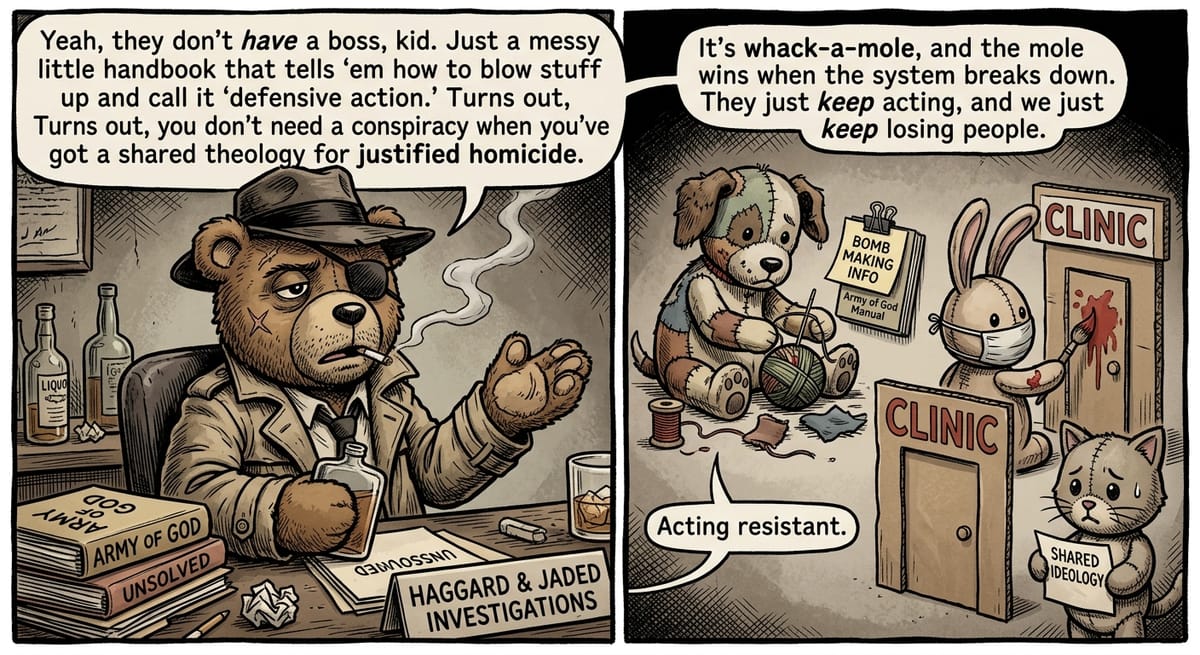
The Army of God is not an organization in the conventional sense — no membership rolls, no treasury, no chain of command. What it has is a manual that circulates among anti-abortion extremists with detailed instructions for destroying abortion clinics, attacking providers, and what it calls “defensive action.” It also has a theology that frames killing abortion doctors as justified homicide. Between 1993 and 2016, anti-abortion extremists killed 11 people in the United States, injured 26 more in shooting attacks, and conducted hundreds of bombings, arsons, acid attacks, and anthrax hoaxes against clinics, providers, and their families. This is the longest-running domestic terrorist campaign in American history.^1^
Why the Army of God Is More Dangerous Without a Chain of Command
The Army of God name appears in American anti-abortion violence as far back as 1982, when Don Benny Anderson kidnapped abortion doctor Hector Zevallos and his wife Rosalie Jean for eight days in Edwardsville, Illinois.^2^ Anderson demanded that President Reagan announce his opposition to abortion as a condition for their release. The couple was ultimately freed; Anderson was convicted and sentenced to 30 years.
The Army of God Manual — a physical document that began circulating in anti-abortion circles in the 1980s and has since been posted online — describes itself as a guide for “those who have a desire to become warriors for the unborn.” It provides instructions for butyric acid attacks on clinics, bomb-making, and clinic invasions, all framed within a theology that identifies abortion as a genocide equivalent to the Holocaust and frames violence against providers as defense of innocent life.
The document is not metaphorical. When federal agents searched the property of Eric Rudolph after his 1998 bombing of the New Woman All Women Health Care clinic in Birmingham — which killed security guard Robert Sanderson and critically injured nurse Emily Lyons — they found evidence of his connection to Army of God ideology. When Paul Jennings Hill shot and killed abortion provider Dr. John Britton and his escort James Barrett outside the Ladies Center in Pensacola, Florida, on July 29, 1994, Hill had previously organized a group called Defensive Action, which had signed a statement declaring lethal force against abortionists justified.^3^
How Leaderless Resistance Makes a Terrorist Campaign Nearly Impossible to Prosecute
The Army of God operates through what terrorism researchers call “leaderless resistance” — a model promoted explicitly by white nationalist Louis Beam in a 1983 essay of the same name, in which individuals and small cells take ideologically directed action without coordination from a central authority. The model makes the network nearly impossible to infiltrate and equally difficult to prosecute as a conspiracy.
Individual actors read the same texts, attend the same churches, consume the same media, and reach the same conclusions independently. When they act, they cannot implicate others through conspiracy testimony because there is no conspiracy in the legal sense — there is only a shared ideology that produces convergent violence. The same structural logic defines the KKK’s most durable eras: when violence is decentralized and ideologically motivated rather than organizationally directed, prosecution becomes a whack-a-mole problem.
The Army of God website, which has operated continuously since 1997, catalogs “prisoners of Christ” — those convicted of anti-abortion violence — alongside statements from convicted killers and bombers framing their actions as heroic. Paul Hill’s written statements are posted there. John C. Salvi III, who killed two clinic workers in Brookline, Massachusetts, in December 1994, is memorialized on the site. Michael Griffin, who killed Dr. David Gunn outside a Pensacola clinic on March 10, 1993 — the first murder of an abortion provider in the United States — is eulogized as a warrior. The site has been defended under the First Amendment, and successfully. Courts have drawn the line at direct incitement, and the Army of God website has remained online while the individuals it celebrates have remained in prison or been executed.
The Killings and Bombings: A Geography of Violence
The campaign of anti-abortion violence in the United States tracks closely along specific geographic and temporal patterns. Florida’s Pensacola region was a repeated site: Dr. David Gunn was murdered there on March 10, 1993; Dr. John Britton and James Barrett were murdered there on July 29, 1994; Dr. George Tiller was shot (and survived) in both arms in Wichita, Kansas, in 1993, and murdered in the foyer of his church — Reformation Lutheran Church in Wichita — on May 31, 2009, by Scott Roeder.^4^
George Tiller had been one of only a handful of doctors in the United States who performed late-term abortions. He had received death threats for decades. His clinic, Women’s Health Care Services in Wichita, had been bombed in 1985 and again in 1986. He had been shot in both arms in 1993. He wore a bulletproof vest to work. On May 31, 2009, he was serving as an usher at his church when Scott Roeder walked up and shot him once in the head.
Roeder had no formal Army of God affiliation. He had connections to the Freemen movement and to anti-abortion networks. He had the phone number of Operation Rescue’s senior policy advisor, Cheryl Sullenger — who had herself served two years in prison in 1988 for conspiracy to bomb an abortion clinic in San Diego — in his car when he was arrested.^5^ Roeder was convicted of first-degree murder and sentenced to life in prison with a minimum of 50 years.
The bombing campaign runs parallel to the assassination campaign. Eric Rudolph’s four attacks between 1996 and 1998 are the most famous, but the pattern goes back further: between 1977 and 2015, abortion providers in the United States experienced more than 300 bombings and arsons. The National Abortion Federation tracks clinic violence annually; even in years without murders, reported incidents of death threats, stalking, invasion, and vandalism number in the hundreds.
Why Does Anti-Abortion Violence Keep Working Even When Perpetrators Go to Prison?
Anti-abortion violence is the longest-running domestic terrorist campaign in American history in terms of continuous duration. It predates the modern militia movement. It has operated across every decade since Roe v. Wade was decided in January 1973, combining religious motivation with political grievance and tactical flexibility — individual actors with different capabilities choosing from a menu of tactics (bombing, shooting, anthrax letters, clinic invasions) without requiring organizational coordination.
The theology matters as a vector. The Army of God’s framework — that abortion is murder and that killing abortionists is therefore justified self-defense or defense of others — is a complete logical system that does not require contact with any external organization to reach. It is available in churches, in self-published pamphlets, and on websites. Individuals have repeatedly consumed that theology, concluded independently that action was required, and acted.
The 2015 shooting at a Planned Parenthood clinic in Colorado Springs — in which Robert Lewis Dear killed three people, including a police officer, on November 27, 2015 — followed the same pattern. Dear had been radicalized by videos released by anti-abortion group Center for Medical Progress. He told investigators after his arrest: “No more baby parts.” He has been found incompetent to stand trial and remains in a state mental institution.
The murder of George Tiller in 2009 effectively ended late-term abortion services in Wichita. His clinic did not reopen. That is the operational logic of the campaign: even when individual perpetrators are imprisoned, the cumulative effect of 40 years of violence is a reduction in the number of providers, the geographic concentration of services, and the reluctance of medical students to specialize in abortion care.
Individual perpetrators have been prosecuted and imprisoned. Paul Hill was executed by lethal injection in Florida on September 3, 2003, the first person executed in the United States for murdering an abortion provider. Scott Roeder is serving life in Kansas. Eric Rudolph is at ADX Florence. The network that produced them — the theology, the websites, the community of believers who regard these men as martyrs — has not been contained. The Army of God manual is still online. The memorial pages for convicted killers are still online. The ideology that justified the murders has, if anything, grown more mainstream in the years since Roe v. Wade was overturned in June 2022.
─────────
Part of Ideological Terror — ← Back to series hub
Sources:
- Blanchard, Dallas A., and Terry J. Prewitt. Religious Violence and Abortion: The Gideon Project. University Press of Florida, 1993.
- Risen, James, and Judy L. Thomas. Wrath of Angels: The American Abortion War. Basic Books, 1998.
- Femenia, Nora. “Anti-Abortion Terrorism and the Army of God.” Journal of Church and State, vol. 41, no. 3, 1999.
- Baird-Windle, Patricia, and Eleanor J. Bader. Targets of Hatred: Anti-Abortion Terrorism. Palgrave Macmillan, 2001.
- National Abortion Federation. Anti-Abortion Violence and Disruption Statistics, 1977–2023. NAF, 2024.