The Weather Underground: When the Left Bombed America
The Weather Underground bombed the Capitol, the Pentagon, and 23 other buildings between 1970 and 1977 — and killed no one through those bombings.
The Weather Underground: When the Left Bombed America
The Weather Underground conducted approximately 25 bombings between 1970 and 1977, killed no one through those bombings, and achieved none of its stated political goals. They are the primary evidence cited whenever American political violence is discussed for ideological “balance” — and that framing usually obscures more than it reveals. The organization emerged from legitimate grievances about an ongoing war and documented state violence against Black Americans, responded with bombs, and ended with most members facing no prison time, which itself tells you something about the federal government’s own conduct during that period.^1^
On March 6, 1970, three people died in a townhouse at 18 West 11th Street in Greenwich Village, New York City — not because someone bombed them, but because they were building a bomb. Diana Oughton, Ted Gold, and Terry Robbins, all members of the Weather Underground Organization, were assembling anti-personnel devices in the townhouse basement when they detonated accidentally. The bombs had been intended for Fort Dix, a U.S. Army base in New Jersey. The plan, investigators concluded, had been to detonate them at a soldiers’ dance.^1^
The accidental explosion shook even committed members of the organization. It also marked the moment the Weather Underground pivoted away from bombing people to bombing property. For the next decade, they targeted buildings: the U.S. Capitol, the Pentagon, New York City Police headquarters, the California Department of Corrections. No one was killed in any of those bombings. That restraint was a deliberate policy change — and it is the policy that defines the organization’s historical legacy.
What the Weather Underground Was and Where It Came From
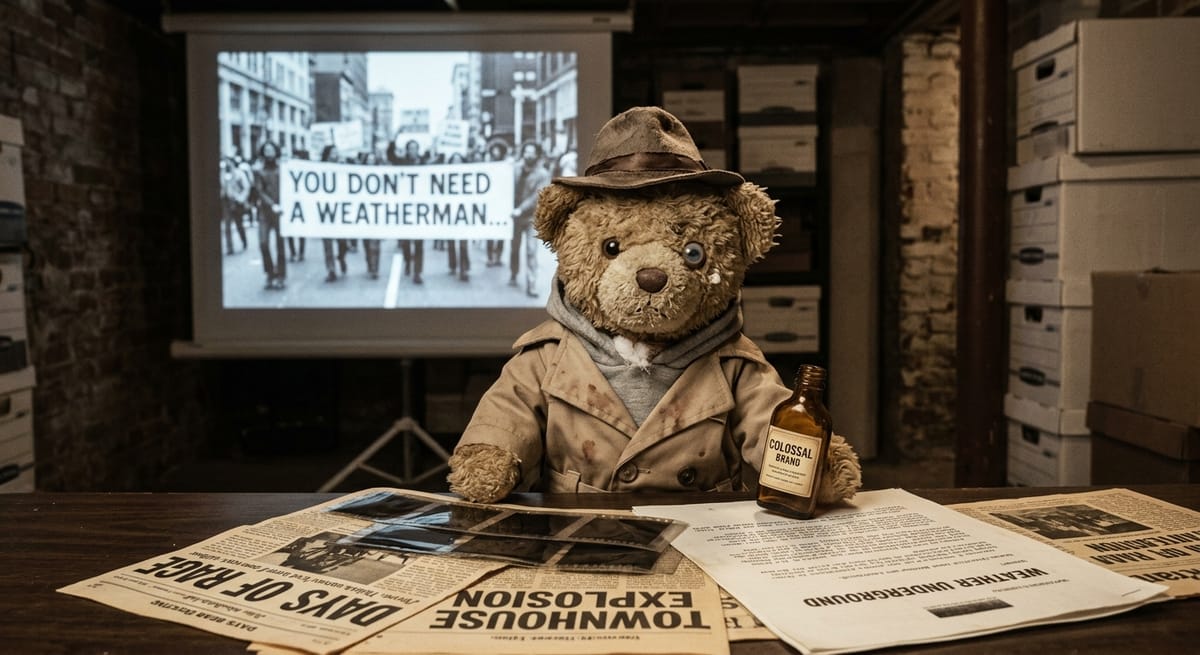
The Weather Underground grew out of Students for a Democratic Society, the dominant organization of the American New Left during the 1960s. SDS had split by 1969 into competing factions; the one that became the Weathermen took its name from a Bob Dylan lyric — “You don’t need a weatherman to know which way the wind blows” — and its politics from a maximalist reading of revolutionary anti-imperialism. Mark Rudd, Bernardine Dohrn, William Ayers, and Jeff Jones were among its founding figures, all of them middle-class white college students who had concluded that protest and organizing were insufficient responses to the Vietnam War, racism, and what they called American imperialism.
The foundational political document — “You Don’t Need a Weatherman to Know Which Way the Wind Blows,” published in June 1969 — argued that white Americans had a specific obligation to support Black liberation and Third World anti-colonial movements, up to and including armed struggle. The Days of Rage in Chicago in October 1969, the organization’s first major action, brought several hundred Weathermen into the streets to smash windows and fight police. The action was supposed to draw thousands. It didn’t.^2^
After the Greenwich Village explosion and the deaths of Oughton, Gold, and Robbins, the organization went underground. Members adopted false identities, disappeared from their previous lives, and continued operating as a clandestine cell network. Bernardine Dohrn and Bill Ayers — who would later marry — lived underground for more than a decade.
How They Structured Bombing Campaigns for Maximum Political Impact
The Weather Underground’s operational model was communiqués and bombs, sequenced for maximum public impact. Before a bombing, they would typically issue a statement explaining the political reasoning. They gave warnings to allow evacuation. They targeted symbols rather than people.
The February 28, 1970, bombing of the U.S. Capitol was preceded by a communiqué protesting the U.S. invasion of Laos. On May 19, 1972, a bomb exploded in the women’s restroom at the Pentagon, timed to coincide with Richard Nixon’s announcement of increased bombing of Hanoi. In January 1975, a bomb exploded at the U.S. State Department. The New York City Police Department headquarters was bombed in June 1970, and NYPD again in 1973.^3^
The group financed itself through robberies, though it maintained a distinction — one that grew increasingly difficult to sustain — between its own bombings and the more violent actions of allied groups. The Symbionese Liberation Army’s kidnapping of Patricia Hearst in February 1974 and the SLA’s shootouts with police represented a kind of escalation the Weather Underground formally disavowed but whose political logic was continuous with their own.
The internal organization was loose and increasingly fractured. By the mid-1970s, arguments over gender politics, race, and ideology had splintered the leadership. A 1974 internal document, Prairie Fire: The Politics of Revolutionary Anti-Imperialism, attempted to restate the group’s ideology but revealed deep disagreements. The organization published an aboveground journal and attempted to maintain contact with the broader left, but by 1977 it had effectively dissolved, with members choosing to surface and face prosecution or simply disperse.
25 Bombings: What They Targeted and Why
Between 1970 and 1977, the Weather Underground claimed responsibility for approximately 25 bombings, each targeting symbolic government or corporate infrastructure.
On March 1, 1971, a bomb exploded in a Senate bathroom in the U.S. Capitol building, causing significant structural damage. On June 19, 1972, a bomb went off at the California Department of Corrections headquarters in Sacramento, in protest of conditions in California prisons. On September 28, 1973, Gulf Oil’s corporate offices in Pittsburgh were bombed following the Chile coup and the assassination of President Salvador Allende — the communiqué specifically named Gulf’s support for the Pinochet government.
Not all the related violence was bloodless. On August 7, 1970, Black Panther Party member Jonathan Jackson took four hostages at the Marin County Courthouse in California in an attempt to free prisoners; four people were killed, including Jackson himself, two prisoners, and a judge. Weapons used in that action were traced to Angela Davis, who was tried for conspiracy and acquitted in 1972. The shooting was not a Weather Underground operation, but it illustrated the broader ecosystem of radical violence in which the organization operated.
The most lethal incident connected to Weather Underground-adjacent networks occurred on October 20, 1981, in Nyack, New York, after the organization had formally dissolved. Former members joined with members of the Black Liberation Army to rob a Brink’s armored truck, killing two Westchester County police officers, Waverly Brown and Edward O’Grady, and Brink’s guard Peter Paige.^4^ Kathy Boudin, a Weather Underground member, was convicted of felony murder and served 22 years.
Did Left-Wing Bombing Campaigns Actually Achieve Anything?
The Weather Underground is regularly invoked in American political arguments — usually to establish symmetry between left and right political violence. That invocation requires precision. The organization did conduct approximately 25 bombings. It killed three of its own members in the Greenwich Village accident. It did not kill anyone else through its bombings, and that restraint was intentional and documented. The Brink’s robbery, which did produce fatalities, occurred two years after the organization had dissolved and was conducted by former members, not by the organization itself.
What makes the Weather Underground historically significant is not the death toll — which is lower than many American mass shootings — but what it reveals about the relationship between political crisis and political violence. The organization emerged from legitimate grievances about a war that killed 58,000 Americans and more than 2 million Vietnamese, about documented state violence against the Black Panther Party through COINTELPRO, about a government that FBI Director J. Edgar Hoover was running surveillance operations against civil rights leaders and antiwar activists. The response to those grievances — bombs — did not advance any of the stated political goals. It provided the Nixon administration with justification for exactly the kind of surveillance and suppression it was already conducting.^5^
Most Weather Underground members who surfaced in the late 1970s faced prosecution, but many charges were dismissed after it emerged that the FBI’s COINTELPRO operations had involved illegal break-ins, warrantless surveillance, and evidence obtained through unconstitutional means. William Ayers and Bernardine Dohrn had charges dropped; Ayers famously told the New York Times in a September 11, 2001 profile — published the morning of the attacks — that he had no regrets. Mark Rudd, Jeff Jones, and others served no prison time.
The organization lasted roughly a decade, bombed 25 buildings, killed no one through those bombings, and achieved none of its stated political goals. The Vietnam War ended in 1975 — due to Vietnamese military action, congressional action cutting off appropriations, and mass domestic protest, not due to Weather Underground bombs. The members who avoided prison built careers: Ayers became an education professor at the University of Illinois at Chicago; Dohrn became a clinical associate professor at Northwestern University School of Law.
They were contained. The conditions they were responding to were not.
─────────
Part of Ideological Terror — ← Back to series hub
Sources:
- Varon, Jeremy. Bringing the War Home: The Weather Underground, the Red Army Faction, and Revolutionary Violence in the Sixties and Seventies. University of California Press, 2004.
- Rudd, Mark. Underground: My Life with SDS and the Weathermen. William Morrow, 2009.
- Ayers, Bill. Fugitive Days: A Memoir. Beacon Press, 2001.
- Castellucci, John. The Big Dance: The Untold Story of Weatherman Kathy Boudin and the Terrorist Family That Committed the Brink’s Robbery Murders. Dodd, Mead, 1986.
- Berger, Dan. Outlaws of America: The Weather Underground and the Politics of Solidarity. AK Press, 2006.